Direct and Inverse Proportion (Edexcel GCSE Maths): Revision Notes
📚Revision Notes
Direct and inverse proportion
Understanding proportional relationships is a fundamental skill in algebra. When we talk about proportion, we're examining how two variables are connected and how they change in relation to each other.
What is proportion?
Proportion describes a special relationship between two variables where one variable changes in a predictable way when the other changes. The symbol means "is proportional to" and helps us express these relationships mathematically.
In proportion problems, you'll typically work with two variables (often called and ) that are linked together. Your job is to figure out their relationship and use it to find missing values when given information about one variable.
Note
The proportionality symbol is a powerful tool that allows us to express relationships before we know the exact mathematical equation. Think of it as a way to say "these variables are connected" before we figure out exactly how.
Simple proportions
The two most common types of proportional relationships you'll encounter are direct proportion and inverse proportion. Understanding these forms the foundation for tackling more complex problems.
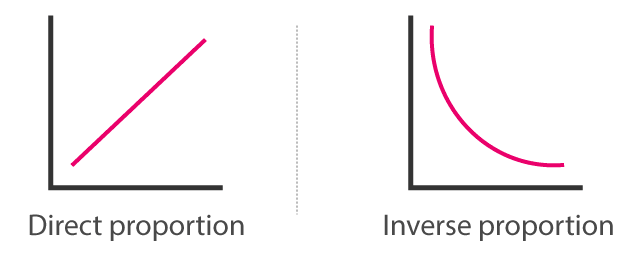
Direct proportion
Direct proportion occurs when two variables increase or decrease together at the same rate. This means that as one variable gets larger, the other also gets larger in a predictable way.
The key characteristics of direct proportion are:
- Both variables move in the same direction
- When one doubles, the other doubles too
- The relationship can be written as
- This converts to the equation (where is a constant)
- The graph is always a straight line passing through the origin
Important
Remember that for a relationship to be directly proportional, the line must pass through the origin (0,0). If it doesn't go through the origin, it's not a direct proportion.
Inverse proportion
Inverse proportion describes a relationship where one variable increases as the other decreases. This creates a balancing effect between the two variables.
The key features of inverse proportion are:
- Variables move in opposite directions
- When one variable doubles, the other halves
- The relationship is written as
- This becomes the equation (where is a constant)
- The graph forms a curved shape called a hyperbola
More complex proportional relationships
Beyond simple direct and inverse relationships, you'll encounter trickier proportions involving squares, cubes, square roots, and other mathematical functions.
Note
These more complex relationships follow the same basic principles. The key insight is that you can always convert a proportionality statement into an equation by replacing the symbol with , where represents an unknown constant.
These more complex relationships follow the same basic principles. For example:
- If is proportional to , then and
- If is proportional to the square root of , then and
- If varies with the cube of , then and
- If is inversely proportional to cubed, then and
Solving proportion problems step by step
When tackling proportion questions, follow this systematic five-step approach:
Important
The 5-Step Method for Proportion Problems:
- Convert the sentence into a proportionality statement using the symbol
- Replace the with to create an equation
- Find the value of the constant using the given information about both variables
- Substitute the value of back into the equation
- Use the complete equation to find the unknown value
Let's work through this method with a practical example:
Worked example
Example
Worked Example: Inverse Proportion Problem
Problem: is inversely proportional to the square root of . When , . Find an equation for in terms of , and use it to work out the value of when .
Solution:
Step 1: Convert to proportionality
Step 2: Replace with
Step 3: Find using the given values (, )
Step 4: Put back into the equation
Step 5: Use the equation to find when
Therefore, when , .
Summary
Key Points to Remember:
- Direct proportion means both variables increase together, forming a straight line through the origin with equation
- Inverse proportion means one variable increases while the other decreases, creating a curved hyperbola with equation
- Always convert proportionality statements () into equations by replacing the symbol with
- Use the five-step method: convert, replace, find , substitute, and solve
- More complex proportions can involve squares, cubes, roots, but follow the same basic principles