Factorising Quadratics (Edexcel GCSE Maths): Revision Notes
📚Revision Notes
Factorising quadratics
What is factorising?
Factorising a quadratic expression means expressing it as a product of two linear expressions in brackets. This is a fundamental skill in algebra that allows you to solve quadratic equations efficiently.
Note
The standard format for any quadratic equation is , where , , and are numbers and . Most exam questions are designed with to make them more manageable, but you need to know both methods.
Method when a = 1
When the coefficient of x² equals 1, the factorising process is much more straightforward. This is the most common type you'll encounter in exams.
Step-by-step approach:
The process involves six clear steps that you should follow systematically:
- Rearrange into standard format: Make sure your equation is in the form
- Set up your initial brackets: Write with spaces to fill in
- Find the right number pair: Look for two numbers that multiply to give c (the constant term) and add or subtract to give b (the coefficient of x)
- Determine the correct signs: Work out whether you need + or - signs in your brackets
- Check your work: Expand the brackets to verify they give you the original equation
- Solve the equation: Set each bracket equal to zero to find your solutions
Important
Key insight: When , you're looking for two numbers that multiply to give and add/subtract to give . This is the heart of the factorising process.
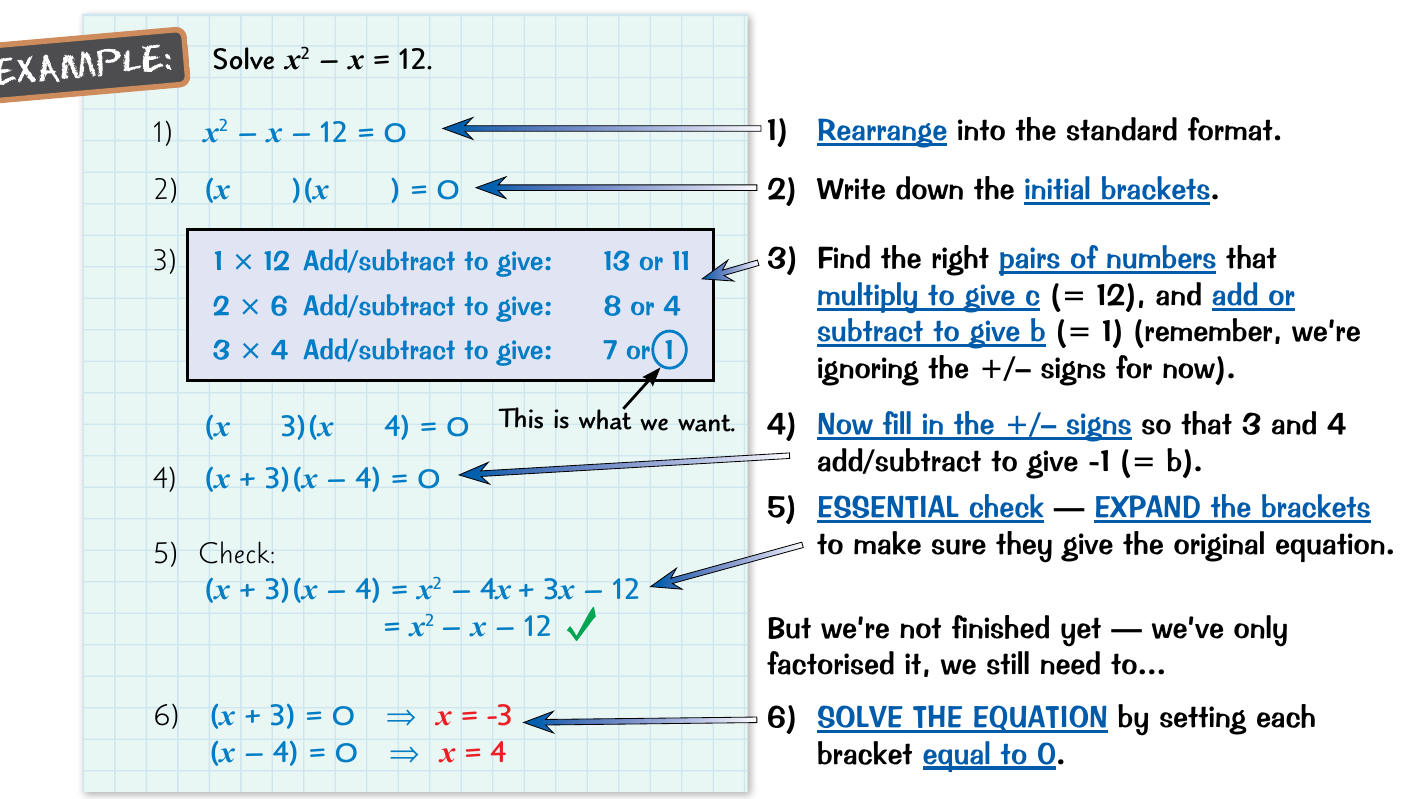
This detailed example shows how to solve using the complete factorising method. Notice how the equation is first rearranged to standard form (), then factorised systematically by finding numbers that multiply to give and add/subtract to give .
Method when a ≠ 1
When the coefficient of x² is not 1, the process becomes more challenging because the initial brackets are different. However, the basic principles remain the same - you're still looking for the right combination of numbers and signs.
Key differences:
The main difference is that instead of starting with , you need to consider brackets like or , depending on what could multiply to give your term.
The systematic approach:
- Rearrange into standard format: Get your equation into the form
- Set up initial brackets: Write brackets where one contains a multiple of x that could multiply to give
- Find number pairs systematically: This is the trickiest part - you need to find pairs of numbers that multiply to give , then test different combinations in both bracket positions
- Check the middle term: For each combination, multiply out to see if you get the correct coefficient for x
- Fill in the correct signs: Once you've found the right numbers, determine the signs needed
- Check by expanding: Multiply out your brackets to confirm they give the original equation
- Solve the equation: Set each bracket equal to zero
Important
Warning: When , don't guess randomly. Work through the factor pairs systematically, testing each combination until you find the one that produces the correct middle term.
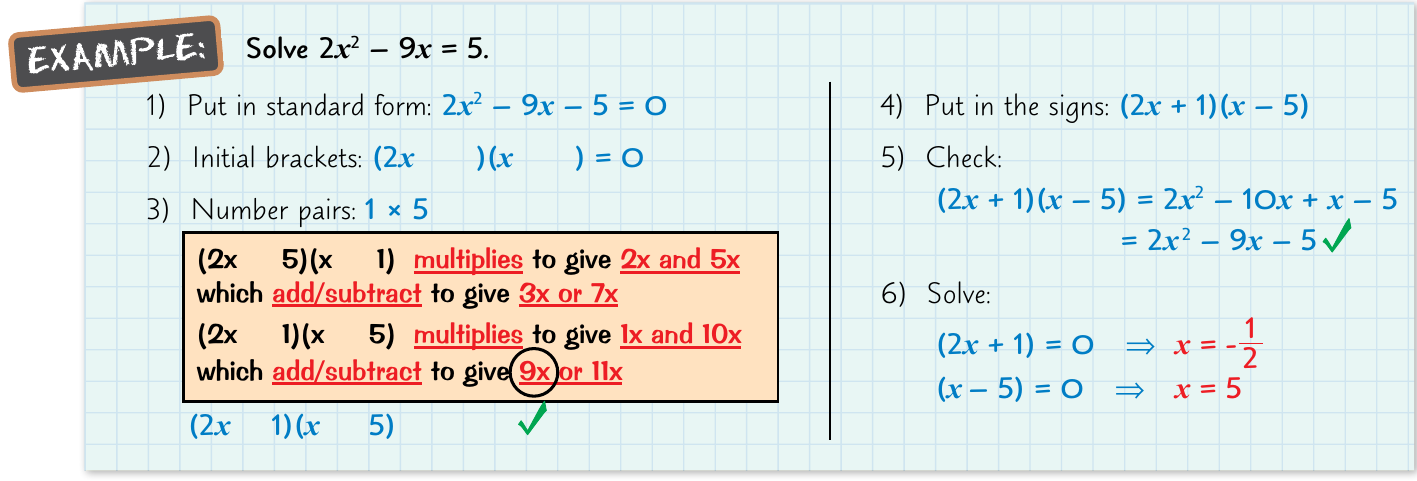
This example demonstrates the systematic approach needed when . The equation is rearranged to , then different number combinations are tested until the correct factorisation is found.
Checking your factorisation
Always expand your brackets as an essential check. This step is crucial because it catches any errors in your factorisation before you attempt to solve the equation.
Note
Always check your work: Expanding the brackets back out is not optional - it's an essential part of the process that will save you from making costly mistakes in exams.
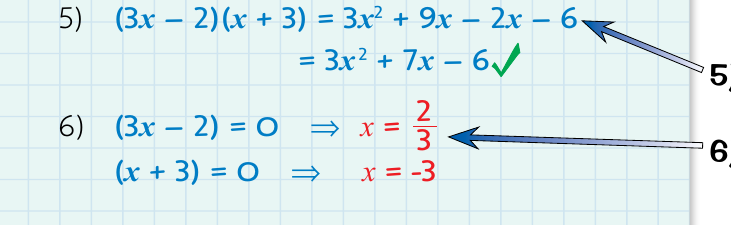
Here you can see how expanding confirms the factorisation is correct by giving . Then each bracket is set to zero to find the solutions and .
Essential tips for success
Note
Understanding sign patterns: If the constant term () is positive, both signs in your brackets will be the same (both positive or both negative). If is negative, the signs will be different - one positive and one negative.
Note
Working methodically: When , don't guess randomly. Work through the factor pairs systematically, testing each combination until you find the one that produces the correct middle term.
Note
Expecting fractional solutions: When , you're more likely to get fractional solutions, so don't be surprised if your answers aren't whole numbers.
Note
Practice builds confidence: The more quadratics you factorise, the quicker you'll become at spotting the right number combinations and recognising patterns.
Remember!
Summary
Key Points to Remember:
- Always rearrange your equation into standard form () before starting
- When , find two numbers that multiply to give c and add/subtract to give b
- When , the process is more complex but follows the same basic principles
- Always check your factorisation by expanding the brackets back out
- To solve the equation, set each bracket equal to zero and solve for x