Manipulating Surds (Edexcel GCSE Maths): Revision Notes
📚Revision Notes
Manipulating surds
What are surds?
Surds are mathematical expressions that contain irrational square roots - these are square roots that cannot be written as simple fractions or whole numbers. The key thing to remember is that surds represent exact values, whereas decimal approximations are just estimates.
Note
Common examples of surds include most square roots (like , , ), cube roots, and π. These appear frequently in mathematical calculations and cannot be expressed as simple fractions.
The six essential rules for working with surds
Understanding how to manipulate surds is crucial for algebra. There are six fundamental rules that you need to master, each serving a specific purpose in mathematical calculations.
Important
Mastering these six rules is essential for success in algebra and higher mathematics. Each rule has a specific application and cannot be used interchangeably.
Rule 1: Multiplying surds
When you multiply surds together, you can combine them under a single square root sign. The rule states that . This works because the square root operation can be distributed across multiplication.
An important related fact is that , which is fairly straightforward once you think about it.
Example
Worked Example: Multiplying Surds
Step 1: Apply the multiplication rule
Step 2: Simplify
Another example:
Rule 2: Dividing surds
Similar to multiplication, division of surds can be simplified by combining them. The rule is . This allows you to work with surds more efficiently in fractional form.
Example
Worked Example: Dividing Surds
Step 1: Apply the division rule
Step 2: Simplify inside the square root
Step 3: Calculate the final answer
Rule 3: Adding and subtracting surds
Here's where many students get confused - you simply cannot combine surds through addition or subtraction. The rule is clear: cannot be simplified further. It definitely does not equal . You must leave these expressions as they are.
Important
Common Mistake to Avoid:
For example: , but
These are completely different values! Always keep addition and subtraction of surds separate.
Rule 4: Expanding brackets with surds
When you have brackets containing surds, you expand them using the same principles as regular algebra. For , you multiply it out as . Notice that you get a mixture of rational and irrational terms.
Example
Worked Example: Expanding
Step 1: Write as two brackets
Step 2: Expand using FOIL
Step 3: Simplify each term
Step 4: Combine like terms
Rule 5: Difference of two squares with surds
This is a particularly useful pattern: . The middle terms cancel out completely, leaving you with a rational answer. This technique is especially helpful when rationalising denominators.
Example
Worked Example: Difference of Two Squares
Step 1: Apply the pattern
Step 2: Use the formula
Step 3: Calculate the result
Notice how the terms cancelled out completely!
Rule 6: Rationalising the denominator
This technique involves removing square roots from the bottom of fractions. To rationalise , you multiply both the numerator and denominator by , giving you . This process is called "rationalising the denominator" and is essential for presenting answers in their simplest form.
Example
Worked Example: Rationalising
Step 1: Multiply numerator and denominator by
Step 2: Simplify
Step 3: Reduce the fraction
Leaving surds and π in exact answers
When problems ask for exact answers, this usually means you should leave your response in terms of surds or π rather than converting to decimal approximations. π is an irrational number that appears frequently in circle calculations, and while calculators can give decimal approximations, exact answers preserve the true mathematical value.
Note
When to Use Exact Answers:
- Circle calculations involving π
- Geometric problems with square roots
- Algebraic solutions requiring surds
- Any problem specifically asking for "exact" answers
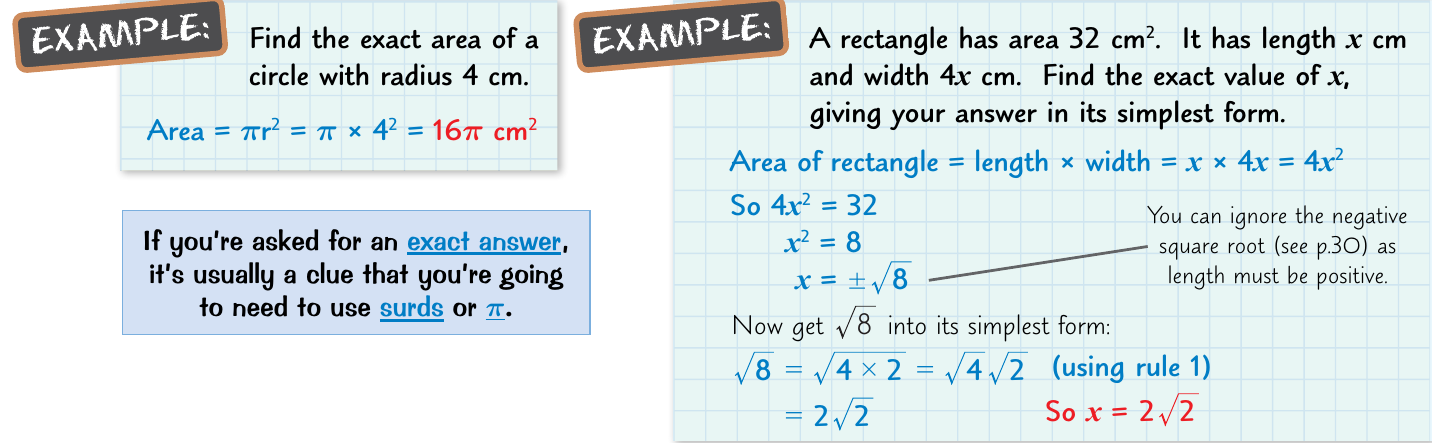
The examples shown demonstrate how exact answers work in practice. For a circle with radius 4 cm, the exact area is cm² rather than a decimal approximation. Similarly, when solving for the exact value of x in geometric problems, the answer might involve surds like .
Working with exact answers step by step
When you encounter problems requiring exact answers, follow these guidelines:
For geometric problems: Use the appropriate formulas but keep π and surds in your final answer rather than calculating decimal values.
For algebraic problems: Simplify surds using the six rules, but don't convert to decimals. When you have , the exact answer is , not
For areas and measurements: Remember that in real-world contexts, you can ignore negative square roots since lengths and areas must be positive.
Note
Key Insight: Exact answers preserve mathematical precision that would be lost through decimal approximation. This is particularly important in advanced mathematics where small errors can compound.
Common mistakes to avoid
Important
Critical Mistakes to Avoid:
- Never add surds incorrectly:
- Always rationalise denominators: Don't leave square roots in the denominator
- Don't convert to decimals: When asked for exact answers, keep surds and π
- Check your arithmetic: Mistakes in surd manipulation can lead to completely wrong answers
Students often struggle with surds because they try to add them incorrectly or forget to rationalise denominators. Remember that cannot be simplified, but . Also, always check whether your final answer needs the denominator rationalised - this is often required in exam questions.
Summary
Key Points to Remember:
- Surds are expressions with irrational square roots that give exact values
- You can multiply and divide surds by combining them under one square root
- You cannot simplify surds when adding or subtracting them
- Always rationalise denominators by multiplying by the appropriate surd
- When asked for exact answers, leave surds and π in your final response rather than using decimal approximations