The Quadratic Formula (Edexcel GCSE Maths): Revision Notes
📚Revision Notes
The quadratic formula
The quadratic formula is a powerful mathematical tool that allows you to find solutions to any quadratic equation. When you have a quadratic equation in the standard form , this formula will always give you the answer, even when the equation cannot be factorised easily.
Understanding the formula
The quadratic formula is written as:
This formula works for any quadratic equation where:
- is the coefficient of
- is the coefficient of
- is the constant term
The expression under the square root is called the discriminant, and it determines how many real solutions the equation has.
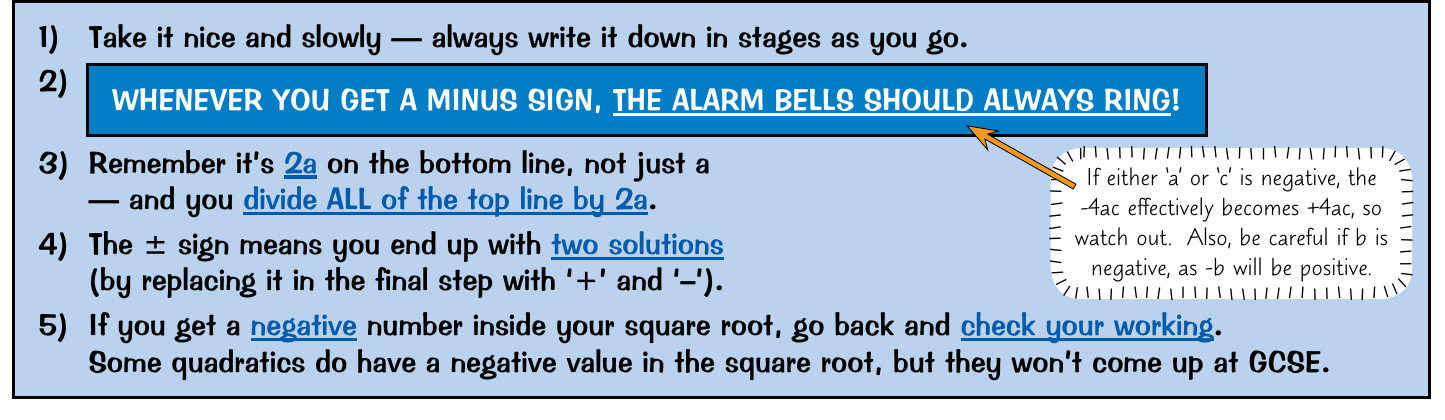
Five crucial details for success
When using the quadratic formula, there are several important points that can help you avoid common mistakes and ensure accurate results.
Note
Take your time and work systematically
Write down each stage as you progress through the calculation. This helps prevent errors and makes it easier to check your work later.
Important
BEWARE OF NEGATIVE SIGNS!
Whenever you encounter a minus sign in your equation, you need to be extra careful. Negative coefficients can easily lead to sign errors, so double-check your work whenever you see them.
Important
The denominator is 2a, not just a
This is a common mistake that students make. You must divide the entire numerator by , which means both parts of the expression ( and the square root term) are divided by .
Note
The ± symbol gives two solutions
The plus-minus sign in the formula is crucial because it means you'll get two solutions. You need to calculate both the positive and negative versions to find both answers. Replace the with for one solution and with for the other solution.
Important
Check negative discriminants
If you get a negative number under the square root, you should go back and check your working. While some quadratic equations do have negative discriminants (meaning no real solutions), this is less common at GCSE level, so it's worth verifying your calculations.
Worked example
Let's work through a complete example to see how the quadratic formula is applied in practice.
Example
Worked Example: Solving
Step 1: Rearrange into standard form
Step 2: Identify the coefficients , , (Notice that is negative because we subtracted 1 from both sides)
Step 3: Substitute into the quadratic formula
Step 4: Calculate the discriminant
Step 5: Complete the calculation
Since :
Step 6: Find both solutions
Answer: To 2 decimal places, or
When to use the quadratic formula
The quadratic formula is particularly useful in several situations. You should consider using it when you have a quadratic equation that won't factorise easily. Sometimes it's difficult to spot the factors, especially with more complex coefficients.
The formula is also essential when the question asks for answers to a specific number of decimal places or significant figures. Factoring typically gives exact answers, but the quadratic formula allows you to work with decimal approximations.
Additionally, if a question asks for answers in surd form (involving square roots), the quadratic formula naturally produces these types of answers. While you might be able to complete the square instead, the quadratic formula is often more straightforward.
Summary
Key Points to Remember:
- The quadratic formula works for any quadratic equation in standard form
- Always be extra careful with negative signs - they're a common source of errors
- Remember that the denominator is , not just , and you divide the entire numerator by this value
- The symbol gives you two solutions, so make sure to calculate both
- Use the quadratic formula when equations don't factorise easily or when you need decimal or surd answers