Finding the Gradient (Edexcel GCSE Maths): Revision Notes
📚Revision Notes
Finding the gradient
What is gradient?
The gradient of a line tells us how steep it is. Think of it as measuring how much a line rises or falls as you move along it. The larger the gradient value, the steeper the line becomes. Understanding gradient is essential for working with straight line graphs and equations.
Note
Gradient is a fundamental concept in mathematics that appears in many different contexts, from simple straight-line graphs to advanced calculus. Mastering this concept now will help you in future mathematical studies.
The step-by-step method
There's a reliable four-step process you can follow to find the gradient of any straight line:
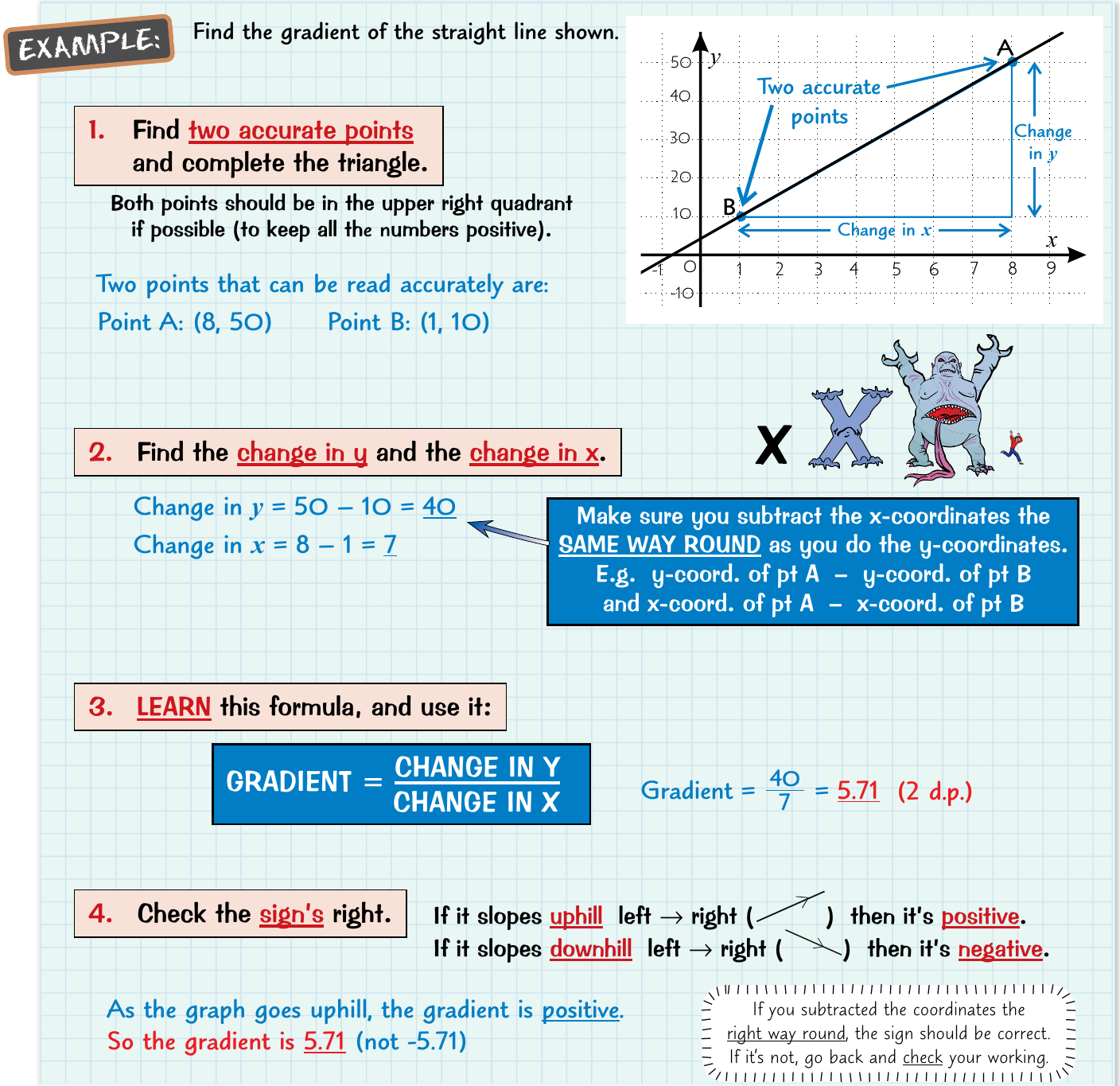
Step 1: Choose two accurate points
Pick two points on the line where you can read the coordinates clearly and precisely. It's best to choose points that fall exactly on grid intersections to avoid reading errors. If possible, select points in the upper right area of the graph to keep your calculations with positive numbers.
Note
Pro tip: When choosing points, look for coordinates that are whole numbers if possible. This makes your calculations much easier and reduces the chance of arithmetic errors.
Step 2: Calculate the changes in coordinates
Work out the change in y-coordinates and the change in x-coordinates between your two points. Remember to subtract the coordinates in the same order - if you're working from point A to point B, then:
- Change in y = y-coordinate of B - y-coordinate of A
- Change in x = x-coordinate of B - x-coordinate of A
Important
Critical Rule: Always subtract the coordinates in the same order for both x and y. Mixing up the order is one of the most common mistakes students make and will give you the wrong sign for your gradient.
Step 3: Apply the gradient formula
Use this essential formula to calculate the gradient:
Simply divide the change in y by the change in x to get your gradient value.
Step 4: Check the sign is correct
This step catches many students out in exams, so it's crucial to get it right. Look at the direction of your line:
- If the line slopes upward from left to right, the gradient is positive
- If the line slopes downward from left to right, the gradient is negative
Important
Exam Warning: Step 4 is often overlooked but is crucial for exam success. Many students calculate the gradient correctly but get the final answer wrong because they don't check the sign. Always verify that your calculated gradient matches the visual slope of the line.
Understanding positive and negative gradients
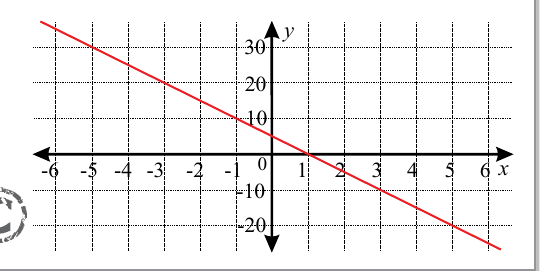
The direction a line travels across the graph determines whether its gradient is positive or negative. When you trace a line from left to right, if it goes upward, you have a positive gradient. If it goes downward, you have a negative gradient.
Note
Memory aid: Think of positive gradients as "going up" and negative gradients as "going down" as you move from left to right across the graph. This visual check is your best friend for avoiding sign errors.
Worked example
Example
Worked Example: Finding the Gradient
Let's see how this works with specific numbers. If you have two points at (8, 50) and (1, 10):
Step 1: Choose two points Points chosen: (8, 50) and (1, 10)
Step 2: Calculate changes
- Change in y = 50 - 10 = 40
- Change in x = 8 - 1 = 7
Step 3: Apply the formula
Step 4: Check the sign Since the line slopes upward from left to right, this gradient is positive: +5.71
Common mistakes to avoid
Many students make calculation errors when finding the change in coordinates. Make sure you subtract the x-coordinates the same way round as you subtract the y-coordinates. If you mix up the order, you'll get the wrong sign for your gradient.
Important
Double-check method: Always verify your final answer by looking at the graph. Does your calculated gradient match what you can see? A steep upward line should give you a large positive number, while a steep downward line should give you a large negative number.
Summary
Key Points to Remember:
- Gradient measures the steepness of a line - the bigger the number, the steeper the line
- Always use the formula:
- Choose two clear, accurate points on the line to avoid calculation errors
- Check your sign: upward slopes are positive, downward slopes are negative
- The fourth step of checking the sign is crucial and often catches students out in exams