Graph Transformations (Edexcel GCSE Maths): Revision Notes
📚Revision Notes
Graph transformations
Graph transformations allow us to take a basic function and change its position, size, or orientation on a coordinate plane. Understanding these transformations is essential for manipulating and interpreting mathematical graphs effectively.
Note
When working with transformations, you might encounter function notation like f(x), which simply represents "some equation in x". Don't let this intimidate you - it's just a convenient way to describe transformations without getting bogged down in specific equations.
The five types of graph transformation
There are five main types of graph transformations that you need to master. Each type affects the graph in a specific way, and understanding these patterns will help you tackle any transformation question.
Important
Master These Five Transformation Types: Each transformation has a specific mathematical form and creates a predictable effect on the graph. Learning to recognise these patterns is crucial for success in graph transformations.
1. Vertical stretch and squash:
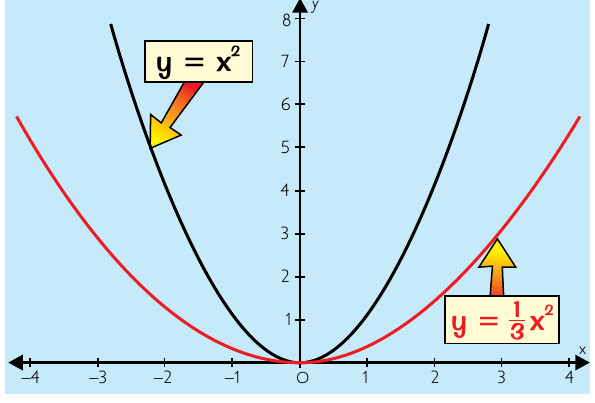
A vertical stretch or squash occurs when you multiply the entire function by a constant . This transformation affects how tall or short the graph appears.
When , the graph stretches vertically, making it taller. When , the graph squashes down, making it shorter. The key point to remember is that this transformation changes the y-coordinates while leaving x-coordinates unchanged.
Example
Worked Example: Vertical Stretch
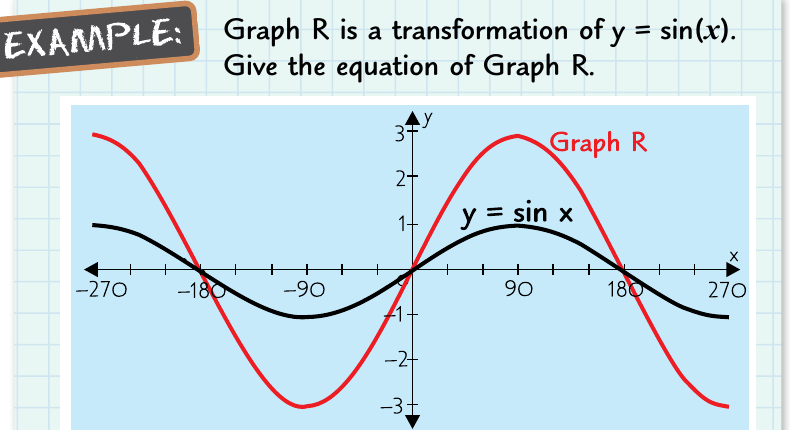
If you have and transform it to , the graph will stretch vertically by a factor of 3. This means the amplitude increases from 1 to 3, so the curve oscillates between -3 and 3 instead of -1 and 1.
2. Vertical shift:
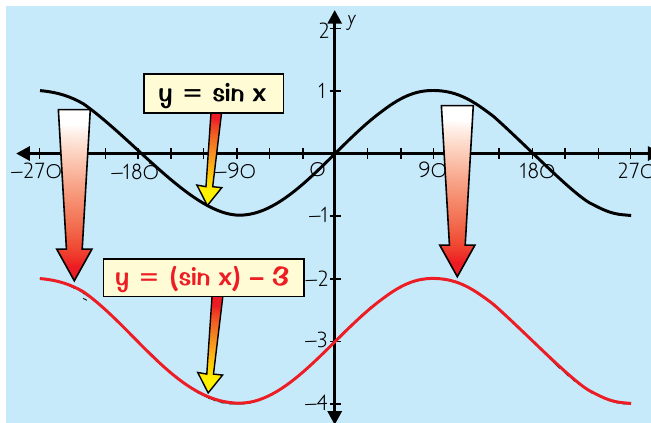
A vertical shift moves the entire graph up or down without changing its shape. This transformation is achieved by adding a constant value to the function.
When you add a positive number, the graph shifts upward. When you add a negative number (or subtract), the graph shifts downward. The amount of shift equals the value of the constant.
Example
Worked Example: Vertical Shift
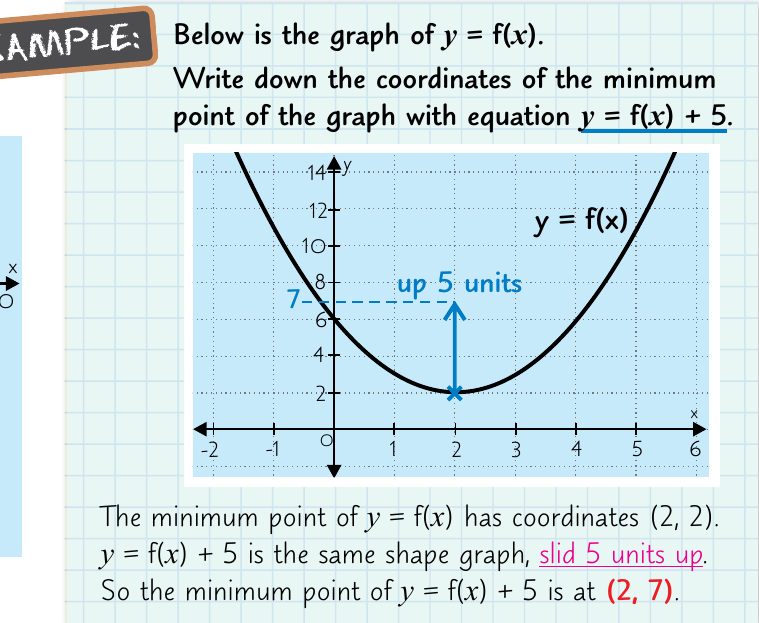
Consider a function with a minimum point at (2, 2). If you apply the transformation , the entire graph moves up by 5 units, so the minimum point becomes (2, 7).
3. Horizontal shift:
Horizontal shifts move the graph left or right along the x-axis. This transformation can be tricky because it works in the opposite direction to what you might expect.
Important
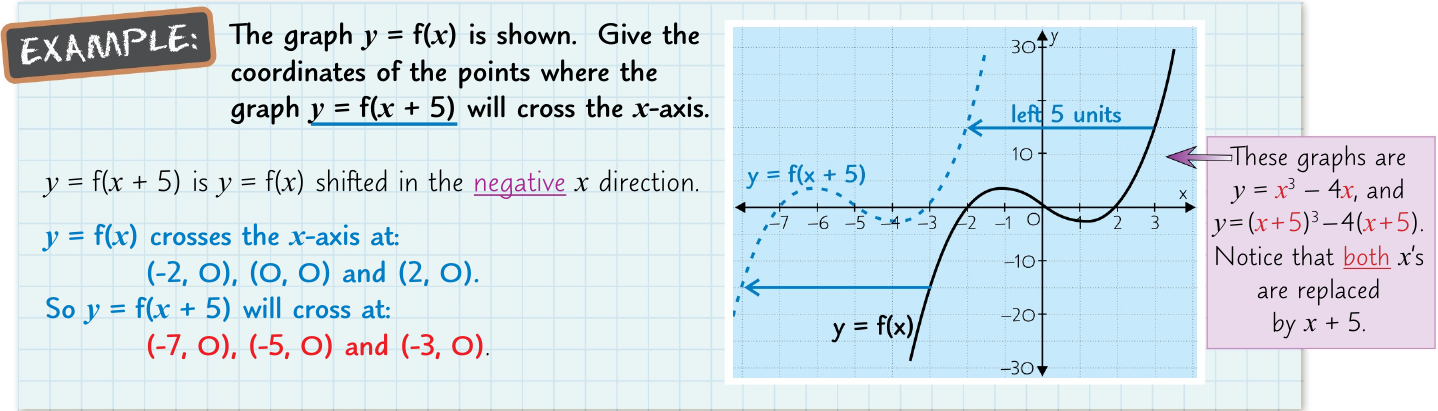
Watch Out for the "Opposite" Rule: When you have where is positive, the graph shifts to the right by units. When is negative, the graph shifts to the left. This "opposite" behaviour happens because you're replacing every in the original function with .
Example
Worked Example: Horizontal Shift
If the original function crosses the x-axis at points (-2, 0), (0, 0), and (2, 0), then will cross the x-axis at (-7, 0), (-5, 0), and (-3, 0), showing a shift of 5 units to the left.
4. Horizontal stretch and squash:
Horizontal stretching and squashing affects how wide or narrow the graph appears. This transformation works by multiplying the x-values inside the function.
When , the graph becomes squashed horizontally, making it narrower. When , the graph stretches horizontally, making it wider. This is the opposite of vertical transformations.
Example
Worked Example: Horizontal Compression
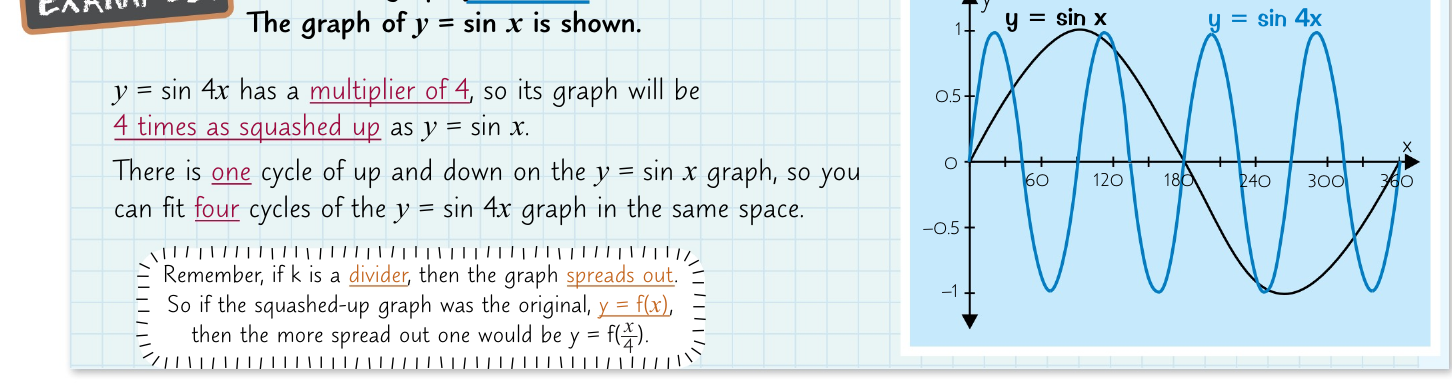
For example, creates a graph that's four times more compressed than . Where the original sine function completes one full cycle, the transformed function completes four cycles in the same horizontal space.
5. Reflections: and
Reflections flip the graph across an axis, creating a mirror image of the original function.
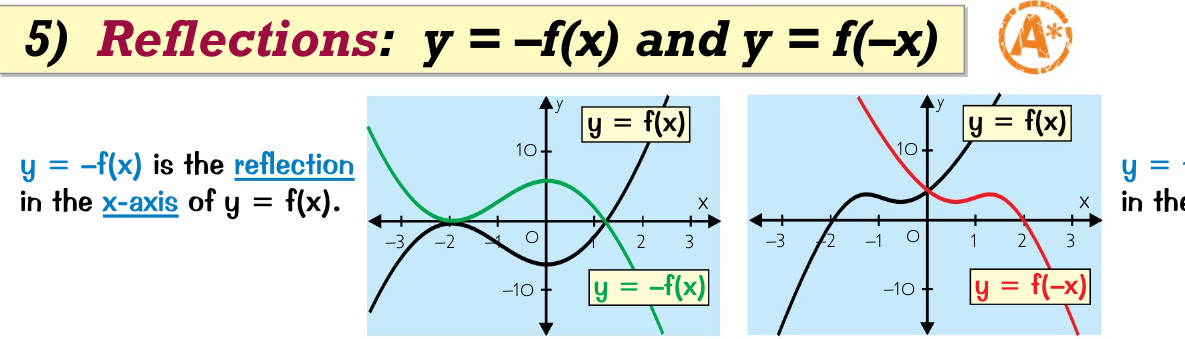
The transformation reflects the graph across the x-axis. Every point that was above the x-axis moves below it, and vice versa. The transformation reflects the graph across the y-axis, so points on the right side of the y-axis move to the left side.
These reflections are particularly useful when working with functions that have asymmetric properties or when you need to create inverse relationships.
Combining transformations
In practice, you might encounter functions that involve multiple transformations. When this happens, it's important to apply the transformations in the correct order and understand how they interact with each other.
Note
Remember that transformations can be combined, but each type affects the graph in its own specific way. Practice identifying each transformation type and predicting its effect on the graph's appearance.
Summary
Key Points to Remember:
- Vertical stretch/squash : Multiplies y-coordinates by , stretching when , squashing when
- Vertical shift : Moves graph up (positive ) or down (negative ) by units
- Horizontal shift : Moves graph right (positive ) or left (negative ) by units - this works opposite to what you'd expect!
- Horizontal stretch/squash : Squashes when , stretches when - opposite to vertical transformations
- Reflections: reflects across x-axis, reflects across y-axis