Parallel and Perpendicular Lines (Edexcel GCSE Maths): Revision Notes
📚Revision Notes
Parallel and perpendicular lines
Understanding the relationship between parallel and perpendicular lines is essential for working with coordinate geometry. These concepts help you determine how lines relate to each other and find equations of new lines based on existing ones.
Parallel lines and their gradients
Parallel lines are lines that never meet - they run alongside each other at exactly the same angle. The key mathematical property that defines parallel lines is that they have identical gradients.
When you write any straight line in the form , the value of (the gradient) tells you the steepness and direction of the line. For lines to be parallel, their values must be exactly the same, even if their values (y-intercepts) are different.
Note
The gradient determines the direction and steepness of a line, while the y-intercept determines where the line crosses the y-axis. Parallel lines can have different y-intercepts but must have the same gradient.
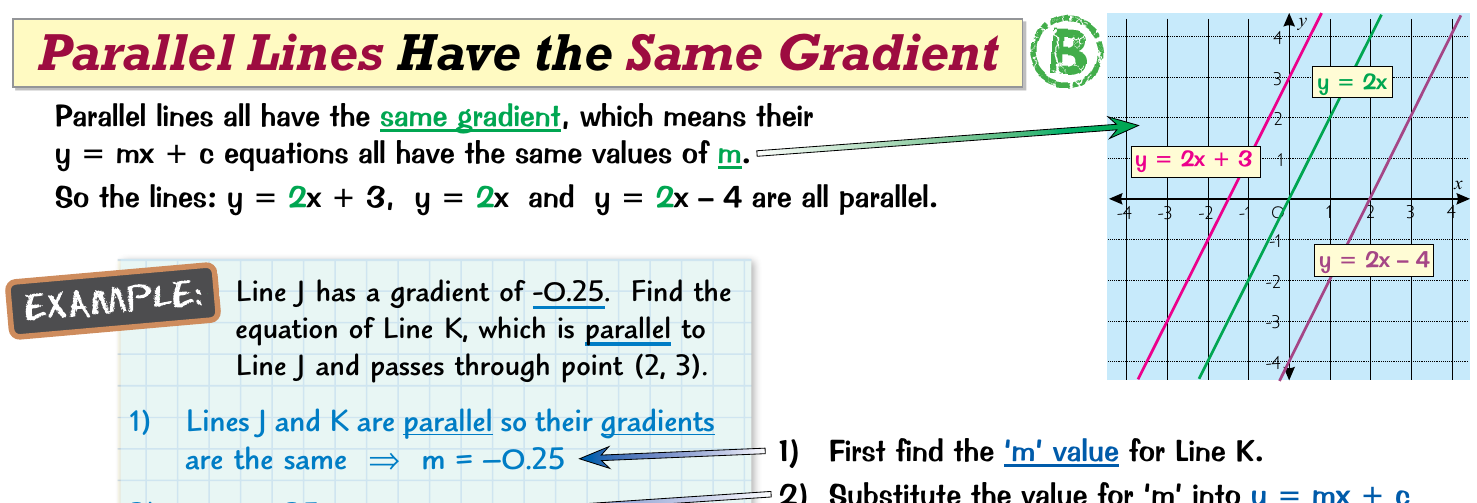
For example, the lines , , and are all parallel because they each have a gradient of . They're positioned at different heights on the coordinate plane, but they all slope upwards at the same rate.
Finding equations of parallel lines
When you need to find the equation of a line parallel to a given line, the key principle is that both lines must have the same gradient. Here's the systematic approach:
Example
Worked Example: Finding a Parallel Line
Find the equation of a line parallel to that passes through the point .
Step 1: Identify the gradient of the original line From , the gradient is
Step 2: Use the same gradient for the parallel line The parallel line will also have gradient
Step 3: Substitute the coordinates into
Step 4: Solve for
Step 5: Write the complete equation
Perpendicular lines and their gradients
Perpendicular lines meet at right angles (90°). The mathematical relationship between their gradients is more complex than parallel lines, but follows a clear pattern.
If one line has gradient , then any line perpendicular to it will have gradient . This means the gradients are negative reciprocals of each other.
Important
The product of perpendicular gradients always equals . This gives you a quick way to check if two lines are perpendicular: if , then the lines are perpendicular.
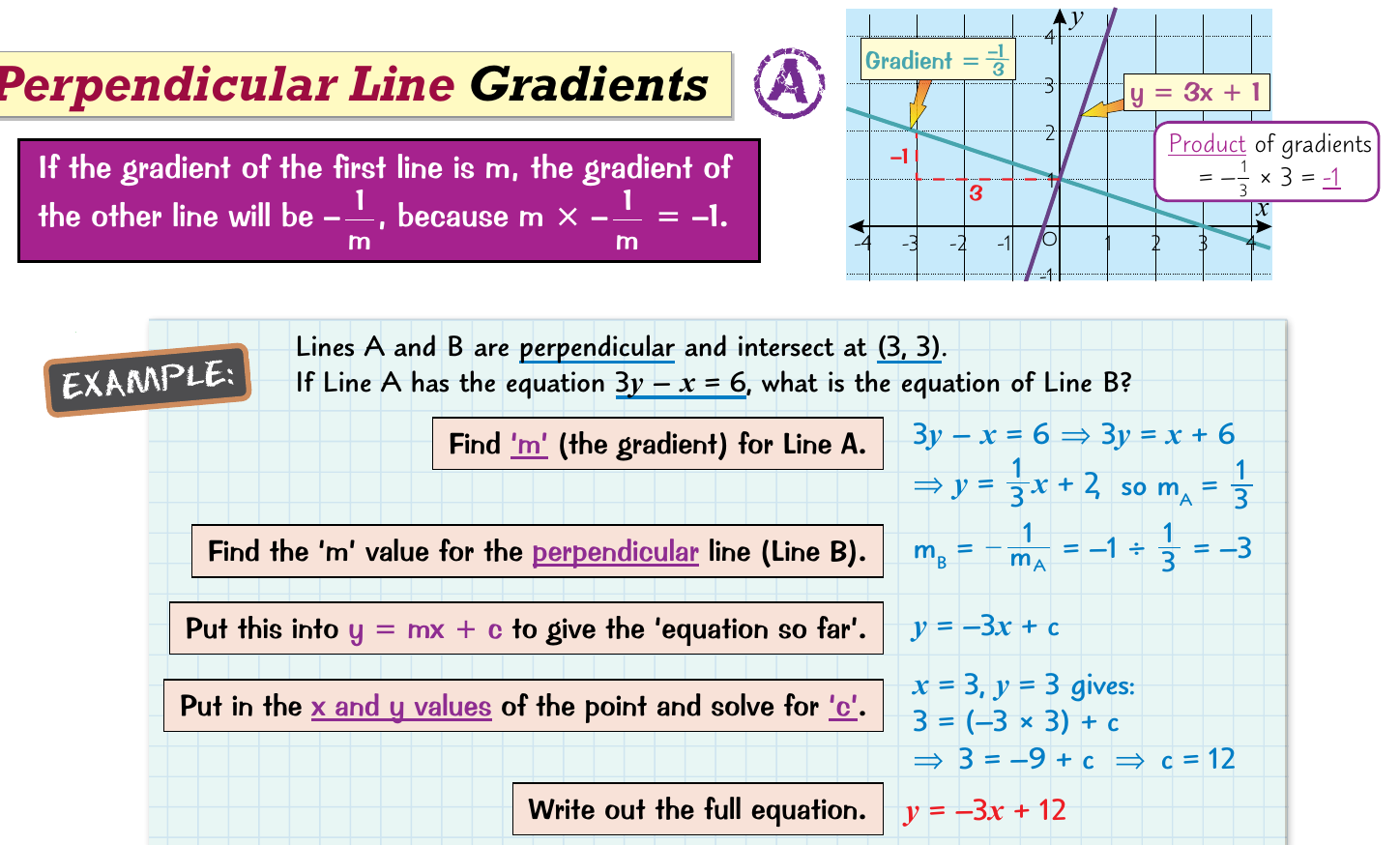
An important property to remember is that when you multiply the gradients of two perpendicular lines together, you always get . This gives you a quick way to check if two lines are perpendicular.
Finding equations of perpendicular lines
To find the equation of a line perpendicular to a given line, you need to calculate the negative reciprocal of the original gradient:
Example
Worked Example: Finding a Perpendicular Line
Find the equation of line B perpendicular to line A with equation , passing through .
Step 1: Find the gradient of line A Rearrange to standard form: , so Gradient of line A =
Step 2: Calculate the perpendicular gradient Perpendicular gradient =
Step 3: Use the perpendicular gradient in
Step 4: Solve for
Step 5: Write the complete equation
Key relationships to remember
The gradient relationships form the foundation for solving parallel and perpendicular line problems. Understanding these relationships allows you to quickly identify the type of relationship between lines and solve complex geometry problems.
Note
When working with line equations that aren't in form, always rearrange them first to easily identify the gradient. This is a essential first step in most parallel and perpendicular line problems.
The fundamental relationships are:
- Parallel lines: gradients are equal ()
- Perpendicular lines: gradients are negative reciprocals ()
- Perpendicular check:
These relationships work regardless of how the original equation is presented. You might need to rearrange equations into form first, but the gradient relationships remain consistent.
Summary
Key Points to Remember:
- Parallel lines have exactly the same gradient - they never meet because they're angled identically
- Perpendicular lines have gradients that are negative reciprocals of each other
- To find a perpendicular gradient, take the negative reciprocal: if gradient is , perpendicular gradient is
- The product of perpendicular gradients always equals
- Always rearrange equations into form to easily identify the gradient