Diffusion (OCR GCSE Biology A (Gateway Science Suite)): Revision Notes
📚Revision Notes
1.3.1 Diffusion
Note
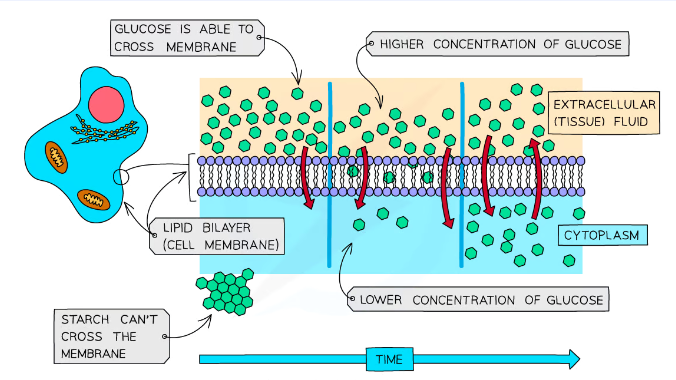
Diffusion is a fundamental process in biology where particles move from an area of higher concentration to an area of lower concentration until they are evenly spread out. This movement occurs naturally due to the random motion of particles and does not require energy from the cell, making it a type of passive transport.
Note
Key Points about Diffusion:
- Concentration Gradient:
- Diffusion occurs when there is a concentration gradient—a difference in the concentration of particles across a space.
- Particles move down the concentration gradient, from regions of higher concentration to regions of lower concentration.
- Types of Substances:
- Gases: Oxygen and carbon dioxide are small molecules that diffuse easily across cell membranes.
- Liquids: Some small molecules dissolved in water, such as glucose and amino acids, can also diffuse through membranes.
- Ions: Charged particles like sodium and potassium ions may require specific channels to diffuse through cell membranes.
- Diffusion in Cells:
- In biological systems, diffusion is crucial for the movement of substances in and out of cells.
- Oxygen: Diffuses from the alveoli in the lungs into the blood, where its concentration is lower.
- Carbon Dioxide: Diffuses from the blood into the alveoli to be exhaled, as its concentration is higher in the blood after respiration.
- Nutrients: In the small intestine, nutrients like glucose diffuse from the gut into the blood.
- Importance in Biology:
- Diffusion is essential for maintaining homeostasis—the stable internal conditions necessary for life.
- It allows cells to acquire the nutrients and oxygen they need while removing waste products like carbon dioxide.
Example
Examples of Diffusion in the Body:
- Gas Exchange: In the lungs, oxygen diffuses into the blood, and carbon dioxide diffuses out, enabling respiration.
Note
Diffusion is a simple but vital process that underpins many biological functions, ensuring that cells and organs receive the substances they need to function effectively.