Terminology and Equally Likely Events (Junior Cert Mathematics): Revision Notes
📚Revision Notes
Terminology and Equally Likely Outcomes
When learning about probability, it's important to understand the key terms that are used. These words will help you talk about and solve probability problems. Let's go through them one by one.
- Trial:
- A trial is when you do an experiment in probability. For example, when you toss a coin or roll a die, you are doing a trial. Each time you perform the experiment, it's called a trial.
Example
Example: Tossing a coin is one trial. Rolling a die is another trial.
- Outcome:
- An outcome is one of the possible results of a trial. It's what happens after you perform the trial.
Example
Example: If you roll a die, one possible outcome is getting a .
- Sample Space:
- The sample space is the set of all possible outcomes in a trial. It's like a list of everything that could happen.
Example
Example: If you flip a coin, the sample space is {Heads, Tails}. If you roll a die, the sample space is .
- Event:
- An event is when one or more specific outcomes happen. It's what you are interested in finding the probability of.
Example
Example: If you roll a die, getting an even number (, or ) is an event.
- Probability:
- Probability is the measure of how likely an event is to happen. It tells you the chance of something happening.
Example
Example: The probability of flipping a coin and getting heads is out of , or .
Understanding Equally Likely Outcomes
When all outcomes of a trial have the same chance of happening, we call them equally likely outcomes. This means that each outcome is just as likely as any other.
Example
Example: If you have a fair coin, the chances of getting heads or tails are the same—they are equally likely.
How to Calculate Probability for Equally Likely Outcomes:
When you know that all outcomes are equally likely, you can use a simple formula to find the probability of an event:
This formula helps you figure out the chance of something happening by comparing the number of outcomes you want to the total number of possible outcomes.
- The number of outcomes you want (favourable outcomes) is the number of outcomes that would lead to the event you're interested in.
- The total number of outcomes is the total number of possible results in the trial.
Why does this formula work? The formula works for equally likely outcomes because it assumes that each outcome has the same chance of happening. By dividing the number of favourable outcomes by the total number of outcomes, you are calculating the proportion of times the event you want would occur out of all possible events. This only works when all outcomes are equally likely because, in that case, each outcome contributes equally to the overall probability.
If the outcomes are not equally likely (e.g., some sections of a spinner are larger than others), the formula wouldn't correctly reflect the actual chances of the event happening. In such cases, you'd need to account for the different likelihoods of each outcome.
Examples to Understand Better:
Note
Example 1: Fair Spinner (Equally Likely Outcomes) Imagine you have a spinner divided into equal parts: red sections, blue section, and yellow section. Here's how you find the probability of landing on different colours:
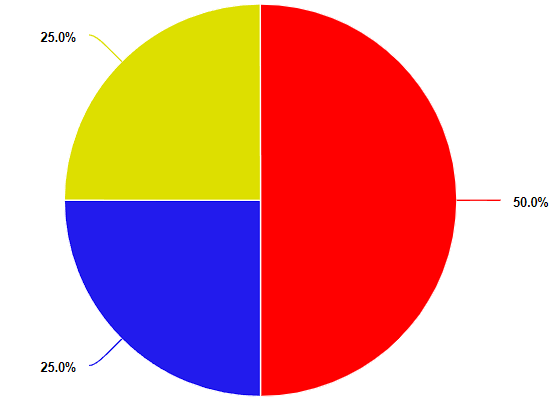
- Probability of landing on red :
- Outcomes you want : There are red sections.
- Total outcomes (All sections): There are sections in total. So, the probability of landing on red is out of , or 50%.
- Probability of landing on blue :
- Outcomes you want : There is blue section.
- Total outcomes (All sections): There are sections in total. So, the probability of landing on blue is out of , or 25%.
Note
Example 2: Spinner with More Frequent Colours (Still Equally Likely) Now, imagine a different spinner divided into equal sections: green section, yellow sections, and red sections. Even though some colours appear more frequently, the sections are all the same size, so each section has an equal chance of being landed on. This means the outcomes are still equally likely.
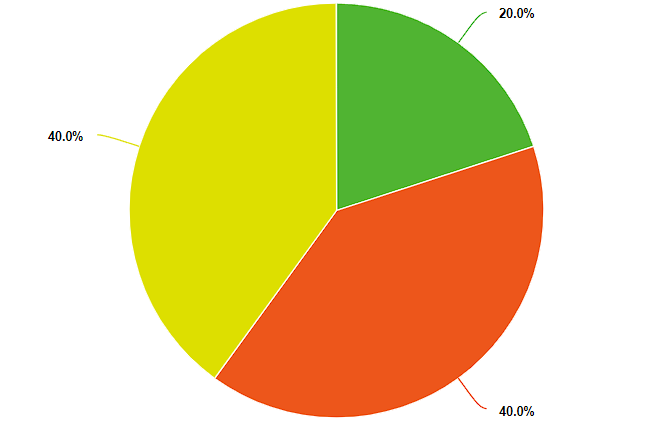
- Probability of landing on green :
- Outcomes you want (Green): There is green section.
- Total outcomes (All sections): There are sections in total. So, the probability of landing on green is out of , or 20%.
- Probability of landing on yellow (P(Yellow)):
- Outcomes you want (Yellow): There are yellow sections.
- Total outcomes (All sections): There are sections in total. So, the probability of landing on yellow is out of , or 40%.
Key Points to Remember:
- Equally Likely Outcomes mean each outcome has the same chance of happening. For example, in a fair game, all outcomes are equally likely.
- Even if a colour or outcome appears more frequently, the outcomes are still equally likely if the sections are equal in size.
- Use the formula to calculate the probability of an event, but remember that it only works correctly when the outcomes are equally likely. Understanding these terms and ideas will help you solve probability problems. Remember to keep practising, and soon these concepts will become easier to understand!