Bacteria and Fungi (Leaving Cert Biology): Revision Notes
📚Revision Notes
Bacteria and Fungi
Introduction to microorganisms
Microorganisms are incredibly small living things that can only be seen with a microscope. This fascinating group includes bacteria, fungi, archaea and some protists. These tiny organisms play crucial roles in our world, from breaking down dead matter to causing diseases, and even helping us make food and medicines.
.jpg)
Note
The Hidden World Around Us
Microorganisms are everywhere - in the air we breathe, the soil beneath our feet, and even inside our bodies. Despite being invisible to the naked eye, they perform essential functions that make life on Earth possible, including nutrient cycling, decomposition, and maintaining ecological balance.
Bacterial structure and characteristics
Bacteria are prokaryotic
Bacteria are prokaryotic organisms, which means they don't have a membrane-bound nucleus like the cells in plants and animals. Instead, their genetic material floats freely in the cytoplasm. This makes them fundamentally different from fungi, which are eukaryotic (having a true nucleus).
Important
Key Distinction: Prokaryotic vs Eukaryotic
Understanding the difference between prokaryotic and eukaryotic cells is crucial for distinguishing bacteria from fungi. This fundamental difference affects everything from their internal structure to how they reproduce and function.
Key components of bacterial cells
Cell wall The bacterial cell wall provides structural support and protection. It's made from a complex mixture of sugars and proteins that prevents the bacterium from swelling up and bursting when water enters the cell. This rigid structure is always present in bacterial cells.
Cell membrane Just inside the cell wall, bacteria have a cell membrane that controls what enters and leaves the cell. This selective barrier is essential for maintaining the cell's internal environment.
Capsule Some bacteria have an additional protective layer called a capsule outside their cell wall. This can be either a semi-solid capsule or a more liquid slime layer. The capsule helps bacteria stick to surfaces and provides extra protection, making them harder for the immune system to destroy.
Chromosome Bacteria have one main chromosome made of a circular strand of DNA. Unlike eukaryotic cells, this genetic material isn't surrounded by a nuclear membrane, so it's considered prokaryotic. The chromosome contains all the essential genes needed for the bacterium to survive and reproduce.
Plasmids Many bacteria also contain small, circular pieces of DNA called plasmids in their cytoplasm. These carry additional genes that often provide advantages like antibiotic resistance. Plasmids are particularly important in genetic engineering and medical research.
Note
Why Plasmids Matter
Plasmids are like bonus genetic material that bacteria can share with each other. This is one reason why antibiotic resistance can spread so quickly between different bacterial species - they can literally pass resistance genes to each other through plasmid transfer.
Cytoplasm The cytoplasm surrounds the chromosome and contains ribosomes and storage granules. However, unlike eukaryotic cells, bacterial cytoplasm doesn't contain membrane-bound organelles like mitochondria or chloroplasts.
Flagella Some bacteria can move because they have whip-like structures called flagella. These rotating structures propel the bacterium through liquid environments.
Bacterial nutrition
Bacteria obtain energy and nutrients in different ways, and we can group these methods into two main categories.
Autotrophic bacteria
Autotrophic bacteria can make their own food, just like plants do. The word "autotrophic" literally means "self-feeding". These remarkable organisms can get energy from two different sources:
Photosynthetic bacteria use sunlight to make food through photosynthesis. Some have chlorophyll in their cell membranes (not in chloroplasts like plants) and work similarly to plant photosynthesis. Others use different pigments and can even use hydrogen sulphide gas instead of water, producing sulphur instead of oxygen.
Chemosynthetic bacteria make food using energy from chemical reactions instead of sunlight. For example, nitrifying bacteria in soil break down ammonia and other nitrogen compounds to get energy. These bacteria are vital for the nitrogen cycle.
Example
Example: Deep-Sea Chemosynthetic Bacteria
In the depths of the ocean where no sunlight reaches, bacteria around hydrothermal vents use chemosynthesis to create food from chemicals like hydrogen sulphide. These bacteria form the base of entire ecosystems, supporting life in complete darkness - from tube worms to deep-sea fish.
Heterotrophic bacteria
Heterotrophic bacteria can't make their own food and must obtain it from other sources. Most bacteria fall into this category and can be further divided into two groups:
Saprophytic bacteria feed on dead organic matter. These decomposers break down dead plants, animals, and waste products, releasing nutrients back into the environment. They're essential for recycling nutrients in ecosystems and include bacteria that cause decay in soil.
Parasitic bacteria obtain food from living organisms (their hosts), often causing harm in the process. Examples include bacteria that cause diseases like pneumonia, tuberculosis, and food poisoning. These bacteria live on or inside other organisms and take nutrients from them.
Fungal structure and characteristics
Fungi are eukaryotic
Unlike bacteria, fungi are eukaryotic organisms with a membrane-bound nucleus containing their DNA. Many fungi like Rhizopus are multicellular, though some (like yeasts) are single-celled.
Structure of a typical fungus (Rhizopus)
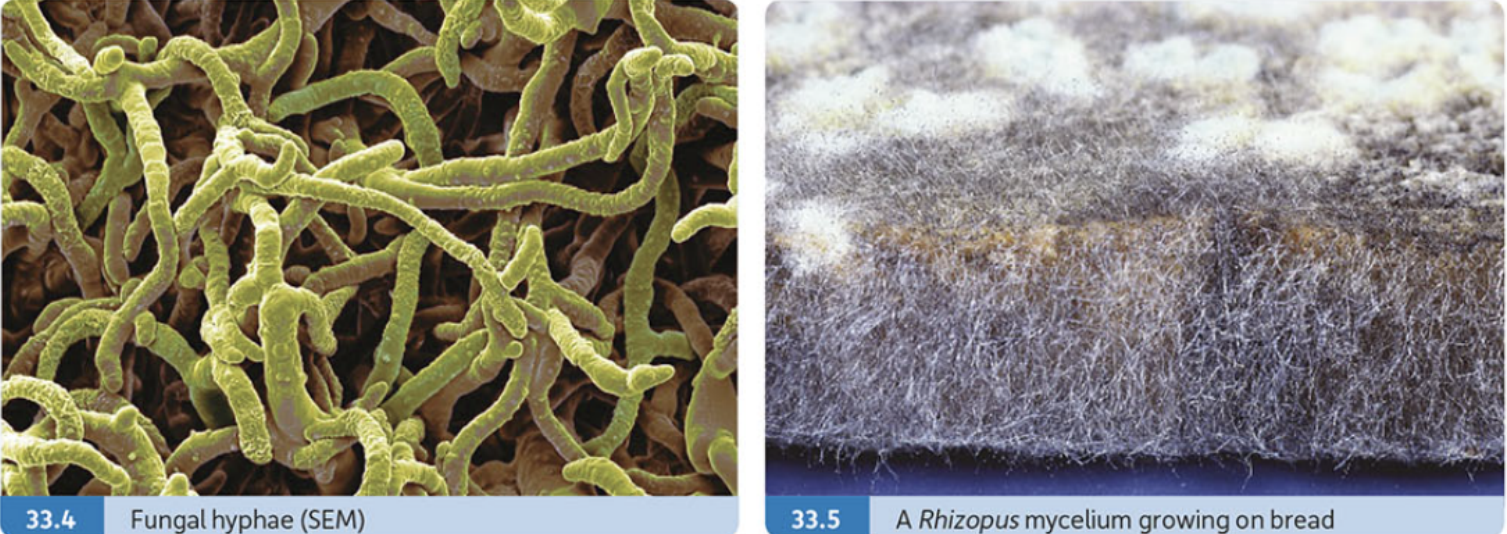
Hyphae The basic building blocks of most fungi are thread-like structures called hyphae. These tubular filaments have walls strengthened with a tough substance called chitin. Hyphae contain multiple nuclei and can grow rapidly by extending at their tips.
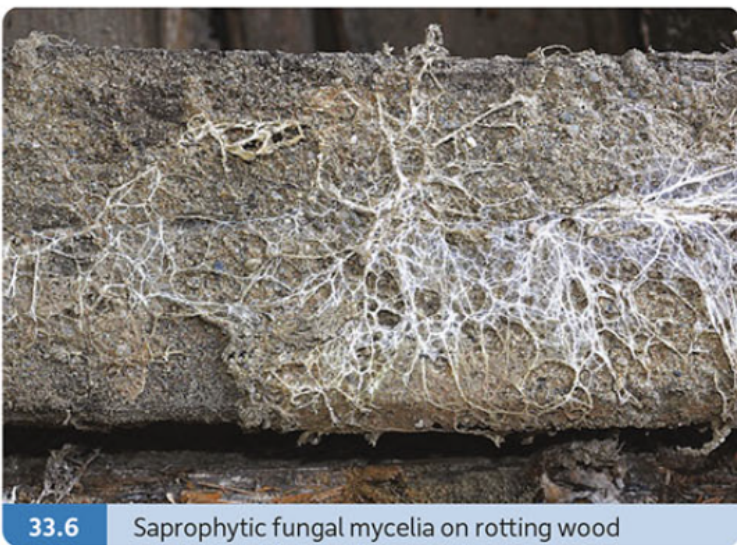
Mycelium When hyphae grow and branch together, they form a network called a mycelium. This is the main body of the fungus and is often visible as the fuzzy growth you see on mouldy bread or rotting wood.
Rhizoids These are root-like structures that grow down into the substrate (the material the fungus is growing on). Rhizoids anchor the fungus and provide extra surface area for absorbing nutrients and water.
Stolons Stolons are horizontal hyphae that help the fungus spread quickly across a surface. They act like runners, allowing the fungus to colonise new areas rapidly.
Sporangiophores These are upright, vertical hyphae that support the reproductive structures. They lift the spore-containing structures up into the air where spores can be easily dispersed.
Sporangium At the top of each sporangiophore is a round structure called a sporangium. This contains many tiny reproductive spores that will grow into new fungi when conditions are right.
Columella The wall at the top of a sporangium is called the columella. It surrounds a swollen area called the apophysis, and when the sporangium bursts, it releases thousands of microscopic spores.
Note
Fungal Reproduction Strategy
The elevated sporangium structure is a brilliant evolutionary adaptation. By lifting spores high above the substrate, fungi maximise their chances of spore dispersal by air currents, allowing them to colonise new areas far from the parent organism.
Fungal nutrition
Fungi can't make their own food like plants because they don't have chlorophyll for photosynthesis. Instead, they're heterotrophic and get their nutrition in two main ways:
Saprophytic fungi
Most fungi are saprophytes, meaning they feed on dead organic matter. They're nature's recyclers, breaking down fallen leaves, dead wood, and other organic waste. As they digest this material, they release minerals back into the soil that plants can use.
Saprophytic fungi are commonly found growing on rotting logs, fallen leaves, and dead animals. You might recognise them as mushrooms growing on tree stumps or the fuzzy mould that appears on old bread. Rhizopus is a common saprophytic fungus that grows on starchy foods like bread and fruit.
Parasitic fungi
Some fungi are parasitic, meaning they get their food from living plants or animals. The fungal hyphae penetrate between or into the cells of their host, absorbing nutrients and often causing damage or disease.
Obligate parasites can only survive on living hosts and typically don't kill their host immediately (since they need it alive). Examples include fungi that cause plant diseases like mildews and rusts.
Facultative parasites can live on both living and dead tissue. They may start by feeding on a living host but continue growing on the dead remains.
Important
Parasitic vs Saprophytic: A Critical Difference
Understanding whether a fungus is parasitic or saprophytic is crucial for disease management. Parasitic fungi require different control strategies because they actively invade living tissue, while saprophytic fungi can often be controlled by removing dead organic matter.
Factors affecting microorganism growth
Several environmental factors significantly influence how well bacteria and fungi can grow and reproduce.
pH levels
Most microorganisms are designed to work best at specific pH levels. Their enzymes become denatured (stop working properly) if the pH is too acidic or too alkaline for them.
Most bacteria and fungi grow best at neutral or slightly alkaline pH levels (around pH 7). However, some microorganisms can tolerate extreme pH conditions. Understanding pH requirements is crucial for food preservation - making foods very acidic or alkaline can prevent harmful microorganisms from growing.
Nutrients
Like all living things, microorganisms need nutrients to survive and grow. They require carbohydrates for energy, proteins for building cellular structures, and various minerals and vitamins for metabolic processes.
Microorganisms can either make their own nutrients (if they're autotrophic) or must obtain them from their environment (if they're heterotrophic). The availability of suitable nutrients directly affects how quickly microorganisms can multiply.
Water
Water is absolutely essential for all microorganisms. They need it for their cytoplasm, to allow metabolic reactions to occur, and to transport materials in and out of their cells or hyphae.
Note
Water and Food Preservation
This is why dried foods last longer - removing water prevents most microorganisms from growing and spoiling the food. Traditional preservation methods like jerky, dried fruits, and dehydrated vegetables all work on this principle.
External solute concentration
The concentration of dissolved substances (solutes) in the environment affects microorganisms through osmosis.
If the external solution has a higher solute concentration than inside the microorganism, water will move out, dehydrating it and stopping enzyme activity. This principle explains why salting and adding sugar are effective food preservation methods.
If the external solution has a lower solute concentration, water will enter the microorganism. While bacterial cell walls usually prevent bursting, this can still affect growth.
Temperature
Temperature significantly affects the rate of metabolic reactions in microorganisms.
Most bacteria and fungi grow best between 20°C and 40°C. At higher temperatures, their enzymes become denatured and stop working. Very low temperatures (like in fridges and freezers) slow down growth dramatically, which is why we use refrigeration to preserve food.
Some special microorganisms can tolerate extreme temperatures. These are often used in industrial processes where high-temperature reactions are beneficial.
Important
Temperature Control in Food Safety
The temperature range of 4°C to 60°C is often called the "danger zone" because most harmful bacteria multiply rapidly in this range. This is why proper refrigeration (below 4°C) and thorough cooking (above 60°C) are essential for food safety.
Antimicrobial chemicals
Various chemicals can kill or prevent the growth of microorganisms. These include:
- Antibiotics that specifically target bacteria
- Antifungals that work against fungi
- Disinfectants that kill a broad range of microorganisms
- Antiseptics that are safe to use on living tissue
Understanding how these chemicals work helps us develop better treatments for infections and more effective ways to preserve food and maintain hygiene.
Key differences between bacteria and fungi
| Feature | Bacteria | Fungi |
|---|---|---|
| Cell type | Prokaryotic (no nucleus) | Eukaryotic (has nucleus) |
| Cell wall | Made of peptidoglycan | Made of chitin |
| Structure | Usually single-celled | Usually multicellular (hyphae) |
| Nutrition | Can be autotrophic or heterotrophic | Always heterotrophic |
| Reproduction | Binary fission | Spores |
| Size | Generally smaller | Generally larger |
Summary
Key Points to Remember:
- Bacteria are prokaryotic - they don't have a membrane-bound nucleus, while fungi are eukaryotic with a proper nucleus
- Bacterial nutrition can be autotrophic (making own food) or heterotrophic (taking food from others), while fungi are always heterotrophic
- Fungal structure is based on thread-like hyphae that form networks called mycelia, with specialised structures for reproduction
- Environmental factors like pH, temperature, nutrients, water, and antimicrobials all significantly affect microorganism growth
- Both bacteria and fungi play crucial ecological roles as decomposers, though some can cause diseases in plants, animals, and humans