Plant Tissue (Leaving Cert Biology): Revision Notes
📚Revision Notes
Plant Tissue
Note
Tissue: a group of similar cells that have a similar function.
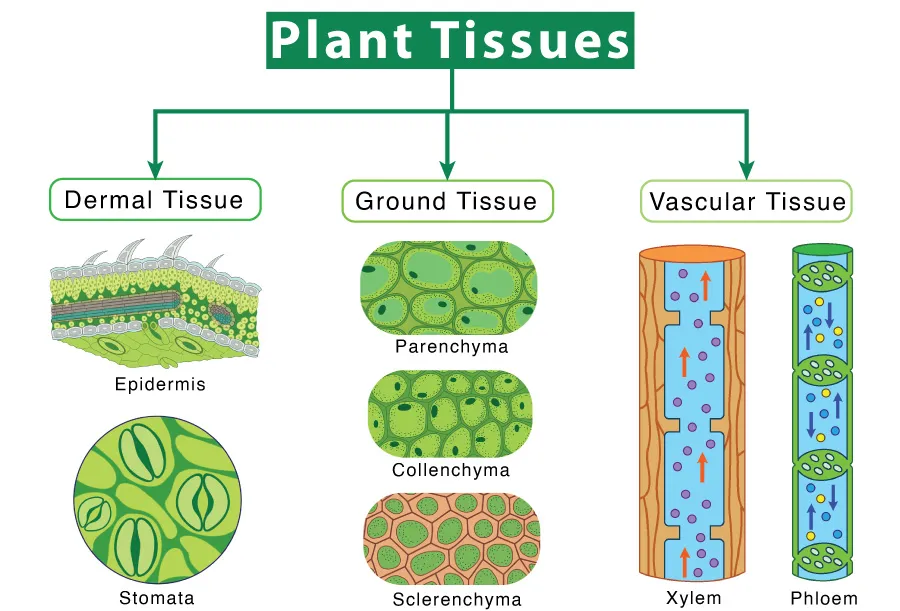
There are three main types of plant tissue:
- Dermal tissue
- Ground tissue
- Vascular tissue
1. Dermal Tissue
- Function: Protects the surface of plants.
- It covers the entire plant, from the roots to the leaves and flowers.
2. Ground Tissue
- Fills the inside of a plant.
- Its function depends on its location.
- Functions include:
- Food storage (in roots/stems)
- Photosynthesis (in leaves)
3. Vascular Tissue
- Function: Transports materials around the plant.
- There are two types:
- Xylem
- Phloem
- Xylem tissue transports water and minerals from the roots to the aerial parts of the plant. Movement in xylem tissue is always upwards.
- Phloem tissue transports food (sugar and nutrients) around the plant. Movement in phloem tissue can be upwards or downwards.
Note
Exam Focus: Name a type of plant tissue and how it is adapted to perform its function.
Dermal tissue has a thickened cell wall.
The Leaf
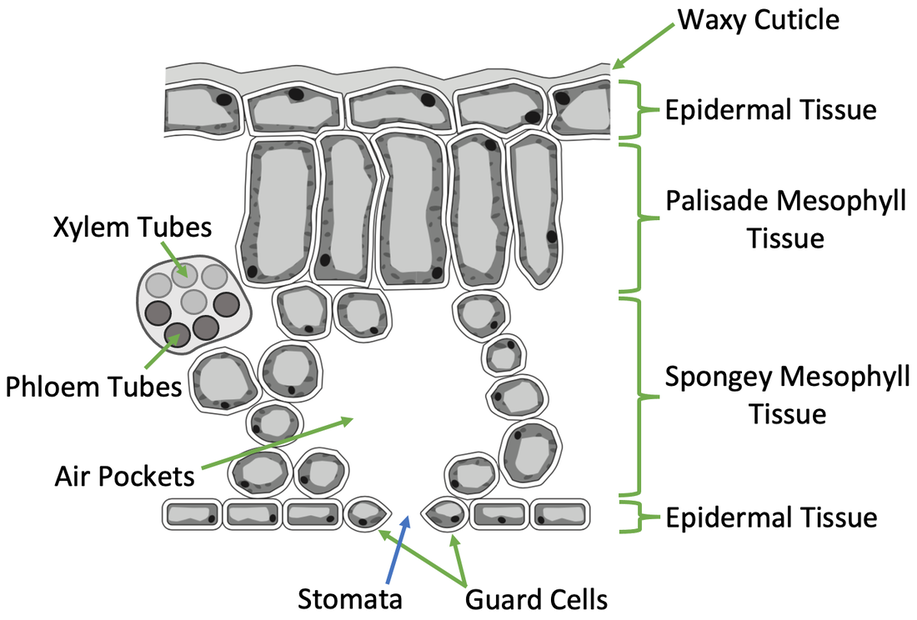
- Dermal Tissue = Epidermal Tissue
- Vascular Tissue = Xylem and Phloem
- Ground Tissue = Mesophyll Tissue
- Stomata: Openings for gas exchange to occur.
- Photosynthesis occurs in the ground tissue, and light must pass through the dermal tissue to reach it. Therefore, the dermal tissue is transparent.
Note
Photosynthesis is the process by which plants use sunlight, carbon dioxide, and water to produce glucose and oxygen.