DNA (Leaving Cert Biology): Revision Notes
📚Revision Notes
DNA
Structure of DNA
- Chromosomes are highly coiled structures made up of 40% DNA and 60% protein.
- The proteins involved are called histones. They help organise the DNA.
- DNA stands for deoxyribonucleic acid.
- It was discovered by Watson and Crick in 1953 (and Rosalind Franklin).
- Each human cell contains about 3 metres of DNA.
- DNA is heavily folded to fit into the nucleus.
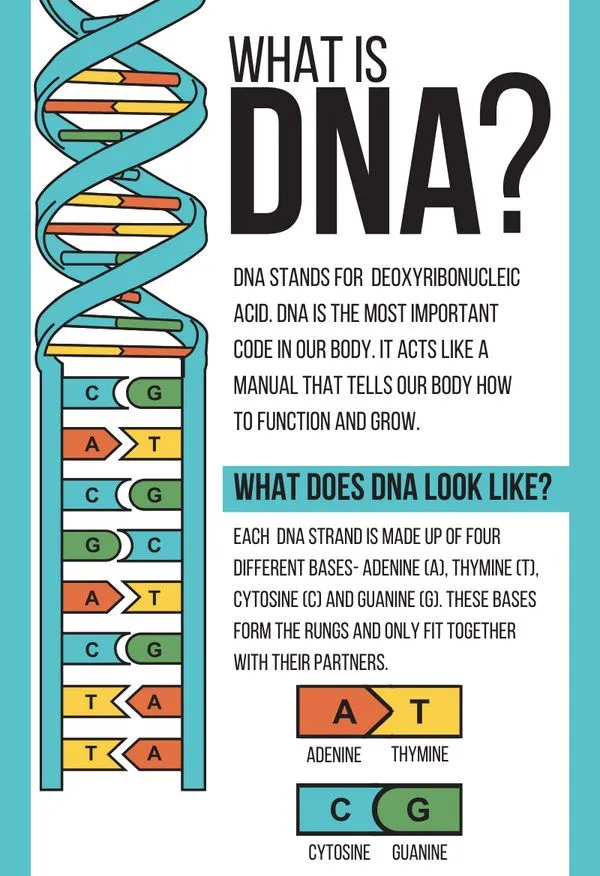
- DNA is double-stranded and forms a double helix.
- The strands are held together by bases.
- DNA is made up of nucleotides, which join to form long chains called polynucleotides.
Nucleotides
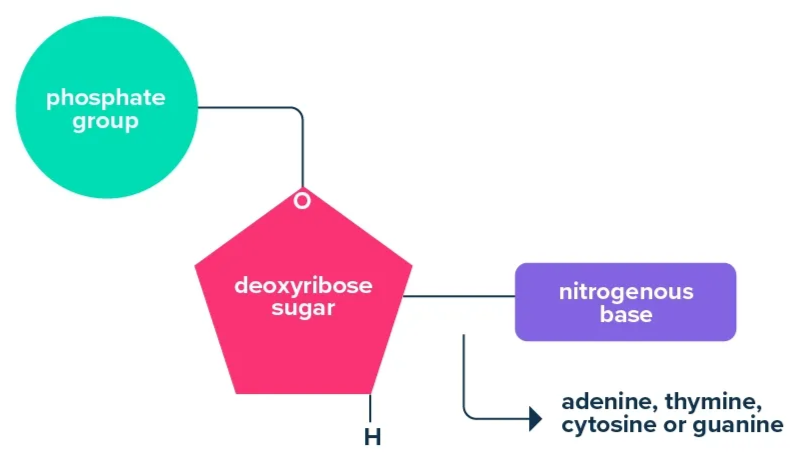
A nucleotide is the building block of DNA.
It is made up of three parts:
- A phosphate group
- A sugar (called deoxyribose)
- One of four nitrogen-containing bases
The four nitrogen-containing bases in DNA are:
- Adenine (A)
- Guanine (G)
- Cytosine (C)
- Thymine (T)
Base Pairing Rules:
- Adenine (A) always pairs with Thymine (T).
- Cytosine (C) always pairs with Guanine (G).
- These pairs are called complementary bases.
Hydrogen Bonds:
- A and T are joined by 2 hydrogen bonds.
- C and G are joined by 3 hydrogen bonds.
Purines and Pyrimidines:
- Adenine (A) and Guanine (G) are classified as purines.
- Cytosine (C) and Thymine (T) are classified as pyrimidines.
Example
Example If one DNA strand contains the sequence AATCGA, its complementary strand will contain TTAGCT.