DNA Replication (Leaving Cert Biology): Revision Notes
📚Revision Notes
DNA Replication
- At the end of mitosis, each new cell has single-stranded chromosomes.
- Before these cells can divide again, the DNA in each chromosome must make an exact copy of itself.
- This process is called DNA replication, and it ensures that the single-stranded chromosomes become double-stranded.
- DNA replication occurs during interphase in the nucleus.
Mechanism of DNA Replication
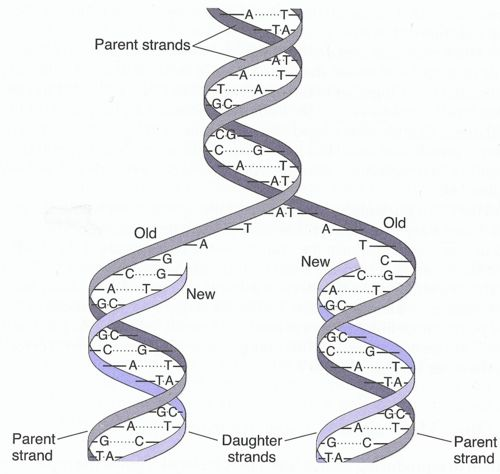
- The double helix unwinds, exposing the two strands of DNA.
- An enzyme breaks the hydrogen bonds between the complementary bases, causing the strands to open like a zip.
- The complementary strands move apart.
- Free DNA nucleotides move into the nucleus from the cytoplasm.
- These nucleotides attach to their complementary bases on the exposed DNA strands:
- A pairs with T.
- C pairs with G.
- The enzyme DNA polymerase assembles the new strands by joining the nucleotides.
- Each new DNA strand has the exact same sequence of bases as the original.
Note
DNA polymerase is an anabolic enzyme.
- The new strands are half old DNA and half new DNA. The two new DNA molecules are identical to the original DNA and to each other.
- Each new stretch of DNA rewinds to form a double helix.
Note
This might seem complicated, but these six steps will help you remember the process:
- Unwinding the Double Helix
- Strand Separation
- Nucleotide Pairing
- Assembly of New Strands
- Identical Strands Form
- Reforming the Double Helix Don't forget to expand on each point if asked about DNA Replication in the exam!
Importance of DNA Replication
- Allows for cell continuity: Ensures that all cells in the body contain the same genetic information.
- Variation: DNA replication is a very accurate process, but occasional mistakes (mutations) in the sequence of bases allow for variation, which is essential for evolution.