Mendel and Genetic Crosses (Leaving Cert Biology): Revision Notes
📚Revision Notes
Mendel and Genetic Crosses
Understanding genetic terminology
Before diving into genetic crosses, it's essential to understand the specialised language that geneticists use. This terminology forms the foundation for understanding how traits are passed from parents to offspring.
Genes and chromosomes
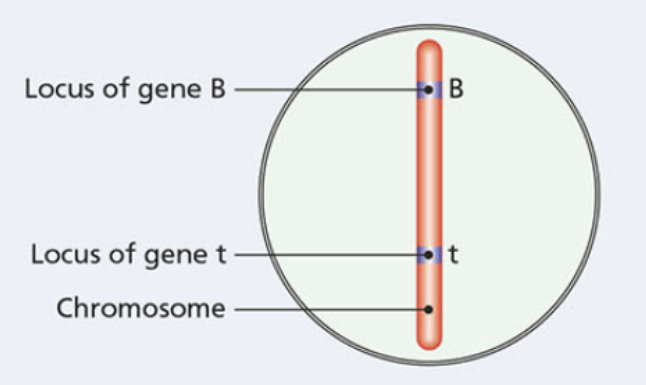
A gene is a section of DNA that controls the production of a protein. Every gene has a specific location on a chromosome called its locus (plural: loci). Think of the locus as the gene's address on the chromosome.
Note
The locus (plural: loci) of a gene is its position on the chromosome. Just like a street address tells you where to find a house, the locus tells you exactly where to find a specific gene on a chromosome.
Alleles - different versions of genes
Alleles are different forms of the same gene. For example, a gene controlling coat colour might have one allele for black coat and another for white coat. Most organisms have two alleles for each trait because they inherit one from each parent.
There are two main types of alleles:
- Dominant alleles prevent recessive alleles from being expressed and are represented by capital letters (e.g., B)
- Recessive alleles are prevented from being expressed when a dominant allele is present and are shown with lowercase letters (e.g., b)
Important
Always use capital letters for dominant alleles and lowercase letters for recessive alleles. This standardised notation is crucial for correctly interpreting genetic crosses and avoiding confusion.
Genotype vs phenotype
Understanding the difference between genotype and phenotype is crucial:
- Genotype: The genetic make-up of an organism (the actual alleles present)
- Phenotype: The physical expression or appearance that results from the genotype
The relationship between these can be summarised as:
This means that whilst genes provide the blueprint, environmental factors can also influence how traits are expressed.
Homozygous and heterozygous
Organisms can be classified based on their allele combinations:
- Homozygous: Having two identical alleles (e.g., BB or bb)
- Heterozygous: Having two different alleles (e.g., Bb)
Gregor Mendel - the father of genetics
Gregor Mendel is known as the 'father of genetics'. He was born in 1822 in Austria and became a monk at the age of 21. Mendel's success came from his careful, methodical approach to studying inheritance.
Mendel's experimental approach
Mendel carried out numerous experiments on garden pea plants, investigating the inheritance of seven characteristics including stem height, flower colour, and seed shape. His experimental design was revolutionary for several reasons:
Note
Mendel's experimental success was due to his systematic approach - he chose characteristics that showed only two distinct forms, carefully counted his results, and used mathematical analysis to identify patterns. This scientific methodology was ahead of its time.
- He studied features that displayed only two forms (e.g., stems were either tall or short, seeds were either green or yellow)
- He counted the number of plants with each type of trait, allowing him to detect mathematical ratios
- He collected seeds and grew them in carefully labelled containers
- He studied the appearances (phenotypes) of the resulting plants
Mendel's work involved removing the pollen-producing structures (anthers) from some flowers and transferring pollen to these flowers using a small brush. The treated flowers were then covered with bags to prevent contamination from other pollen sources.
Monohybrid crosses
A monohybrid cross involves studying the inheritance of a single characteristic. This is the simplest type of genetic cross and forms the basis for understanding more complex inheritance patterns.
Working out genetic crosses
When working out genetic crosses, follow these essential rules:
Important
Essential Rules for Genetic Crosses:
- A pair of alleles is present in the cells of each organism for each characteristic
- It's essential to distinguish clearly between upper-case (capital) and lower-case letters
- Only one allele for each characteristic is carried in each gamete
- As a result of gametes joining at fertilisation, a pair of alleles is present in the progeny or offspring
Sample genetic cross - coat colour in rats
Let's examine a practical example. In rats, black coat (B) is dominant over white coat (b). When we cross two rats with genotypes BB (black) and bb (white):
Example
Worked Example: Rat Coat Colour Cross
Parents: Black coat (BB) × White coat (bb)
Gametes: All B from black parent, all b from white parent
Offspring genotype: All Bb
Offspring phenotype: All black coat
Result: 100% of offspring display the dominant trait
This demonstrates that when a homozygous dominant individual is crossed with a homozygous recessive individual, all offspring are heterozygous and display the dominant trait.
Punnett squares - a useful tool
A Punnett square is a table used to show all the possible genotypes of the progeny of a genetic cross. It's named after English geneticist Reginald Punnett, who also discovered important concepts about genetic linkage and sex determination.

More complex crosses - heterozygous parents
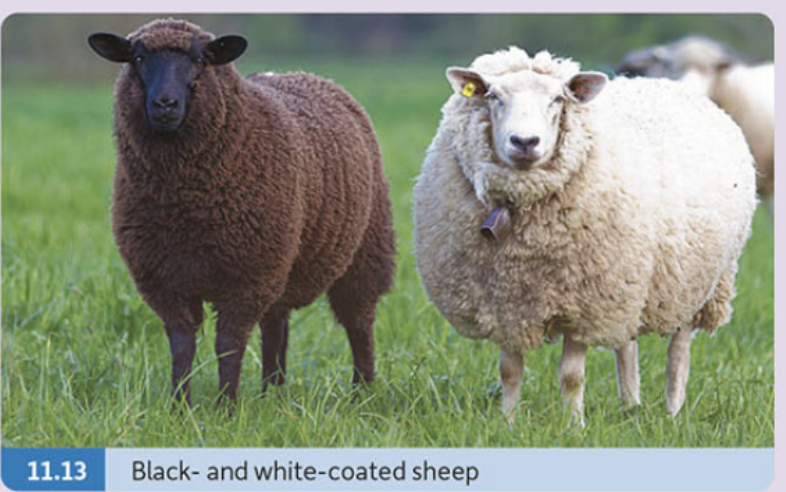
When both parents are heterozygous, we see more interesting ratios. Consider sheep where white wool (W) is dominant over black wool (w):
Example
Worked Example: Sheep Wool Colour Cross
Cross: Ww × Ww
Results:
- 25% WW (white wool)
- 50% Ww (white wool)
- 25% ww (black wool)
Phenotypic ratio: 3 white : 1 black
This 3:1 ratio is characteristic of crosses between two heterozygous individuals.
Pedigree studies
A pedigree is a diagram showing the genetic history of a group of related individuals. Pedigrees are essential tools for tracking the inheritance of traits through families.

Reading pedigrees
In pedigree charts:
- Males are represented by squares
- Females are represented by circles
- Individuals displaying the trait are shown in one colour
- Those not displaying the trait are shown in a different colour
- Lines connect parents to their offspring
Note
Pedigrees are like family trees for geneticists. They help us trace how traits move through generations and determine whether a trait is likely controlled by dominant or recessive alleles.
Analysing inheritance patterns
Pedigrees help us determine whether a trait is controlled by dominant or recessive alleles. For example, if two parents without a trait have children who display the trait, this suggests the trait is recessive.
Expected ratios in genetic crosses
Understanding the mathematical patterns that emerge from different types of crosses is crucial for predicting inheritance outcomes.
Common genetic ratios
- 1:0 (100%): When crossing homozygous dominant with any genotype
- 1:1 (50%:50%): When crossing heterozygous with homozygous recessive
- 3:1 (75%:25%): When crossing two heterozygous individuals
Important
These ratios are theoretical expectations based on probability. In real experiments, especially with small sample sizes, the actual ratios may deviate slightly from these predicted values due to chance.
Key terms for genetic crosses
- Progeny: The offspring that are produced (F₁ is short for the first filial generation)
- F₁ generation: The offspring of the parents in any cross
- Homozygous: The two alleles are identical
- Heterozygous: The alleles are different
Summary
Key Points to Remember:
- Genetic terminology is essential - understand the difference between genotype (genetic makeup) and phenotype (physical appearance)
- Mendel's approach was successful because he studied simple traits, counted offspring, and used mathematical analysis
- Monohybrid crosses examine one trait at a time and follow predictable mathematical ratios
- Punnett squares are invaluable tools for predicting the outcomes of genetic crosses
- Common ratios to remember: 3:1 for heterozygous crosses, 1:1 for test crosses, and 1:0 for homozygous dominant crosses