Diagrams and Formulas (Leaving Cert Chemistry): Revision Notes
📚Revision Notes
Diagrams and Formulas
Chemical compounds can be represented using various visual and written methods. Understanding these representations is essential for working with ionic compounds and predicting their properties.
Lewis diagrams for ionic bonding
Lewis diagrams (also called dot-and-cross diagrams) provide a visual way to show how electrons are transferred when ionic bonds form. These diagrams help us understand the electron movements that create charged ions.
How Lewis diagrams work
In a Lewis diagram, we represent electrons from different atoms using dots and crosses. This makes it easy to track which electrons originally belonged to which atom. When drawing these diagrams, we show the transfer of electrons from metal atoms to non-metal atoms.
For example, when magnesium reacts with fluorine, the magnesium atom loses two electrons while each fluorine atom gains one electron. The Lewis diagram clearly shows this electron transfer process.

The diagram above demonstrates how MgF₂ forms. Notice how the two outer electrons from magnesium transfer to the two fluorine atoms, creating a magnesium ion with a 2+ charge and two fluoride ions each with a 1- charge.
Note
Understanding Lewis Diagram Symbols:
- Dots represent electrons from one type of atom
- Crosses represent electrons from another type of atom
- Arrows show the direction of electron transfer
- Charges indicate the final ionic charges after electron transfer
Important
Key Rule for Electron Transfer:
- Metals lose electrons to form positive ions (cations)
- Non-metals gain electrons to form negative ions (anions)
Crystal structure representations
Ionic compounds don't exist as separate molecules - instead, they form crystal structures where ions are arranged in regular, repeating patterns. Understanding these structures helps explain many properties of ionic compounds.
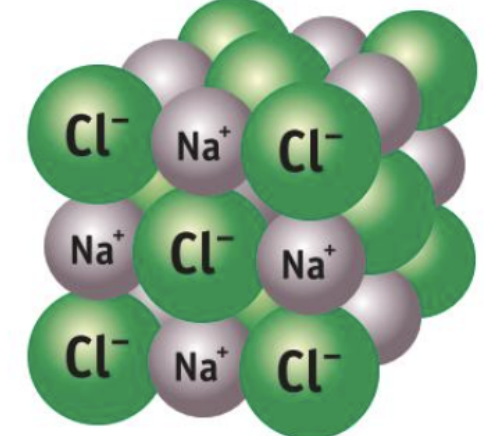
The image above shows the crystal structure of sodium chloride (NaCl). In this arrangement, each sodium ion is surrounded by six chloride ions, and each chloride ion is surrounded by six sodium ions. This regular pattern is called a crystal lattice.
Note
Crystal Structure Key Terms:
- Unit cell: The smallest repeating unit that contains all the information needed to build the entire crystal
- Crystal lattice: The overall three-dimensional arrangement of ions
- The structure extends in all directions, containing millions of ions
- Salt crystals are built from these repeating units stacked together
Writing chemical formulas for ionic compounds
A chemical formula represents a compound using symbols to show which elements are present and in what proportions. Writing correct formulas for ionic compounds follows specific rules based on maintaining electrical neutrality.
Basic principles for formula writing
The key principle is that the total positive charges must equal the total negative charges in the compound. This ensures the compound is electrically neutral overall.
When writing formulas:
- Write the metal (positive ion) first
- Write the non-metal (negative ion) second
- Use subscripts to show how many of each ion are needed
- Don't write subscripts of 1
Example
Worked Example: Writing Ionic Formulas
Magnesium fluoride: Magnesium forms Mg²⁺ ions, fluorine forms F⁻ ions. To balance charges, we need two fluoride ions for every magnesium ion, giving us MgF₂.
Potassium bromide: Potassium forms K⁺ ions, bromine forms Br⁻ ions. Since both have charges of the same magnitude, we need equal numbers, giving us KBr.
Aluminium oxide: Aluminium forms Al³⁺ ions, oxygen forms O²⁻ ions. To balance the charges, we need two aluminium ions (total +6) and three oxide ions (total -6), giving us Al₂O₃.
Working with polyatomic ions
Many ionic compounds contain polyatomic ions - groups of atoms that carry an overall charge and behave as single units in chemical reactions. These ions are sometimes called group ions.
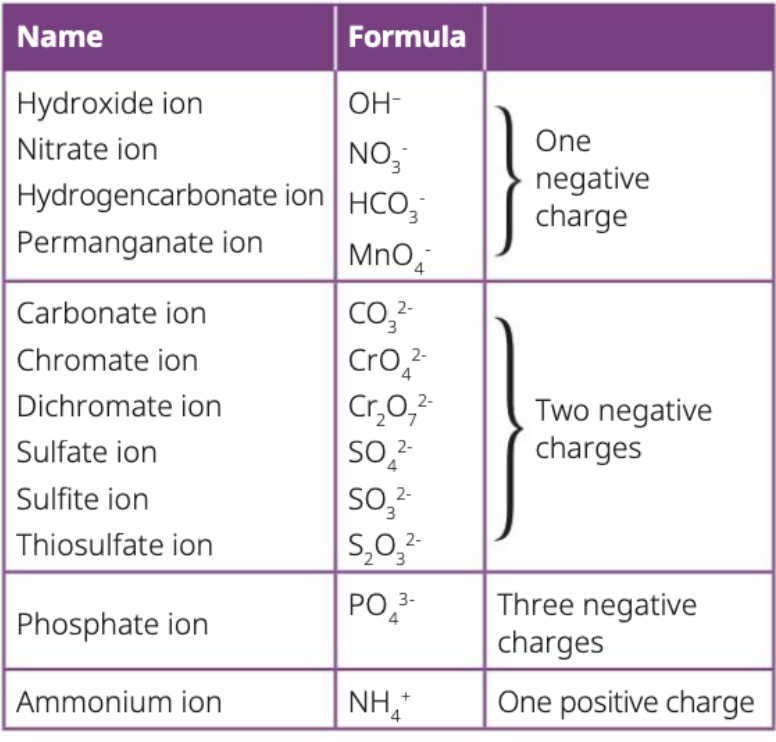
The table above shows common polyatomic ions you'll encounter. Notice that most polyatomic ions carry negative charges, with ammonium (NH₄⁺) being the main exception.
Note
Rules for Polyatomic Ion Formulas:
- Treat the entire polyatomic ion as a single unit when balancing charges
- Use brackets around the polyatomic ion if you need more than one of them
- The charge applies to the entire group, not individual atoms within it
Example
Worked Example: Formulas with Polyatomic Ions
Potassium hydroxide: K⁺ and OH⁻ combine in a 1:1 ratio to give KOH.
Sodium sulphate: Na⁺ and SO₄²⁻ require two sodium ions for each sulphate ion, giving Na₂SO₄.
Calcium hydrogencarbonate: Ca²⁺ and HCO₃⁻ require two hydrogencarbonate ions for each calcium ion, giving Ca(HCO₃)₂.
Note the brackets around HCO₃ in the last example - these are essential when you need more than one polyatomic ion.
Transition metals and variable valency
Transition metals present special challenges when writing formulas because they can form ions with different charges. Unlike main group elements, which form predictable ions, transition metals show variable valency.
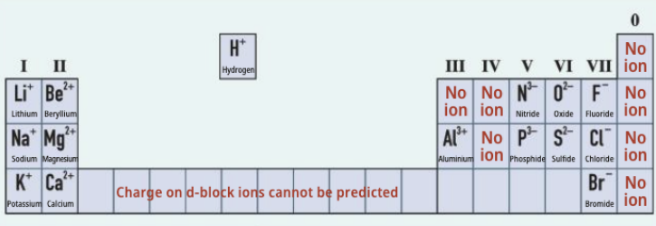
This periodic table section shows how main group elements (Groups I, II, III) form predictable ions, while d-block elements cannot be predicted in the same way.
Understanding variable valency
Variable valency means that the same metal can form different ions with different charges. For example:
- Iron can form Fe²⁺ or Fe³⁺ ions
- Copper can form Cu⁺ or Cu²⁺ ions
- Chromium can form Cr²⁺ or Cr³⁺ ions
Important
Critical Difference: Transition vs Main Group Elements
When transition metals are involved, you must be told the charge on the metal ion, or you must work it out from other information in the compound. The metal's charge is often indicated using Roman numerals in the compound's name.
This is completely different from main group elements, which have predictable charges!
Example
Worked Example: Transition Metal Formulas
- Iron(II) chloride contains Fe²⁺ ions, so the formula is FeCl₂
- Iron(III) chloride contains Fe³⁺ ions, so the formula is FeCl₃
- Copper(I) oxide contains Cu⁺ ions, so the formula is Cu₂O
- Copper(II) oxide contains Cu²⁺ ions, so the formula is CuO
Practical tips for formula writing
Writing chemical formulas becomes much easier when you follow a systematic approach and avoid common pitfalls.
Example
Step-by-Step Formula Writing Method
- Identify the ions: Determine what positive and negative ions are present
- Find the charges: Look up or work out the charge on each ion
- Balance the charges: Use the lowest whole number ratio that gives electrical neutrality
- Write the formula: Put the positive ion first, then the negative ion, with appropriate subscripts
Important
Common Mistakes to Avoid
- Don't change the charges on ions to make them balance
- Remember to use brackets around polyatomic ions when needed
- Don't write subscripts of 1
- Always check that your formula is electrically neutral
Note
Memory Aids for Success
For common polyatomic ions, try creating word associations or use the mnemonic "Nick the Camel ate a Clam for Supper in Phoenix" to remember nitrate, carbonate, chlorate, sulphate, and phosphate.
For transition metals, remember that they're "variable" unlike the predictable main group elements.
Summary
Key Points to Remember:
-
Lewis diagrams use dots and crosses to show electron transfer in ionic bonding, helping visualise how ions form
-
Crystal structures show how ions arrange in regular, repeating patterns called crystal lattices, with millions of ions packed together
-
Chemical formulas must be electrically neutral - total positive charges must equal total negative charges
-
Polyatomic ions are groups of atoms with an overall charge that behave as single units in compounds
-
Transition metals show variable valency and can form different ions with different charges, unlike predictable main group elements