13 – Standardising a Sodium Thiosulfate Solution (LC 2027) (Leaving Cert Chemistry): Revision Notes
📚Revision Notes
13 – Standardising a Sodium Thiosulfate Solution
Introduction and aim
Standardisation is the process of finding the exact concentration of a solution by titrating it against another solution of known concentration. In this experiment, you will prepare an approximate 0.1 M solution of sodium thiosulfate and then find its precise concentration by titrating it against a solution of iodine.
Note
Standardisation is crucial in analytical chemistry because solutions prepared by dissolving solids often don't have precisely the expected concentration due to factors like water content in crystals, impurities, or measurement errors. By standardising against a known standard, we can determine the true concentration for accurate quantitative analysis.
The aim is to determine the exact concentration of sodium thiosulfate solution through iodine-thiosulfate titration, which is a classic redox titration used in analytical chemistry.
Chemical reactions involved
This experiment involves two key chemical reactions that work together:
Step 1: Generating iodine from potassium permanganate
When acidified potassium permanganate (KMnO₄) reacts with excess potassium iodide (KI), iodine is produced:
Step 2: Titrating iodine with sodium thiosulfate
The iodine produced is then titrated with sodium thiosulfate solution:
The half-equation for the permanganate reduction is:
Important
Understanding both reactions is essential — the first reaction generates a known amount of iodine from the standard KMnO₄ solution, while the second reaction allows us to determine the thiosulfate concentration by measuring how much is needed to react with that iodine.
Equipment and materials
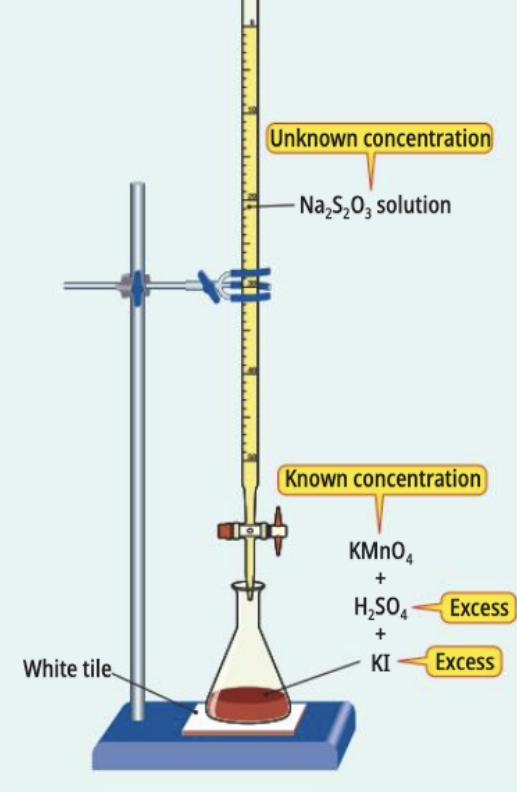
The experimental setup includes:
- Burette containing the sodium thiosulfate solution of unknown concentration
- Conical flask for the reaction mixture
- White tile placed under the flask to observe colour changes clearly
- Pipette for accurate measurement of solutions
- Measuring cylinder for approximate measurements
Note
The white tile is essential for clearly observing the subtle colour changes, especially near the end point when the solution becomes very pale yellow. This seemingly simple piece of equipment significantly improves the accuracy of end point detection.
Chemicals needed:
- Sodium thiosulfate (Na₂S₂O₃) solution
- Potassium permanganate (KMnO₄) solution
- Dilute sulphuric acid (H₂SO₄)
- Potassium iodide (KI) solution
- Starch solution (indicator)
- Distilled water
Procedure
Preparation stage
- Weigh some sodium thiosulfate crystals using a digital balance and transfer them to a beaker containing distilled water
- Stir the mixture until the crystals fully dissolve, then transfer the solution to a clean volumetric flask
- Make up to the mark with distilled water and mix thoroughly
- Wash the burette with some sodium thiosulfate solution, then fill it with the thiosulfate solution
Setting up the titration
- Pipette a standardised KMnO₄ solution into a clean, dry beaker and wash with distilled water
- Add the required amount of KMnO₄ solution to the conical flask using a pipette filler
- Add dilute sulphuric acid to the conical flask to make the solution acidic
- Add excess potassium iodide solution to the conical flask
Important
Always add the sulphuric acid before the potassium iodide to ensure the solution is properly acidified. The permanganate reaction requires acidic conditions to proceed correctly.
Observations and colour changes
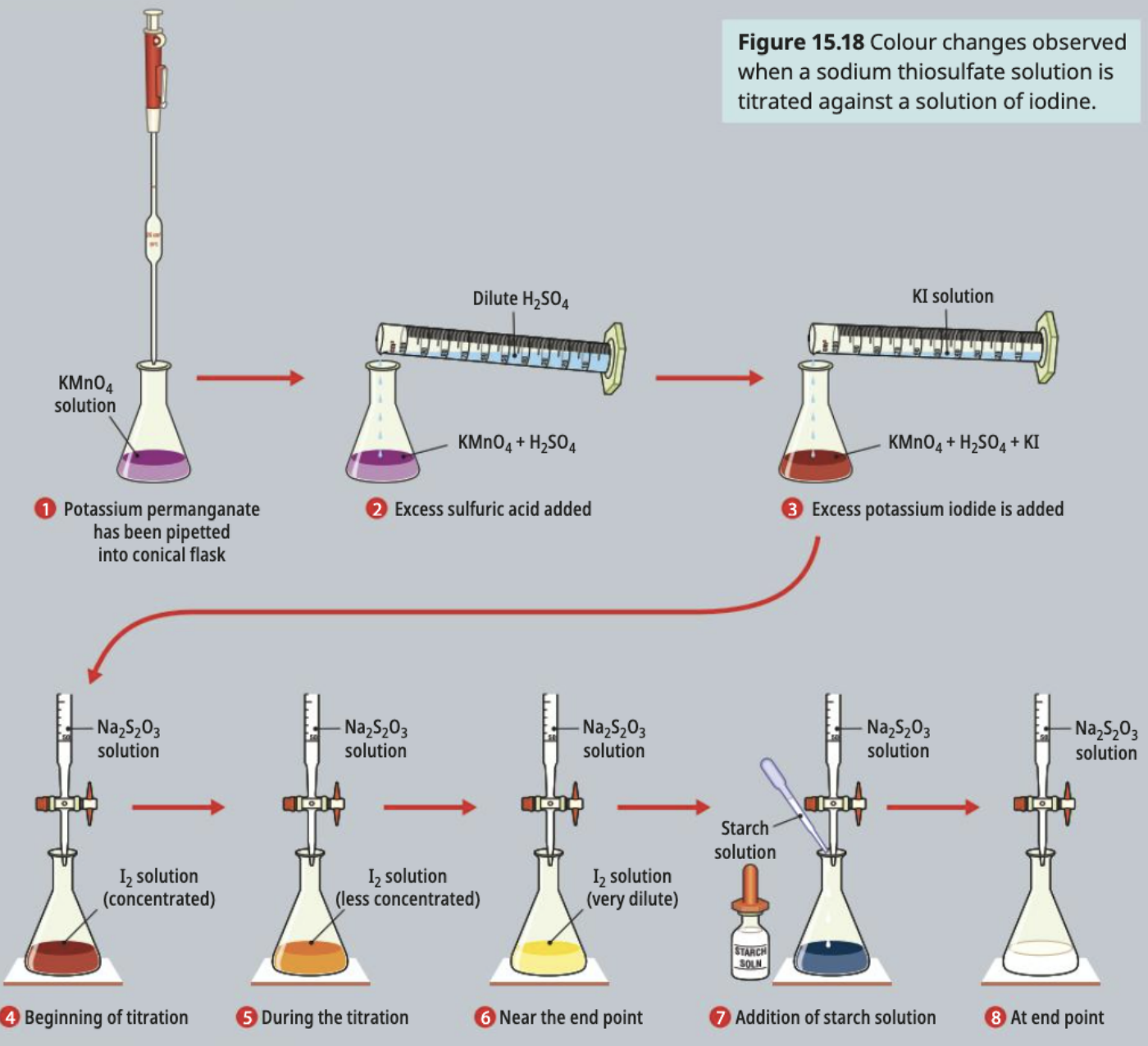
This titration involves a fascinating sequence of colour changes that help you identify the end point:
Initial observations
- Purple colour: The solution initially appears purple due to the KMnO₄ present
- Reddish-brown formation: When KI is added in excess, the solution turns reddish-brown due to iodine formation according to the equation:
During titration
- Beginning of titration: The solution appears dark brown/red due to high iodine concentration
- Progress: As sodium thiosulfate is added, the dark brown colour becomes less intense and gradually changes to a yellow colour
- Near end point: When the solution becomes very pale yellow (very dilute iodine), this indicates you are close to the end point
Example
Colour Change Sequence During Titration
Step 1: Purple (KMnO₄) → Reddish-brown (I₂ formed)
Step 2: Dark brown → Lighter brown (I₂ being consumed)
Step 3: Yellow → Pale yellow (very little I₂ remains)
Step 4: Add starch → Blue-black (starch-I₂ complex)
Step 5: Blue-black → Colourless (end point reached)
End point determination
- Add starch indicator: A few drops of starch solution are added when the solution becomes pale yellow
- Blue-black colour: The solution immediately turns blue-black due to the starch-iodine complex
- End point reached: Continue adding thiosulfate drop by drop until the blue-black colour completely disappears, leaving a colourless solution
Understanding the chemistry
Why does the colour change occur?
The reddish-brown colour appears because iodine (I₂) has been formed when the potassium permanganate oxidises the iodide ions. The potassium iodide is added in excess to ensure complete reduction of the permanganate ions.
Role of starch indicator
Starch forms a distinctive blue-black complex with iodine, making it easier to spot the exact end point. However, starch should only be added near the end point (when the solution is pale yellow) because:
Note
Why Timing Matters for Starch Addition
- Adding starch too early makes the colour change difficult to observe due to the intense dark colour
- The starch-iodine complex is more stable at lower iodine concentrations
- Adding starch when the solution is pale yellow ensures a sharp, clear end point
Why use excess reagents?
- Excess sulphuric acid ensures the solution remains acidic, which is essential for the permanganate reaction
- Excess potassium iodide ensures all permanganate ions are completely reduced, producing the maximum amount of iodine
Important
Using excess reagents is crucial for ensuring complete reactions. Insufficient acid would prevent the permanganate from reacting completely, while insufficient iodide would mean not all the permanganate gets reduced, leading to inaccurate results.
End point determination
The end point is reached when the blue-black colour completely disappears, indicating that all the iodine has reacted with the thiosulfate ions. At this point:
- There is no more iodine left in solution
- The starch-iodine complex breaks down
- The solution becomes colourless
Titration technique: The titration should be continued drop by drop near the end point to ensure accuracy. Two or three accurate titration readings should agree within 0.1 cm³.
Important
Recognising the True End Point
The end point is NOT when the blue-black colour becomes very faint — it must completely disappear. A persistent pale blue tinge means there is still iodine present. Keep adding thiosulfate drop by drop until the solution is completely clear and colourless.
Calculations
Once you have your titration results, you can calculate the exact concentration of the sodium thiosulfate solution using the stoicheiometry of the reactions involved. The method involves:
- Recording accurate titration volumes
- Using the molar ratios from the balanced equations
- Calculating the concentration based on the volume relationships
Note
The calculation process uses the fact that you know the exact amount of KMnO₄ used, which determines the amount of I₂ produced, which in turn tells you how much Na₂S₂O₃ was needed. By working backwards through the stoicheiometry, you can determine the precise concentration of your thiosulfate solution.
The calculation method is detailed in examples throughout your textbook and should be practised thoroughly.
Remember!
Summary
Key Points to Remember:
- Standardisation determines the exact concentration of a solution through titration against a known standard
- Two reactions occur: permanganate + iodide → iodine, then iodine + thiosulfate → products
- Colour sequence follows: purple → reddish-brown → yellow → blue-black → colourless
- Starch indicator is added only when the solution becomes pale yellow, not at the beginning
- End point is when the blue-black colour completely disappears, leaving a clear, colourless solution
- Excess reagents (H₂SO₄ and KI) ensure complete reactions and accurate results
- Drop-by-drop addition near the end point is essential for accuracy