15 – Investigating the Effect of Surface Area on Reaction Rates (LC 2027) (Leaving Cert Chemistry): Revision Notes
📚Revision Notes
15 – Investigating the Effect of Surface Area on Reaction Rates
Introduction
This experiment investigates how particle size affects the rate of chemical reactions. We examine the reaction between calcium carbonate (marble chips) and hydrochloric acid to understand how surface area influences reaction speed. This practical demonstration helps explain the collision theory and factors affecting reaction rates.
Note
This experiment is fundamental to understanding how physical factors can dramatically alter chemical reaction speeds, which has important applications in industrial processes and everyday chemical reactions.
The chemical reaction
The reaction studied involves marble chips (calcium carbonate) reacting with dilute hydrochloric acid:
- Calcium carbonate + Hydrochloric acid → Calcium chloride + Water + Carbon dioxide
The carbon dioxide gas escapes from the solution, causing a measurable loss in mass that allows us to track the reaction's progress.
Equipment and materials needed
- Marble chips of different sizes (large, medium, and small)
- Dilute hydrochloric acid (approximately 50 cm³)
- Electronic balance (accurate to 0.01g)
- Conical flasks
- Cotton wool plugs
- Graduated cylinder
- Stopwatch
- Measuring cylinder
Note
Ensure all equipment is clean and dry before starting. The electronic balance must be calibrated and placed on a stable, vibration-free surface for accurate readings.
Experimental procedure
Setting up the experiment
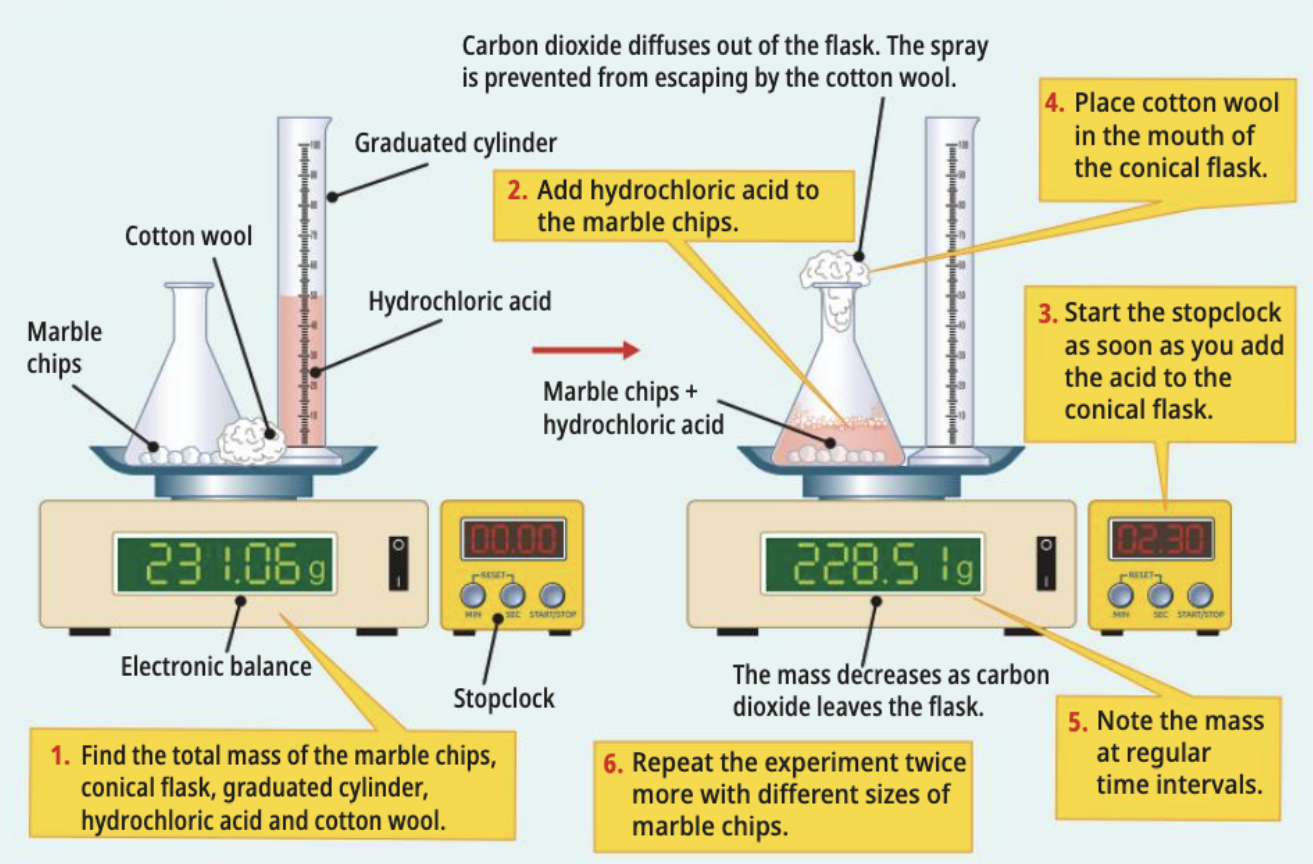
- Initial preparation: Place a conical flask containing about 20g of large marble chips on an electronic balance alongside a graduated cylinder with dilute hydrochloric acid.
- Cotton wool placement: Insert a cotton wool plug into the mouth of the conical flask. This prevents acid spray from escaping whilst allowing carbon dioxide gas to pass through.
- Mass recording: Record the total initial mass of the apparatus from the electronic balance.
Important
The cotton wool plug is essential for safety and accuracy. It prevents dangerous acid spray while allowing CO₂ to escape, ensuring accurate mass loss measurements. Never conduct this experiment without proper ventilation.
Conducting the reaction
- Adding the acid: Remove the cotton wool plug briefly and quickly add the hydrochloric acid to the marble chips using a swirling motion. Immediately replace the cotton wool plug.
- Timing: Start the stopwatch as soon as you add the acid to the conical flask.
- Data collection: Record the mass at regular 30-second intervals for approximately 10 minutes, noting the gradual decrease as carbon dioxide escapes.

Repeating with different particle sizes
The experiment must be repeated using medium and small marble chips, keeping all other conditions identical:
- Same mass of marble chips (20g)
- Same volume and concentration of hydrochloric acid
- Same temperature conditions
- Same timing intervals for measurements
Important
Control Variables are Critical: Only the marble chip size should change between experiments. Any variation in mass, acid concentration, temperature, or timing will invalidate your results and conclusions.
Results and observations
Mass loss calculations
The loss in mass is calculated by subtracting each recorded mass from the initial mass before the reaction began. This mass loss directly corresponds to the amount of carbon dioxide gas that has escaped from the flask.
Example
Worked Example: Calculating Mass Loss
Initial mass of apparatus: 245.67g Mass after 2 minutes: 243.42g
Mass loss = Initial mass - Current mass Mass loss = 245.67g - 243.42g = 2.25g
This 2.25g represents the mass of CO₂ gas that has escaped.
Key findings
The experimental results reveal that:
- Small marble chips react most rapidly
- Medium marble chips show intermediate reaction rates
- Large marble chips react most slowly
- All reactions eventually reach the same final mass loss

Graph analysis and interpretation
Understanding the curves
The graph plotting mass loss against time shows three distinct curves:
- Steepest curve: Small marble chips (fastest initial rate)
- Moderate curve: Medium marble chips (intermediate rate)
- Gentlest curve: Large marble chips (slowest rate)
Why surface area matters
The greater the surface area, the faster the rate of reaction. When marble chips are smaller:
- More calcium carbonate surface is exposed to the acid
- More collision opportunities exist between reactant particles
- The reaction proceeds more quickly initially
- The same total amount of product is eventually formed
Important
Common Misconception: Students often think smaller particles produce more gas. Remember: smaller particles react faster, but all sizes produce the same total amount of CO₂ because the same mass of CaCO₃ is used.
Reaction completion
All three reactions reach the same final mass loss because:
- The same mass of calcium carbonate is used in each experiment
- The same amount of carbon dioxide is ultimately produced
- Only the rate of reaction differs, not the total yield
Key scientific principles
Important
Collision Theory Explanation
This experiment demonstrates collision theory principles:
- Chemical reactions occur when reactant particles collide with sufficient energy
- Increasing surface area provides more collision opportunities
- More frequent successful collisions lead to faster reaction rates
Surface area and particle size relationship
- Smaller particles = larger total surface area = faster reaction
- Larger particles = smaller total surface area = slower reaction
The total volume of marble chips remains constant, but breaking them into smaller pieces dramatically increases the available reaction surface.
Exam tips
Note
Essential Points for Exams
- Always explain that the cotton wool prevents acid spray escaping whilst allowing gas to pass through
- Remember that the same total mass loss occurs regardless of particle size
- Be able to sketch and interpret rate curves for different surface areas
- Link observations to collision theory in your explanations
Summary
Key Points to Remember:
- Smaller particles react faster due to increased surface area available for collisions
- Cotton wool plugs prevent spray loss while allowing carbon dioxide to escape
- Mass loss occurs because carbon dioxide gas leaves the reaction mixture
- All reactions reach the same endpoint - only the rate differs, not the total yield
- Surface area is a key factor controlling reaction rates alongside temperature, concentration, and catalysts