16 – Studying the Effect of Concentration on Reaction Rate (LC 2027) (Leaving Cert Chemistry): Revision Notes
📚Revision Notes
16 – Studying the Effect of Concentration on Reaction Rate
Introduction
This experiment investigates how the concentration of reactants affects the rate of a chemical reaction. We use the reaction between sodium thiosulfate solution and hydrochloric acid as our model system because it produces a visible change that can be easily timed.
Important
The key principle being tested is that reaction rate increases as concentration increases. This happens because more concentrated solutions contain more particles in the same volume, leading to more frequent collisions between reactant molecules.
The chemical reaction
When sodium thiosulfate reacts with hydrochloric acid, a precipitate of sulphur is formed:
The sulphur precipitate doesn't dissolve in water, so it remains suspended in the solution, creating a cloudy yellow mixture. This cloudiness is what we use to measure the reaction rate.
Note
The sulphur precipitate forms gradually, making the solution increasingly cloudy until the cross underneath becomes completely invisible. This provides a clear, measurable endpoint for timing the reaction.
Experimental method
The cross disappearing technique
This experiment uses a clever method to measure reaction rate:
- Setup: Place a conical flask on a sheet of white paper with a cross drawn on it
- Add reactants: Pour a fixed volume of sodium thiosulfate solution into the flask, then quickly add a measured amount of dilute hydrochloric acid
- Start timing: Begin the stopwatch immediately after adding the acid and swirl the flask
- Observe: Watch the cross through the solution from above
- Stop timing: Stop the stopwatch when the cross can no longer be seen through the cloudy mixture
Ensuring a fair test
Important
To make this a fair test, we must control variables carefully:
- Keep constant: Volume and concentration of hydrochloric acid, temperature, volume of thiosulfate solution
- Change only: Concentration of sodium thiosulfate solution
- Use the same observer to judge when the cross disappears (this reduces human error)
Data collection and analysis
Setting up the data table
The experiment is repeated with different concentrations of sodium thiosulfate solution. A typical data table would look like this:

Calculating reaction rate
Example
Worked Example: Calculating Reaction Rate
Once you have the time measurements, you can calculate the reaction rate using:
For example:
- If the reaction takes 20 seconds: Rate = 1/20 = 0.05 sec⁻¹
- If the reaction takes 10 seconds: Rate = 1/10 = 0.10 sec⁻¹
The faster the reaction, the shorter the time, and therefore the higher the rate value.
Interpreting the results
Graph 1: Time vs concentration
When you plot time (y-axis) against concentration of sodium thiosulfate (x-axis), you get a curved line showing an inverse relationship.
Note
This graph shows that:
- As concentration increases, the time decreases
- The relationship is not linear but follows a curve
- Higher concentrations react much faster than lower ones
Graph 2: Rate vs concentration
When you plot reaction rate (y-axis) against concentration (x-axis), you get a straight line through the origin.
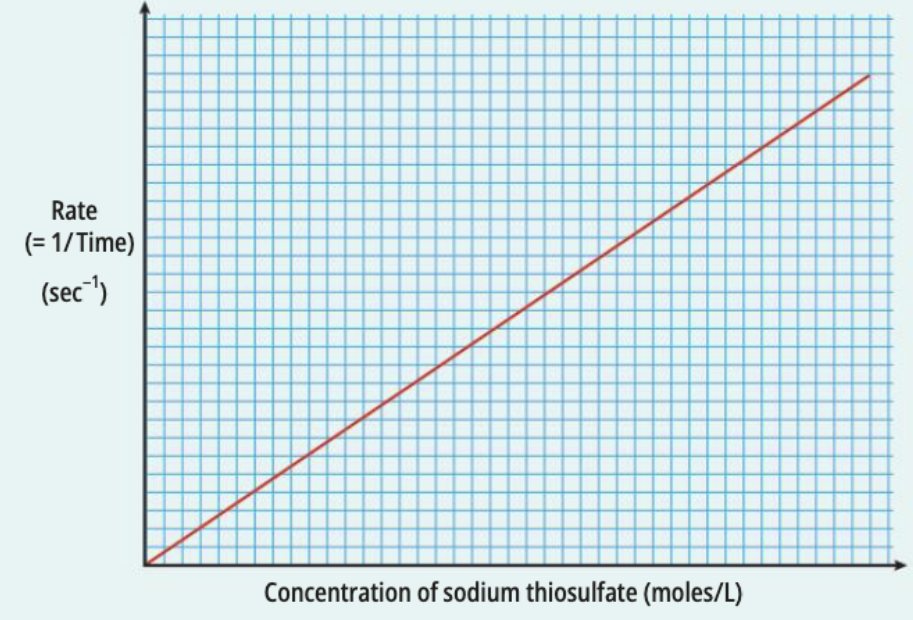
This straight line relationship tells us that:
- Rate is directly proportional to concentration
- If you double the concentration, you double the rate
- This supports collision theory - more particles mean more collisions
Why does concentration affect reaction rate?
The explanation lies in collision theory:
Note
Understanding Collision Theory:
- Chemical reactions occur when particles collide with sufficient energy
- In more concentrated solutions, there are more reactant particles in the same volume
- More particles means more collisions per second
- More collisions leads to a faster reaction rate
Exam tips
Summary
Key Points for Exams:
- Remember the equation:
- Know why we use this reaction: The sulphur precipitate provides a clear visual endpoint
- Understand fair testing: Only change one variable at a time
- Graph interpretation: Straight line through origin = direct proportionality
- Units matter: Rate is measured in sec⁻¹ (per second)
Remember!
Summary
Key Points to Remember:
- Higher concentration = faster reaction rate due to more particle collisions per second
- The cross disappearing method provides an easy way to measure reaction rate by timing when a cross becomes invisible through the cloudy precipitate
- Rate = 1/time - the shorter the time, the faster the rate
- Direct proportionality between concentration and rate is shown by a straight line graph through the origin
- Fair testing requires keeping all variables constant except the one being investigated (concentration of sodium thiosulfate)