18 – Investigating Effects on the State of Equilibrium (LC 2027) (Leaving Cert Chemistry): Revision Notes
📚Revision Notes
18 – Investigating Effects on the State of Equilibrium
Introduction
This experiment explores how changes in concentration and temperature can affect the position of chemical equilibrium. We'll investigate these effects using the reaction between iron(III) chloride and potassium thiocyanate, which produces a distinctive colour change that makes it easy to observe equilibrium shifts.
The chemical system we're studying involves the following equilibrium:
(yellow) (colourless) (red)
In this reaction, we use iron(III) chloride (FeCl₃) as our source of Fe³⁺ ions and potassium thiocyanate (KCNS) as our source of CNS⁻ ions. When these combine, they form a complex ion called Fe(CNS)²⁺, which gives the solution its characteristic red colour.
The equilibrium system
The equilibrium can be written more completely as:
(yellow) (colourless) (red)
This colour change from yellow to red makes it perfect for observing how Le Chatelier's Principle works in practice. When the equilibrium lies to the left (favouring reactants), the solution appears yellow. When it shifts to the right (favouring products), the solution turns red.
Important
Le Chatelier's Principle: When a system at equilibrium is disturbed by a change in concentration, temperature, or pressure, the equilibrium will shift in the direction that opposes the change to restore equilibrium.
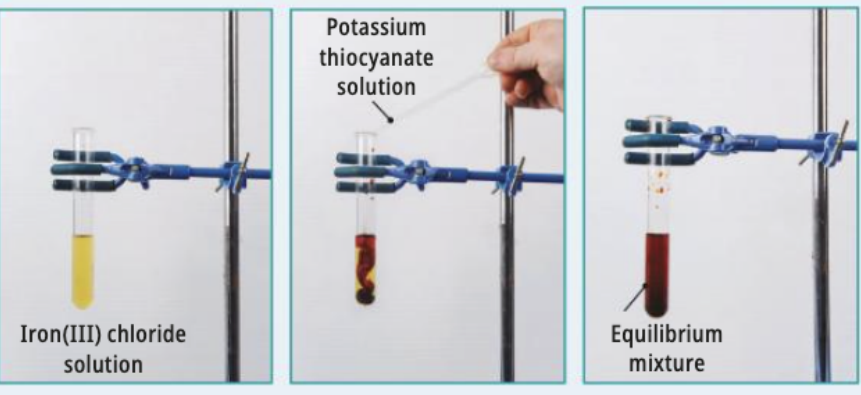
Part (a): Investigating the effect of concentration
Procedure
The first part of this experiment examines how adding different substances affects the equilibrium position:
Example
Experimental Procedure: Concentration Effects
- Initial setup: Mix about 5 cm³ of iron(III) chloride solution with one drop of potassium thiocyanate solution in a test tube
- Observe: A red colour forms, indicating the equilibrium mixture
- Test 1: Add dilute hydrochloric acid until the red colour disappears
- Test 2: Add more potassium thiocyanate solution to the mixture
Observations and explanations
Note
When hydrochloric acid is added:
- Observation: The red colour gradually disappears, and the solution returns to yellow
- Explanation: The hydrochloric acid provides additional Cl⁻ ions. According to Le Chatelier's Principle, the equilibrium shifts to the left to counteract this increase in Cl⁻ concentration. This means more Fe(CNS)²⁺ breaks down into Fe³⁺ and CNS⁻, causing the solution to become yellow again.
Note
When potassium thiocyanate is added:
- Observation: The red colour becomes more intense
- Explanation: Adding more CNS⁻ ions increases the concentration of this reactant. Le Chatelier's Principle tells us the equilibrium will shift right to use up the excess CNS⁻, producing more red Fe(CNS)²⁺ complex and intensifying the colour.
Key principle
These observations demonstrate Le Chatelier's Principle perfectly: when you disturb an equilibrium by changing concentrations, the system responds by shifting in the direction that opposes the change.
Part (b): Investigating the effect of temperature
Understanding the reaction type
Before examining temperature effects, it's important to know that this equilibrium reaction is exothermic in the forwards direction:
This means heat is released when the red complex forms, and heat is absorbed when it breaks down.
Procedure
Example
Experimental Procedure: Temperature Effects
- Setup: Prepare the equilibrium mixture (about 10 cm³ iron(III) chloride + drops of potassium thiocyanate)
- Divide: Split the red solution between three test tubes
- Temperature treatments:
- One tube in hot water bath
- One tube in ice bath
- One tube at room temperature (control)
Observations and explanations
Note
Hot water treatment:
- Observation: The red colour fades and the solution becomes more yellow
- Explanation: Adding heat disturbs the equilibrium. Since the forwards reaction is exothermic (releases heat), Le Chatelier's Principle says the equilibrium will shift left (towards reactants) to absorb the added heat. This breaks down the red Fe(CNS)²⁺ complex, making the solution more yellow.
Note
Ice water treatment:
- Observation: The red colour becomes more intense
- Explanation: Cooling the system removes heat. The equilibrium shifts right (towards products) to replace the lost heat by favouring the exothermic forwards reaction. This produces more red Fe(CNS)²⁺ complex, intensifying the colour.
Temperature-equilibrium relationship
This experiment beautifully demonstrates how temperature affects equilibrium position:
Important
- Higher temperature: Favours the endothermic direction (absorbs heat)
- Lower temperature: Favours the exothermic direction (releases heat)
The system always responds to oppose the temperature change you impose on it.
Practical applications
Understanding equilibrium shifts has many real-world applications:
- Industrial processes: Optimising reaction conditions for maximum yield
- Environmental chemistry: Understanding how temperature changes affect natural chemical cycles
- Biological systems: Many enzyme reactions involve equilibrium shifts
Exam tips
- Colour memory: Remember yellow = reactants, red = products
- Le Chatelier's rule: The equilibrium always shifts to oppose the change
- Temperature effects: Know whether the reaction is exothermic or endothermic
- Practice explaining: Be able to explain observations using Le Chatelier's Principle
Summary
Key Points to Remember:
- Le Chatelier's Principle states that when a system at equilibrium is disturbed, it responds by shifting to oppose the change
- Increasing concentration of reactants shifts equilibrium right; increasing products shifts it left
- Higher temperatures favour endothermic reactions; lower temperatures favour exothermic reactions
- The iron(III)/thiocyanate system shows clear colour changes: yellow (reactants) to red (products)
- This experiment demonstrates both concentration and temperature effects on equilibrium position in a visually obvious way