22 – Investigating with Inert Electrodes (LC 2027) (Leaving Cert Chemistry): Revision Notes
📚Revision Notes
22 – Investigating with Inert Electrodes
What is electrolysis with inert electrodes?
Electrolysis involves passing an electric current through a solution or molten compound to cause chemical decomposition. Inert electrodes are electrodes that don't react during the process - they simply provide a surface for reactions to occur. Common inert electrodes include platinum, carbon, and graphite.
Note
The key characteristic of inert electrodes is their chemical stability - they remain unchanged throughout the electrolysis process. This allows us to study the behaviour of the electrolyte solution without interference from electrode reactions.
When we use inert electrodes, the products formed depend entirely on the ions present in the solution, not on the electrode material itself. This makes them perfect for investigating what happens during electrolysis of different compounds.
Experiment 1: Electrolysis of acidified water
Apparatus and method
The electrolysis of water requires adding a small amount of dilute sulfuric acid to help the water conduct electricity. The experiment uses either a voltameter (a specialised apparatus for studying electrical conduction) or simple inverted test tubes to collect the gases produced.
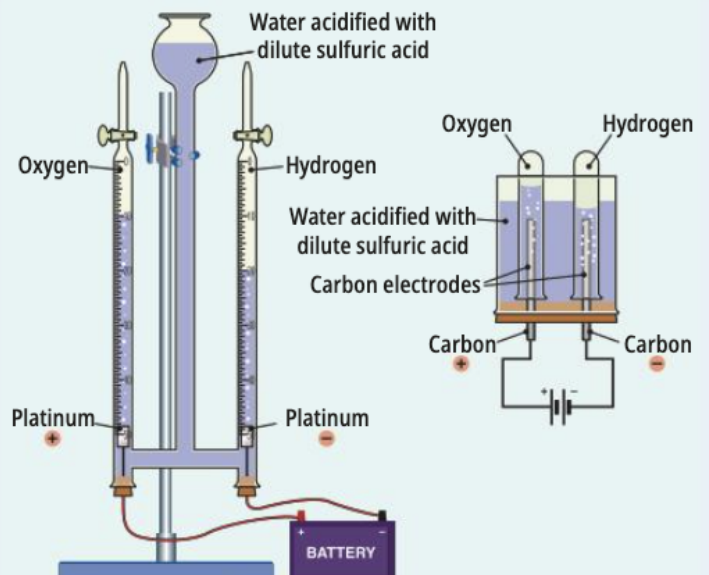
Key equipment:
- Water acidified with dilute sulfuric acid
- Platinum or carbon electrodes (inert)
- Gas collection tubes
- Battery or DC power supply
Observations and gas tests
When the electric current flows through the acidified water, you'll notice:
- Gas bubbles form at both electrodes
- The volume of gas at the negative electrode is twice that at the positive electrode
- Gas tests reveal:
- Gas at positive electrode relights a glowing splint → this is oxygen
- Gas at negative electrode ignites with a 'pop' → this is hydrogen
Important
The 2:1 volume ratio of hydrogen to oxygen matches perfectly with the chemical formula H₂O! This provides direct evidence for the composition of water molecules.
Electrode reactions
Example
Worked Example: Water Electrolysis Reactions
At the negative electrode (cathode - reduction):
- H⁺ ions from the sulfuric acid are attracted to the negative electrode
- Each H⁺ ion gains an electron to become a hydrogen atom
- Two hydrogen atoms combine to form a hydrogen molecule
Chemical equation:
At the positive electrode (anode - oxidation):
- Water molecules lose electrons
- This breaks them down into hydrogen ions and oxygen gas
Chemical equation:
Experiment 2: Electrolysis of copper(II) chloride solution
Apparatus and method
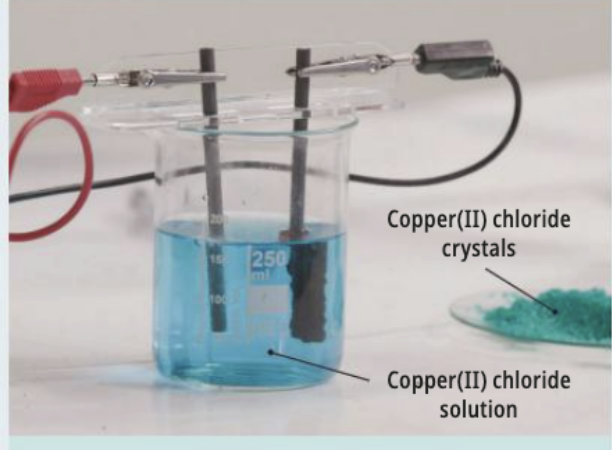
This experiment uses a simple beaker containing copper(II) chloride solution with two carbon electrodes connected to a DC power supply.
Observations
When you switch on the power supply, you'll observe:
- A brown solid forms at the electrode connected to the negative terminal - this is copper metal
- Bubbles of gas are produced at the positive electrode
- Testing this gas with moist blue litmus paper causes the paper to bleach - this indicates chlorine gas
Note
The bleaching of litmus paper is a definitive test for chlorine gas. Unlike other gas tests that produce sounds or flames, chlorine's oxidising properties cause the permanent colour change in the indicator.
Electrode reactions
Example
Worked Example: Copper(II) Chloride Electrolysis
At the negative electrode (cathode - reduction):
- Copper ions gain electrons to form copper metal
At the positive electrode (anode - oxidation):
- Chloride ions lose electrons to form chlorine gas
Overall reaction:
Experiment 3: Electrolysis of potassium iodide solution
Apparatus and method
This experiment is particularly interesting because it uses phenolphthalein indicator to help identify one of the products. The potassium iodide solution is colourless initially.
Observations and indicators
During electrolysis, you'll notice:
- A brown colour develops at the positive electrode - this is iodine forming
- The solution turns pink at the negative electrode - phenolphthalein indicates alkaline conditions (OH⁻ ions present)
- Gas bubbles form at the negative electrode
- Testing shows this gas ignites with a 'pop' - confirming it's hydrogen
Note
Phenolphthalein is colourless in neutral and acidic solutions but turns bright pink in alkaline conditions. This colour change directly indicates the formation of hydroxide ions (OH⁻) at the cathode.
Electrode reactions
Example
Worked Example: Potassium Iodide Electrolysis
At the positive electrode (anode - oxidation):
- Iodide ions lose electrons to form iodine atoms
- Two iodine atoms combine to form an iodine molecule
At the negative electrode (cathode - reduction):
- Water molecules gain electrons and break down
- This produces hydrogen gas and hydroxide ions
Overall reaction:
Understanding electrode terminology
It's crucial to remember the CROA acronym for electrode processes:
- Cathode - Reduction (electrons gained)
- Oxidation - Anode (electrons lost)
Important
Critical Distinction: In electrolytic cells (like our experiments), the cathode is the negative electrode and the anode is the positive electrode. This is opposite to galvanic cells (batteries), where the cathode is positive and the anode is negative.
Many students confuse these relationships, so always remember: the type of cell determines which electrode is positive or negative!
Remember!
Summary
Key Points to Remember:
-
Inert electrodes don't participate in reactions - they only provide surfaces for reactions to occur
-
Gas test results: Hydrogen pops, oxygen relights glowing splints, chlorine bleaches litmus paper
-
CROA helps you remember: Cathode = Reduction (gain electrons), Anode = Oxidation (lose electrons)
-
Water electrolysis produces hydrogen and oxygen in a 2:1 ratio, matching the H₂O formula
-
Phenolphthalein indicator turns pink when OH⁻ ions are present, showing alkaline conditions