24 – Preparing an Ester (LC 2027) (Leaving Cert Chemistry): Revision Notes
📚Revision Notes
24 – Preparing an Ester
Introduction to ester preparation
Esters are important organic compounds that often have pleasant, fruity smells and are used in perfumes, flavourings, and solvents. In this experiment, you'll learn how to prepare an ester called methyl propanoate using a laboratory technique called reflux. This process demonstrates the fundamental reaction between carboxylic acids and alcohols to form esters.
The esterification reaction
Esterification is a condensation reaction where a carboxylic acid reacts with an alcohol to produce an ester and water. This type of reaction requires heat and an acid catalyst to proceed efficiently.
The general equation for esterification is: Carboxylic acid + Alcohol → Ester + Water
For this specific experiment, propanoic acid reacts with methanol to form methyl propanoate:

The reaction shown above demonstrates how the -OH group from the carboxylic acid combines with the H from the alcohol's -OH group to form water, whilst the remaining parts join to create the ester linkage.
Key features of the reaction
Note
The esterification reaction has several important characteristics that you need to understand:
- It's a reversible reaction - the ester can break down back into the acid and alcohol
- Concentrated sulfuric acid acts as a catalyst, speeding up the reaction without being consumed
- The reaction is equilibrium-based, meaning both forwards and backwards reactions occur simultaneously
- Heat is required to provide the energy needed for the reaction to proceed at a reasonable rate
Equipment setup - reflux apparatus
The experiment uses a reflux apparatus to maintain constant heating whilst preventing the loss of volatile reactants through evaporation.
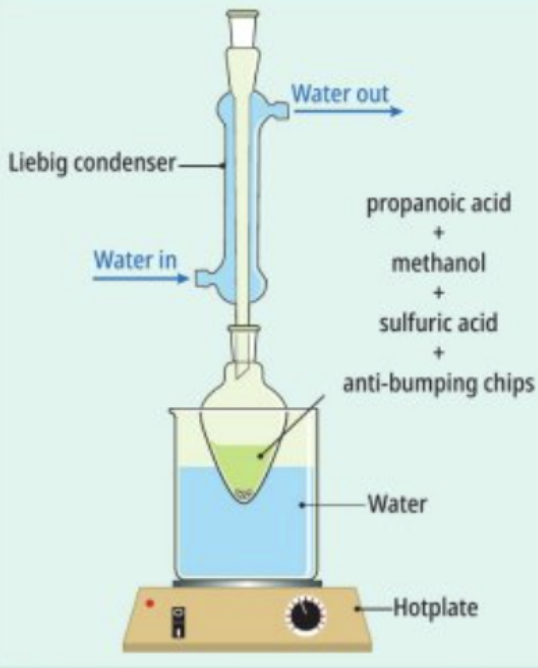
The reflux setup includes several essential components:
- Round-bottom flask containing the reaction mixture
- Liebig condenser with water flowing in and out to cool vapours
- Water bath on hotplate for controlled, gentle heating
- Anti-bumping chips to prevent violent boiling and ensure smooth heating
Note
The water bath is used instead of a Bunsen burner because both methanol and propanoic acid are volatile and flammable liquids. The water bath provides better temperature control and reduces fire risk.
Step-by-step procedure
Initial reaction setup
The procedure begins by combining the reactants in the round-bottom flask:
- Propanoic acid (carboxylic acid)
- Methanol (alcohol)
- Concentrated sulfuric acid (catalyst)
- Anti-bumping chips for safe heating
The mixture is heated under reflux for approximately 30 minutes. During this time, the vapours that form are continuously condensed and returned to the flask, ensuring no reactants are lost whilst maintaining the reaction temperature.
Separation using a separating funnel
After heating, the reaction mixture contains the desired ester along with unreacted starting materials and water. The mixture is transferred to a separating funnel for separation.
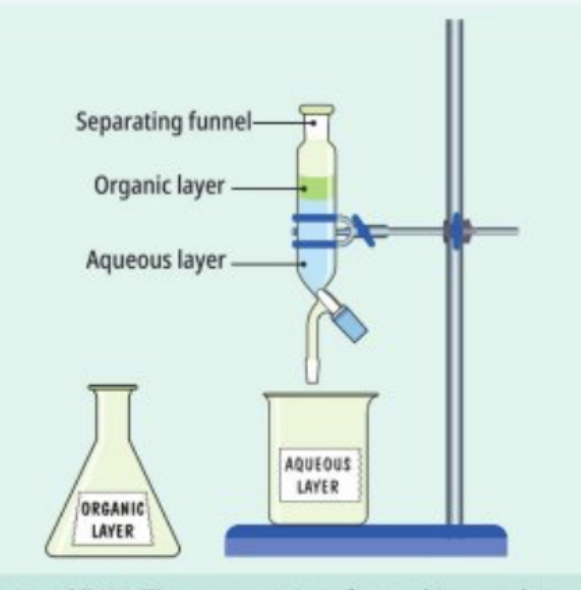
In the separating funnel, two distinct layers form:
- Organic layer (top): Contains methyl propanoate and other organic compounds
- Aqueous layer (bottom): Contains water, sulfuric acid, and water-soluble impurities
Note
The layers separate because organic compounds and water are immiscible (don't mix) and have different densities. The denser aqueous layer settles at the bottom.
Neutralisation and washing
The organic layer still contains traces of sulfuric acid, which must be removed. This is achieved by washing with sodium carbonate solution:
Example
Neutralisation Process:
Step 1: Add sodium carbonate solution to the organic layer Step 2: The sodium carbonate reacts with any remaining sulfuric acid Step 3: Observe effervescence as carbon dioxide gas is produced Step 4: The acidic impurities are successfully removed from the organic layer
Drying the organic layer
After neutralisation, the organic layer may still contain small amounts of water. Anhydrous calcium chloride is added as a drying agent:
- Calcium chloride absorbs water molecules from the organic layer
- The mixture is shaken and left to stand until the liquid becomes clear
- The dried ester is then separated from the solid calcium chloride
Final purification by distillation
For maximum purity, the ester can be purified using distillation:
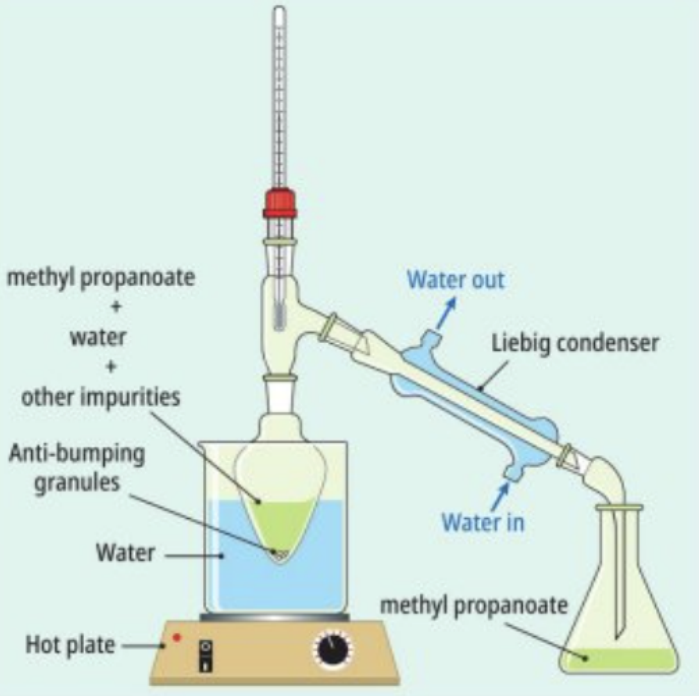
During distillation:
- The mixture is heated and methyl propanoate vaporises at its boiling point (79.8°C)
- The vapour travels through the distillation column and condenser
- Pure methyl propanoate is collected in the receiving flask
- Impurities with different boiling points remain behind or are collected separately
Key observations and explanations
Throughout the experiment, several important observations can be made:
Example
Observable Changes During the Experiment:
During reflux: The mixture may show signs of reaction such as colour changes or the formation of two distinct layers as the ester forms.
During separation: Clear separation of organic and aqueous layers demonstrates the immiscible nature of organic compounds and water.
During neutralisation: Effervescence (bubbling) occurs when sodium carbonate reacts with residual acid, producing carbon dioxide gas.
During drying: The cloudy appearance of the organic layer clears as the drying agent removes water.
Safety considerations
Important
This experiment involves several critical safety considerations:
- Use of water bath: Prevents fire risk associated with volatile, flammable reactants
- Proper ventilation: Ensures harmful vapours don't accumulate
- Careful handling of acids: Concentrated sulfuric acid is corrosive and requires careful handling
- Temperature monitoring: Prevents overheating and maintains optimal reaction conditions
Applications and importance
Note
Ester preparation is important in many industries:
- Food industry: Esters provide flavours and aromas
- Cosmetics: Used in perfumes and fragrances
- Pharmaceuticals: Many medicines contain ester functional groups
- Industrial solvents: Esters are used as environmentally friendly solvents
Summary
Key Points to Remember:
- Esterification is the reaction between a carboxylic acid and alcohol to form an ester plus water
- Reflux apparatus prevents loss of volatile reactants during heating and maintains reaction temperature
- Separating funnels exploit density differences to separate immiscible liquids into distinct layers
- Multiple purification steps (separation, neutralisation, drying, distillation) are needed to obtain pure ester
- Safety precautions including water bath heating and proper ventilation are essential when working with volatile, flammable organic compounds