27 – Synthesising & Investigating Benzoic Acid (LC 2027) (Leaving Cert Chemistry): Revision Notes
📚Revision Notes
27 – Synthesising & Investigating Benzoic Acid
Introduction
Benzoic acid is an important organic compound with the molecular formula . It appears as white crystalline solid and is commonly found in our everyday lives as its sodium salt, sodium benzoate (E211), which serves as a food preservative to prevent bacterial, yeast, and fungal growth.
Note
Benzoic acid and its derivatives are among the most widely used preservatives in the food industry due to their effectiveness against microorganisms and their safety profile when used in appropriate concentrations.
This experiment involves three main stages: synthesising benzoic acid through oxidation, purifying it by recrystallisation, and testing its purity by measuring its melting point.
Part 1: Synthesis of benzoic acid by oxidation
Theory and chemical reactions
The synthesis involves oxidising phenylmethanol (benzyl alcohol) using potassium permanganate under alkaline conditions. This is a redox reaction where the alcohol is oxidised to a carboxylic acid.
Important
Main Oxidation Reaction
The balanced chemical equation is:
During this reaction, several important changes occur:
- The purple colour of permanganate changes to brown as manganese dioxide precipitate forms
- Sodium benzoate forms as an intermediate because the reaction occurs under alkaline conditions
- The final conversion to benzoic acid requires acidification with hydrochloric acid
The conversion equation is:
Laboratory procedure
The synthesis follows these key steps:
- Mixing reagents: Combine phenylmethanol, potassium permanganate solution, and sodium carbonate in a conical flask
- Heating: Heat the mixture using boiling water for approximately one hour
- Cooling: Cool the solution under running cold water
- Acidification: Add concentrated hydrochloric acid in a fume cupboard to convert sodium benzoate to benzoic acid
- Addition of sodium sulfite: Remove excess permanganate ions
- Filtration: Philtre the benzoic acid crystals using a Buchner funnel
Observations and explanations
Note
Key Observable Changes During Synthesis
- Colour change: The solution changes from purple to brown due to the formation of manganese dioxide ()
- Precipitate formation: A brown precipitate of manganese dioxide appears, which is insoluble in water
- Crystal formation: White crystals of benzoic acid become visible after acidification and cooling
The potassium permanganate acts as the oxidising agent, while the sodium carbonate maintains alkaline conditions necessary for the reaction to proceed efficiently.
Important
Safety Considerations
- Wear gloves when handling concentrated potassium permanganate and hydrochloric acid
- Use a fume cupboard during acidification to avoid inhaling acid vapours
- Handle hot solutions with care to prevent burns
Part 2: Purification by recrystallisation
Theory of recrystallisation
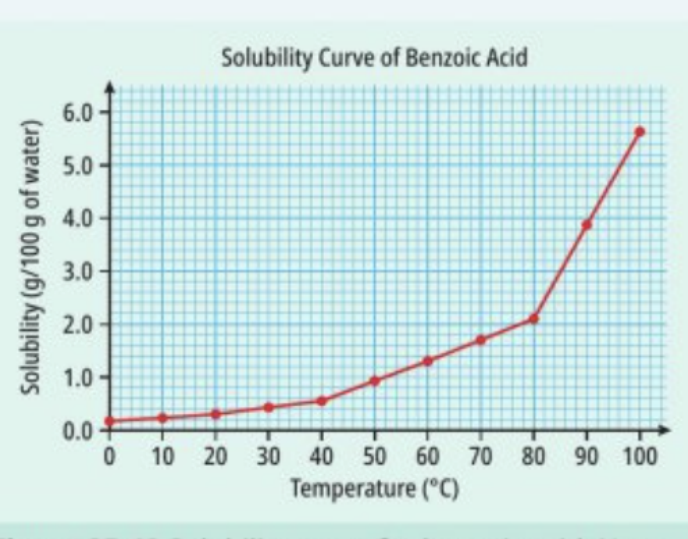
Recrystallisation is a purification technique that takes advantage of different solubilities at different temperatures. Most solids are more soluble in hot solvents than in cold solvents. Benzoic acid is very soluble in hot water but only slightly soluble in cold water.
Note
The solubility curve shows how benzoic acid's solubility increases dramatically with temperature, reaching about 5.7 g per 100g of water at 100°C.
Recrystallisation procedure
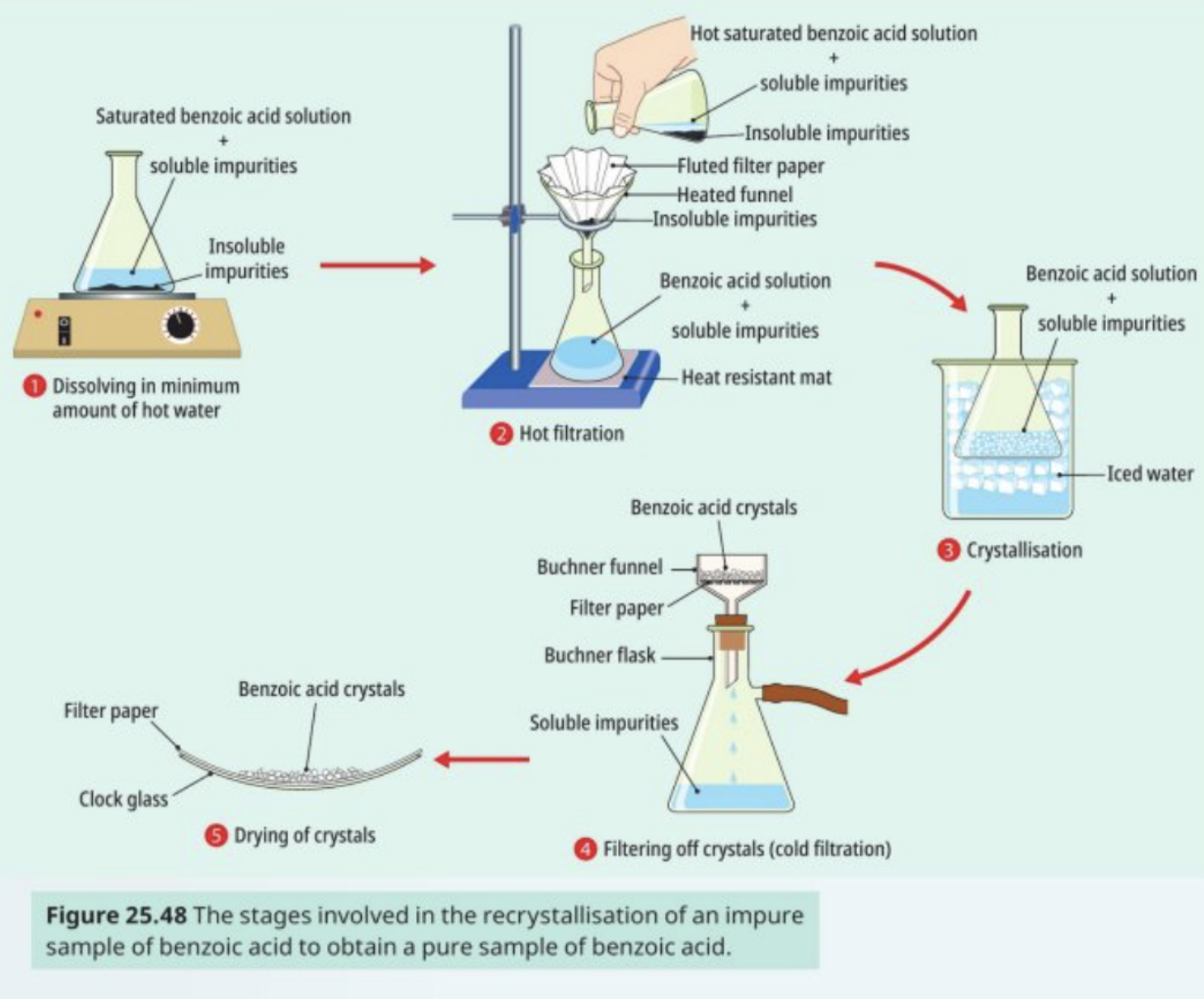
The purification process involves five stages:
- Dissolving: Dissolve the impure benzoic acid in the minimum amount of hot water
- Hot filtration: Philtre the hot solution using a heated funnel and fluted philtre paper to remove insoluble impurities
- Crystallisation: Cool the solution in an ice bath to allow pure benzoic acid crystals to form
- Cold filtration: Philtre the crystals using a Buchner funnel to separate them from soluble impurities
- Drying: Dry the purified crystals under a watch glass
Key principles
Note
Understanding Recrystallisation Principles
- Minimum solvent: Using the minimum amount of hot water ensures maximum crystal yield upon cooling
- Hot filtration: Removes insoluble impurities while keeping the product dissolved
- Cold filtration: Separates pure crystals from soluble impurities that remain dissolved in cold water
- Vacuum filtration: Speeds up the filtration process and helps dry the crystals
Part 3: Measuring melting point
Purpose and theory
The melting point is a key indicator of purity. Pure benzoic acid has a sharp melting point of 121-122°C. Impure samples typically:
- Melt over a wider temperature range
- Have lower melting points
- Show gradual softening rather than sharp melting
Procedure for melting point determination
- Sample preparation: Ensure crystals are completely dry and finely ground
- Capillary tube filling: Seal one end of a melting point tube and fill with sample to about 1 cm depth
- Apparatus setup: Place the tube in an aluminium heating block connected to a digital thermometer
- Heating: Heat slowly and observe when crystals begin to melt
- Recording: Note both the temperature when melting starts and when it's complete
Interpreting results
Example
Worked Example: Interpreting Melting Point Data
- Pure benzoic acid: Sharp melting point at 121-122°C
- Impure benzoic acid: Lower melting point and wider range (e.g., 116-119°C)
- Very impure samples: May show gradual softening over an even wider range
What this tells us: A sharp, high melting point indicates high purity, while a broad, lower melting point suggests the presence of impurities.
Quality control and calculations
Percentage yield calculation
The efficiency of the synthesis can be calculated using:
Example
Worked Example: Calculating Percentage Yield
Formula:
Example calculation: If 2.5g of impure benzoic acid yields 2.25g of pure crystals:
Factors affecting yield
Note
Factors That Influence Crystal Yield
- Temperature control: Proper cooling maximises crystallisation
- Solvent amount: Using minimum hot water increases yield
- Filtration technique: Efficient filtration prevents product loss
- Drying method: Complete drying ensures accurate mass measurements
Summary
Key Points to Remember:
-
Benzoic acid synthesis uses oxidation of phenylmethanol with potassium permanganate under alkaline conditions, producing sodium benzoate intermediate that must be acidified to form the final product
-
Recrystallisation purifies the crude product by dissolving in minimum hot water, filtering hot to remove insoluble impurities, cooling to crystallise, then filtering cold to separate pure crystals
-
Melting point determination tests purity - pure benzoic acid melts sharply at 121-122°C, while impure samples melt over wider, lower temperature ranges
-
Safety is crucial - always use fume cupboards for acidification steps and wear appropriate protective equipment when handling strong oxidising agents and acids
-
The colour change from purple permanganate to brown manganese dioxide precipitate indicates the oxidation reaction is proceeding correctly