6 – Preparing Sodium Carbonate (LC 2027) (Leaving Cert Chemistry): Revision Notes
📚Revision Notes
6 – Preparing Sodium Carbonate
Introduction and purpose
This experiment involves creating a standard solution of sodium carbonate with a precisely known concentration. The process is fundamental to quantitative analysis and forms the basis for many analytical chemistry techniques, particularly acid-base titrations.
A standard solution is essential because it allows us to determine unknown concentrations of other substances through careful measurement and calculation. The accuracy of this preparation directly affects the reliability of any subsequent analysis.
Note
Why Standard Solutions Matter
Standard solutions are the foundation of quantitative analysis in chemistry. Without accurately prepared standards, we cannot determine unknown concentrations in samples, making them crucial for quality control, environmental monitoring, and research applications.
Understanding primary standards
Anhydrous sodium carbonate is classified as a primary standard. This means it possesses several important characteristics:
- High purity - The substance is essentially 100% pure with minimal impurities
- Stable composition - It doesn't change composition when exposed to air
- Known formula - We can calculate its exact molecular mass
- Non-hygroscopic - It doesn't absorb moisture from the atmosphere
These properties make sodium carbonate ideal for preparing solutions with precisely known concentrations, which is why we use it rather than other sodium compounds.
Important
Primary Standard Requirements
A substance can only be used as a primary standard if it meets ALL of these criteria. Missing even one property would compromise the accuracy of your final solution concentration.
Equipment and materials required
The following apparatus is essential for accurate solution preparation:
- Electronic balance (capable of weighing to 0.001g)
- Clock glass (for holding the solid during weighing)
- 250 cm³ volumetric flask (for final solution volume)
- Glass funnel and glass rod
- Plastic wash bottle containing deionised water
- Dropper for fine adjustment
- 250 cm³ beaker for initial dissolution
- Stirring rod for mixing
Using deionised water throughout is crucial because tap water contains dissolved ions that would affect the final concentration.
Note
Equipment Precision
The electronic balance must be capable of weighing to at least 0.001g accuracy. Using a less precise balance will introduce significant errors into your final concentration calculations.
Step-by-step experimental procedure
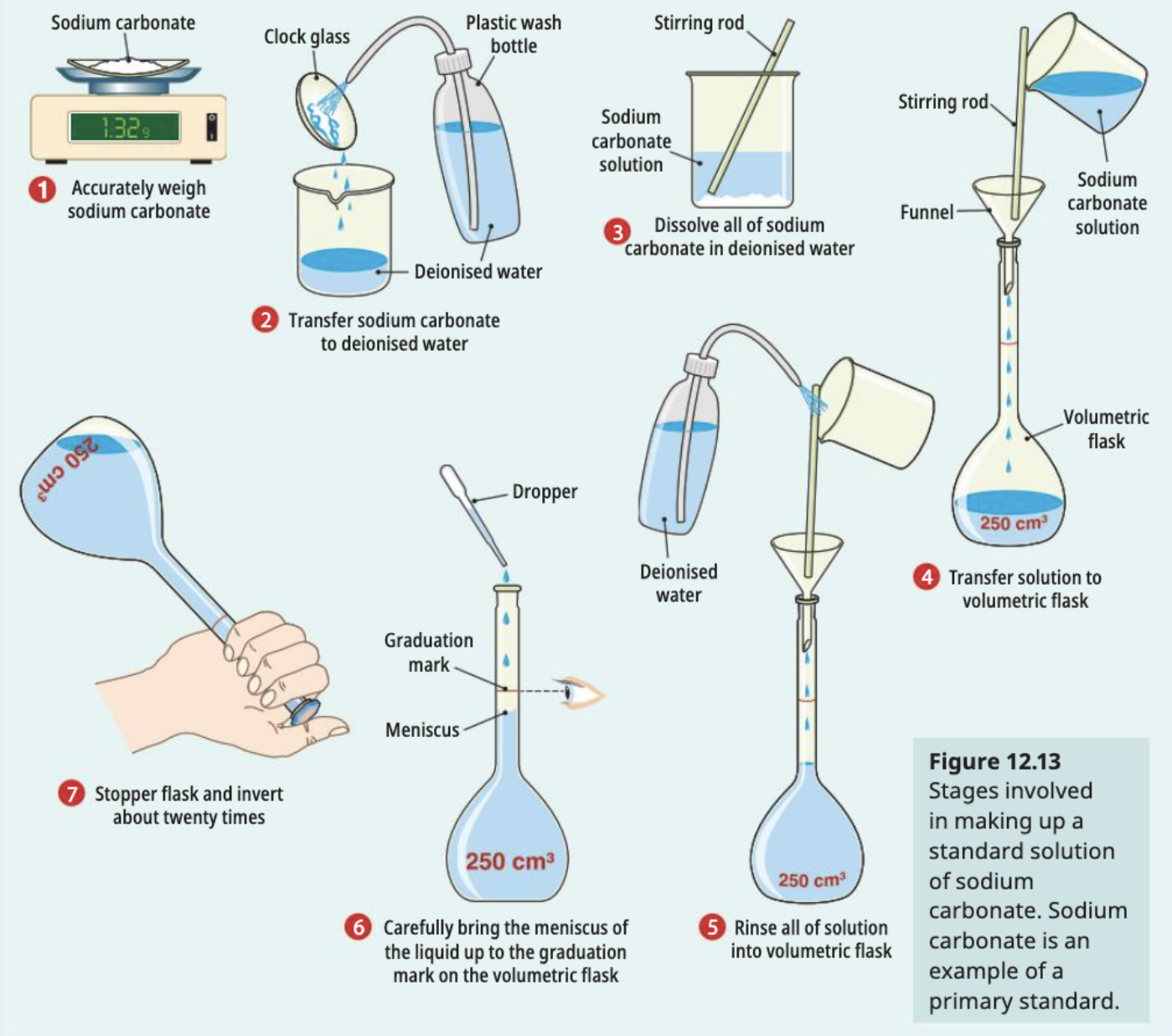
Weighing and initial dissolution
The process begins with precise measurement of the sodium carbonate:
- Accurate weighing - Use an electronic balance to weigh the required mass of anhydrous sodium carbonate on a clock glass. The mass needed depends on the desired final concentration.
- Initial dissolution - Transfer the weighed sodium carbonate to a beaker containing deionised water. The amount of water used here isn't critical as this is just for dissolution.
- Washing the clock glass - Use deionised water from a wash bottle to rinse any remaining traces of sodium carbonate from the clock glass into the beaker. This ensures no material is lost.
- Complete dissolution - Stir the mixture with a glass rod until all the solid has completely dissolved, creating a clear solution.
Transfer and washing procedures
Once dissolved, the solution must be transferred to the volumetric flask:
- Transfer using funnel - Pour the dissolved solution through a funnel into a clean 250 cm³ volumetric flask. The funnel prevents spillage and ensures all solution enters the flask.
- Washing apparatus - Rinse the beaker, stirring rod, and funnel with deionised water, allowing all washings to flow into the volumetric flask. This step is critical because it ensures that every trace of the sodium carbonate reaches the final solution.
Important
Quantitative Transfer is Critical
This washing step is often overlooked by students, but it's essential for accuracy. Even microscopic amounts of sodium carbonate left on the apparatus will result in a lower concentration than calculated.
Final dilution and mixing
The final steps create the precisely measured volume:
- Initial dilution - Add deionised water to the volumetric flask until the solution level is near, but below, the graduation mark.
- Final adjustment - Use a dropper to add water drop by drop until the bottom of the meniscus aligns exactly with the graduation mark when viewed at eye level.
- Thorough mixing - Replace the stopper and invert the flask approximately 20 times to ensure the solution is completely homogeneous.
Key laboratory techniques
Accurate measurement techniques
Several techniques are crucial for preparing an accurate standard solution:
- Quantitative transfer - Every particle of the weighed sodium carbonate must reach the final solution
- Multiple washing - Rinse all apparatus that contacted the sodium carbonate
- Proper mixing - Ensure uniform distribution throughout the solution
Meniscus reading
Reading the meniscus correctly is essential for accurate volume measurement:
- Eye-level viewing - Your eye must be level with the graduation mark
- Bottom of meniscus - Read from the lowest point of the curved liquid surface
- Good lighting - Ensure adequate illumination to see the meniscus clearly
Note
Meniscus Reading Technique
The meniscus forms due to surface tension between the liquid and glass. Water forms a concave meniscus, so always read from the bottom of the curve. Reading from the top or sides will give inaccurate volume measurements.
Volumetric flask handling
Proper use of volumetric flasks ensures accurate final volumes:
- Temperature consideration - Use at room temperature for calibrated volume
- Gentle mixing - Invert rather than shake to avoid breaking
- Single-use preparation - Don't attempt to adjust volume once mixed
Calculations and final solution
After completing the preparation, you can calculate the exact concentration of your standard solution using:
Where the number of moles equals the mass weighed divided by the molecular mass of sodium carbonate ().
Example
Worked Example: Calculating Concentration
If you weighed 2.65 g of anhydrous sodium carbonate and made it up to 250 cm³:
Step 1: Calculate moles of
Step 2: Convert volume to litres
Step 3: Calculate concentration
This standard solution now has a precisely known concentration and can be used in quantitative analysis experiments such as titrations with acids.
Summary
Key Points to Remember:
- Anhydrous sodium carbonate is a primary standard - it's pure, stable, and doesn't absorb water from air
- Quantitative transfer is essential - wash all apparatus to ensure no material is lost
- Read the meniscus at eye level - use the bottom of the curved surface for accurate volume measurement
- Mix thoroughly after dilution - invert the flask about 20 times for homogeneous distribution
- Deionised water must be used throughout - tap water contains ions that affect concentration