7 – Standardising a Hydrochloric Acid Solution (LC 2027) (Leaving Cert Chemistry): Revision Notes
📚Revision Notes
7 – Standardising a Hydrochloric Acid Solution
Introduction to standardisation
Standardising a solution means finding its exact concentration. In volumetric analysis, we need to know precise concentrations to get accurate results. Hydrochloric acid solutions lose concentration over time due to the escape of HCl gas, so we must standardise them regularly using a primary standard solution.
Note
A primary standard solution is one whose concentration is known very accurately. Sodium carbonate () is commonly used as a primary standard because it's stable, pure, and doesn't absorb moisture from the air.
The chemical reaction
When sodium carbonate reacts with hydrochloric acid, the following reaction occurs:
This shows that one mole of sodium carbonate reacts with exactly two moles of hydrochloric acid. This 1:2 ratio is crucial for our calculations.
Note
The ionic equation helps us understand what's happening:
The carbonate ion accepts two protons ( ions) from the acid, forming water and carbon dioxide gas.
Equipment needed
- Burette (25 cm³ or 50 cm³) - to deliver the HCl solution accurately
- Pipette (25 cm³) - to measure exactly 25 cm³ of solution
- Conical flask (250 cm³) - for the reaction to take place
- Methyl orange indicator - to detect the end point
- White tile - to see colour changes clearly
- Funnel - to fill the burette safely
- Wash bottle with deionised water
Detailed procedure
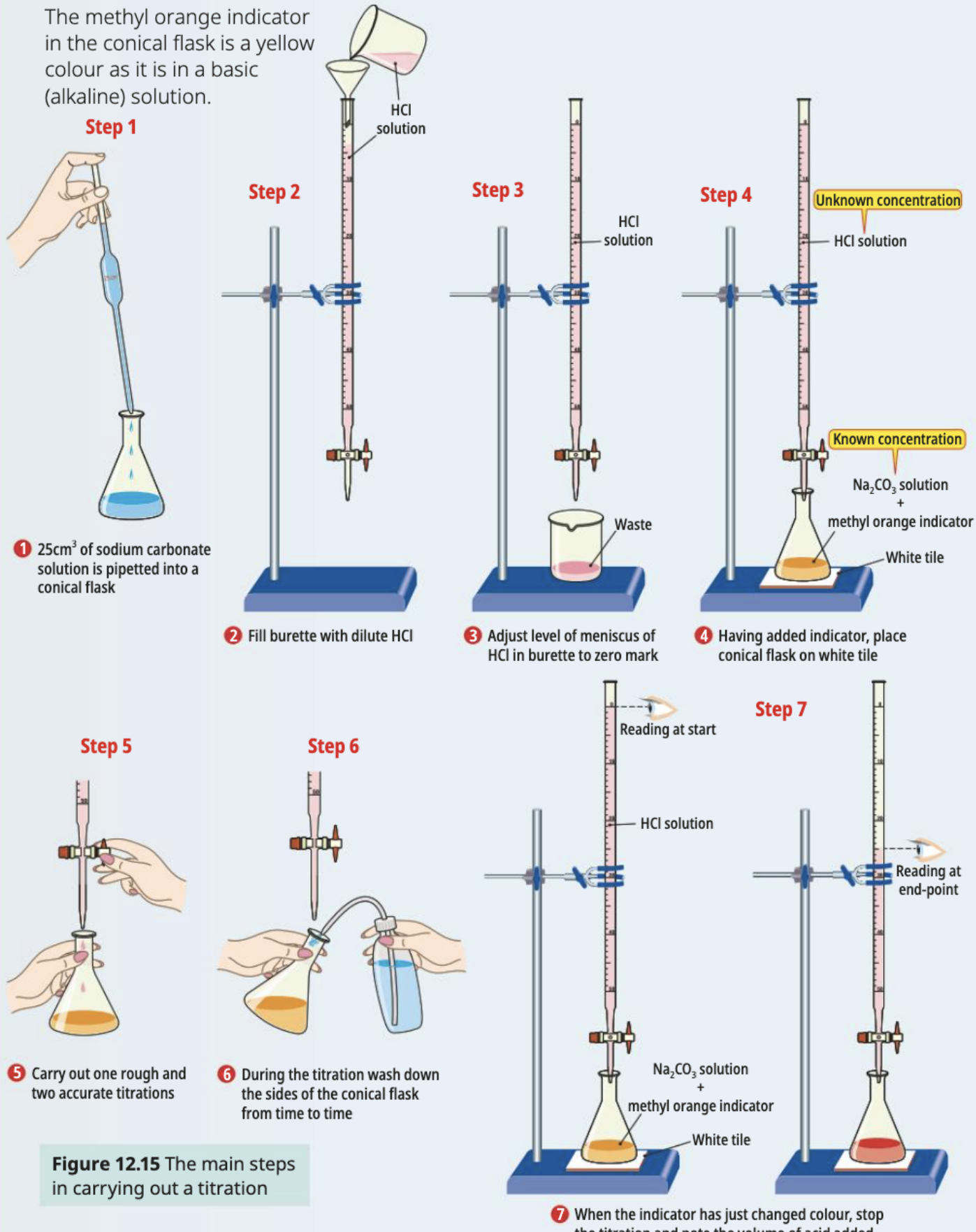
Preparation steps
- Clean all apparatus - Rinse the pipette, burette, and conical flask with deionised water
- Rinse the pipette with the sodium carbonate solution to avoid dilution
- Rinse the burette with the hydrochloric acid solution
Setting up the titration
- Fill the burette with dilute HCl solution using a funnel, then remove the funnel
- Adjust the meniscus to the zero mark (or note the starting reading)
- Check for air bubbles in the burette tip and remove them if present
- Pipette exactly 25 cm³ of sodium carbonate solution into the conical flask
- Add 2-3 drops of methyl orange indicator to the conical flask
- Place the flask on a white tile for better colour observation
Carrying out the titration
- Perform a rough titration first - Add HCl fairly quickly until the colour changes from yellow to red/pink
- Note the rough titre - This gives you an idea of the end point volume
- Refill the burette and reset to zero (or note the reading)
- Repeat with accurate titrations - Add HCl drop by drop near the expected end point
- Swirl the flask continuously throughout the titration
- Stop when the indicator just changes colour permanently from yellow to red/pink
Key observations
During the titration, you'll need to watch carefully for several key changes that indicate the reaction is proceeding and when it reaches completion.
Note
Important colour changes to watch for:
- Initial colour: The methyl orange indicator appears yellow in the alkaline sodium carbonate solution
- End point colour: The solution turns red/pink when acidic
- Colour change: The transition should be sharp and permanent
- Gas evolution: You may notice slight fizzing as is produced
Important technique points
Accuracy tips
Important
Critical techniques for accurate results:
- Wash down the sides of the conical flask with deionised water during titration - this doesn't affect the number of moles
- Add acid drop by drop near the end point for maximum accuracy
- Use the bottom of the meniscus for all burette readings
- Read at eye level to avoid parallax errors
End point detection
The end point occurs when one drop of HCl changes the solution from yellow to faint red/pink permanently. The solution should remain this colour when swirled.
Calculations
Getting your results
Accurate results require careful data collection and processing:
- Carry out at least three accurate titrations
- Your results should agree within 0.1 cm³ (these are called concordant results)
- Calculate the average titre from your concordant results only
- Discard any results that don't agree within 0.1 cm³
Example
Worked Example: Calculating Average Titre
If your concordant titres are 22.4 cm³, 22.3 cm³, and 22.5 cm³:
You would then use this average titre with the known concentration of sodium carbonate to calculate the exact concentration of the hydrochloric acid.
Why this method works
This standardisation technique is both reliable and accurate because it combines several advantageous chemical and practical factors.
Note
The science behind standardisation:
- Sodium carbonate is a primary standard - its concentration is known exactly
- The reaction is stoichiometric - exactly 2 moles of HCl react with 1 mole of
- The end point is sharp - methyl orange gives a clear colour change
- The reaction goes to completion - no equilibrium problems
Common mistakes to avoid
Important
Critical errors that will ruin your results:
- Don't rinse the conical flask with either solution - only use deionised water
- Don't add too much indicator - it can affect the end point
- Don't rush the titration near the end point - accuracy is crucial
- Don't forget to remove the funnel from the burette after filling
- Don't include rough titrations in your average calculation
Summary
Key Points to Remember:
- Standardising means finding the exact concentration of a solution using a primary standard
- Sodium carbonate reacts with HCl in a 1:2 ratio - one needs two HCl molecules
- Methyl orange changes from yellow (alkaline) to red/pink (acidic) at the end point
- Concordant results must agree within 0.1 cm³ for accuracy
- Always wash down the flask sides during titration to ensure complete reaction