9 – Determining the Concentration of an Ammonia Solution (LC 2027) (Leaving Cert Chemistry): Revision Notes
📚Revision Notes
9 – Determining the Concentration of an Ammonia Solution
Introduction
This experiment uses a technique called titration to find the exact concentration of an ammonia solution. Titration is a method where you add a solution of known concentration (called a standard solution) to a solution of unknown concentration until the reaction is complete.
In this case, we use hydrochloric acid (HCl) as our standard solution to determine the concentration of ammonia. Ammonia is commonly supplied to laboratories as a concentrated solution (around 16 M NH₃), but for this experiment, you'll work with a more dilute solution.
When ammonia dissolves in water, it forms ammonium hydroxide because NH₄⁺ ions and OH⁻ ions are present in the solution, making it basic.
Note
The formation of ammonium hydroxide is why ammonia solutions are basic - the OH⁻ ions increase the pH of the solution above 7.
The chemical reaction
The neutralisation reaction between hydrochloric acid and ammonia is:
HCl₍ₐq₎ + NH₃₍ₐq₎ → NH₄Cl₍ₐq₎
This is an acid-base reaction where the acid (HCl) neutralises the base (NH₃) to form a salt (NH₄Cl).
Note
This is a 1:1 stoichiometric reaction, meaning one mole of HCl reacts with exactly one mole of NH₃. This simple ratio makes the calculations straightforward.
Equipment and setup
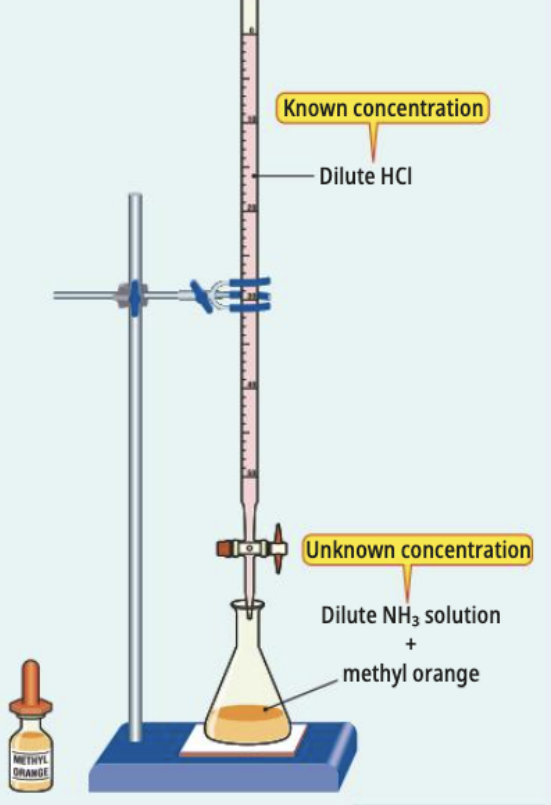
The titration setup includes:
- Burette: Contains the HCl solution (known concentration)
- Conical flask: Contains the ammonia solution (unknown concentration)
- Methyl orange indicator: Shows when the reaction reaches its endpoint
- White tile: Placed under the conical flask to make colour changes easier to see
Important
The choice of indicator is crucial - methyl orange is specifically chosen because it changes colour in the pH range where this neutralisation occurs.
Method
Key steps in the procedure
- Prepare the ammonia solution
- Rinse a pipette with deionised water, then with ammonia solution
- Use the pipette to transfer exactly 25 cm³ of ammonia solution into a clean conical flask
- Add a few drops of methyl orange indicator to the ammonia solution
- Set up the burette
- Rinse the burette with deionised water, then with the HCl solution
- Fill the burette with the standard HCl solution
- Adjust the meniscus to the zero graduation mark
- Perform the titration
- Place a white tile under the conical flask to help see colour changes
- Slowly add HCl from the burette to the ammonia solution whilst swirling the flask
- Continue until the indicator changes colour (this is the endpoint)
- Repeat the titration 2-3 times to get consistent results (within 0.1 cm³)
Important
Critical Points for Accuracy:
- Always rinse equipment with the solution you're about to use
- The endpoint is reached when the colour change is permanent after swirling
- Multiple titrations are essential - never rely on just one result
Observations
During the titration, you'll observe:
- Initial colour: Yellow (because the ammonia solution is basic and methyl orange is yellow in basic conditions)
- Endpoint colour: Red/pink (because the solution becomes acidic when excess HCl is added)
Note
The colour change should be sharp and definitive. If you see a gradual change over several drops, you may be adding the acid too quickly near the endpoint.
Explanation of observations
The methyl orange indicator changes from yellow to red/pink because:
- In basic conditions (excess ammonia), methyl orange appears yellow
- At the endpoint (when acid and base are neutralised), the solution becomes acidic due to slight excess of HCl
- In acidic conditions, methyl orange appears red/pink
This colour change tells us exactly when we've added enough acid to neutralise all the ammonia.
Important
The endpoint occurs when the solution is slightly acidic, not neutral. This is because we need a definitive colour change to see the endpoint clearly.
Calculations
To find the concentration of the ammonia solution:
- Record your titration results - note the volume of HCl used in each titration
- Calculate the average volume of HCl used (exclude any anomalous results)
- Use the equation: concentration × volume = moles
- Apply stoicheiometry - from the balanced equation, 1 mole HCl reacts with 1 mole NH₃
- Calculate the ammonia concentration in both mol/L and g/L
The calculation process uses the relationship between the known concentration and volume of HCl to determine the unknown concentration of ammonia.
Example
Worked Example: Calculating Ammonia Concentration
Given data:
- HCl concentration = 0.100 mol/L
- Average volume of HCl used = 24.5 cm³
- Volume of ammonia solution = 25.0 cm³
Step 1: Calculate moles of HCl used Moles HCl = concentration × volume (in L) Moles HCl = 0.100 × (24.5/1000) = 0.00245 mol
Step 2: Use stoicheiometry (1:1 ratio) Moles NH₃ = Moles HCl = 0.00245 mol
Step 3: Calculate concentration of NH₃ Concentration NH₃ = moles ÷ volume (in L) Concentration NH₃ = 0.00245 ÷ (25.0/1000) = 0.098 mol/L
Exam tips
Important
Essential Exam Tips:
- Always use a white tile under the conical flask - this makes the colour change much easier to spot
- Swirl the flask constantly during titration to ensure proper mixing
- Add the acid slowly near the endpoint - the colour change can happen very quickly
- Record all titration values - you need multiple readings to calculate a reliable average
- Remember that methyl orange is yellow in alkali and red in acid
Remember!
Summary
Key Points to Remember:
- Titration is used to find the concentration of an unknown solution using a standard solution
- The reaction is: HCl + NH₃ → NH₄Cl
- Methyl orange indicator changes from yellow (basic) to red/pink (acidic) at the endpoint
- The burette contains the acid (known concentration) and the conical flask contains the ammonia (unknown concentration)
- Multiple titrations are needed to ensure accurate and reliable results