States of Matter (Leaving Cert Chemistry): Revision Notes
📚Revision Notes
States of Matter
Particle Movement in Solids, Liquids, and Gases
The behaviour of particles in different states of matter is defined by their movement and energy:
- Solids: Particles vibrate in fixed positions and are tightly packed. This structure gives solids a definite shape and volume.
- Liquids: Particles slide past each other while staying close. Liquids have a definite volume but no fixed shape; they take the shape of their container.
- Gases: Particles move freely and are far apart. Gases have neither a fixed shape nor volume, filling any container they occupy. The energy of particles determines their movement. Gas molecules have the most energy, followed by liquid particles, while solid particles have the least.
Diffusion: Movement of Particles
Diffusion is the process where particles spread from an area of high concentration to low concentration until they are evenly distributed. It is an important concept to understand the random movement of particles.
Note
Example: Diffusion of Ammonia and Hydrochloric Acid Gases
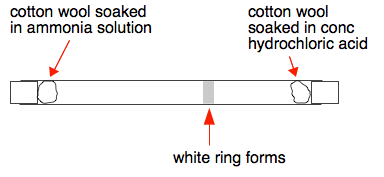
When ammonia () and hydrochloric acid () gases are placed at opposite ends of a sealed glass tube, they diffuse towards each other.
When they meet, a white ring of ammonium chloride () forms.
The reaction:
The ring forms closer to the HCl end because hydrogen chloride gas has a higher molecular mass, making it slower than ammonia gas.
Note
Other Examples of Diffusion
- Smoke in Air: The movement of smoke particles in the air demonstrates diffusion.
- Ink in Water: When blue ink is added to water, the ink spreads throughout the water, showing diffusion in liquids. Diffusion in liquids is slower than in gases because the particles are closer together.
The Kinetic Theory of Gases
The kinetic theory explains the behaviour of gas particles:
- Negligible Volume: Gas particles are so far apart that their actual volume is insignificant compared to the distance between them.
- No Significant Forces: There are no attractive or repulsive forces between gas particles under normal conditions.
- Constant Motion: Gas particles move in straight lines at high speeds, frequently colliding with each other and the walls of the container. These random collisions are called Brownian motion.
- Elastic Collisions: Collisions between gas particles do not result in a loss of energy. This means that energy is conserved in these collisions.
- Kinetic Energy and Temperature: The average kinetic energy of gas particles is directly proportional to the absolute temperature (measured in Kelvin). As the temperature increases, the kinetic energy and movement of particles increase.
Ideal Gas Assumptions
An ideal gas is a theoretical gas that perfectly follows all the rules of the kinetic theory under any conditions of temperature and pressure. Real gases, however, deviate from this behaviour under certain conditions.
Limitations of the Kinetic Theory
The kinetic theory has some limitations, especially under extreme conditions:
- High Pressure/Low Temperature: The assumption that gas particles have negligible volume is not accurate under high pressure or low temperature, where particles are forced closer together.
- Attractive Forces: At high pressures and low temperatures, the assumption that there are no forces between gas particles is also not valid. Van der Waals forces (weak forces between molecules) become significant when particles are closer together.
Note
Summary
The movement of particles varies across the three states of matter, with gases having the most freedom and energy. The kinetic theory provides an explanation for the behaviour of gas particles, although it has limitations in real-world scenarios. Diffusion, which demonstrates the random movement of particles, is an important concept in understanding how substances spread.