Dilution of Solutions (Leaving Cert Chemistry): Revision Notes
📚Revision Notes
Dilution of Solutions
What is dilution?
Dilution is the process of reducing the concentration of a solution by adding more solvent (usually water). When you dilute a solution, you're essentially making it weaker by spreading the same amount of solute over a larger volume.
Important
The key principle to remember is that the amount of solute stays exactly the same - only the concentration changes.
Think of it like adding water to squash - you have the same amount of flavouring, but it tastes weaker because it's spread through more liquid.
Common laboratory reagents
In the laboratory, many chemical reagents are purchased as highly concentrated solutions that need to be diluted before use. The table above shows the typical concentrations of common laboratory chemicals:
- Sulphuric acid: 18 M
- Nitric acid: 16 M
- Hydrochloric acid: 12 M
- Ammonia: 16 M
- Ethanoic acid: 17 M
Note
These concentrated solutions are then diluted to the required strength for specific experiments and analyses. Working with these concentrated reagents requires careful handling and precise dilution techniques.
The dilution equation
The fundamental relationship in dilution calculations is:
Where:
- = initial volume
- = initial concentration (molarity)
- = final volume
- = final concentration (molarity)
Important
This equation works because the number of moles of solute remains constant during dilution. When you add solvent, the volume increases and concentration decreases, but the actual amount of dissolved substance doesn't change.
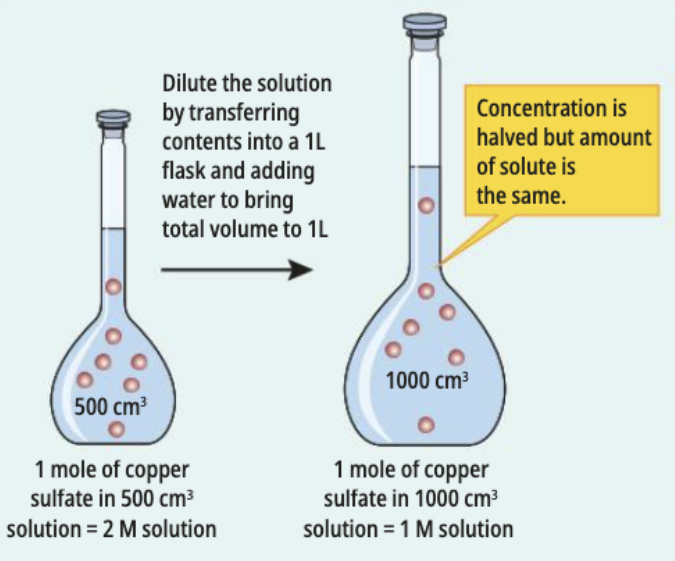
The diagram above illustrates this concept perfectly - notice how the same number of particles (representing solute molecules) are present in both flasks, but they're spread over a larger volume in the diluted solution.
Serial dilution
Serial dilution is a step-by-step process where a solution is diluted multiple times in a systematic way. Each step reduces the concentration by the same factor, commonly 1:10 (meaning the solution becomes 10 times more dilute).
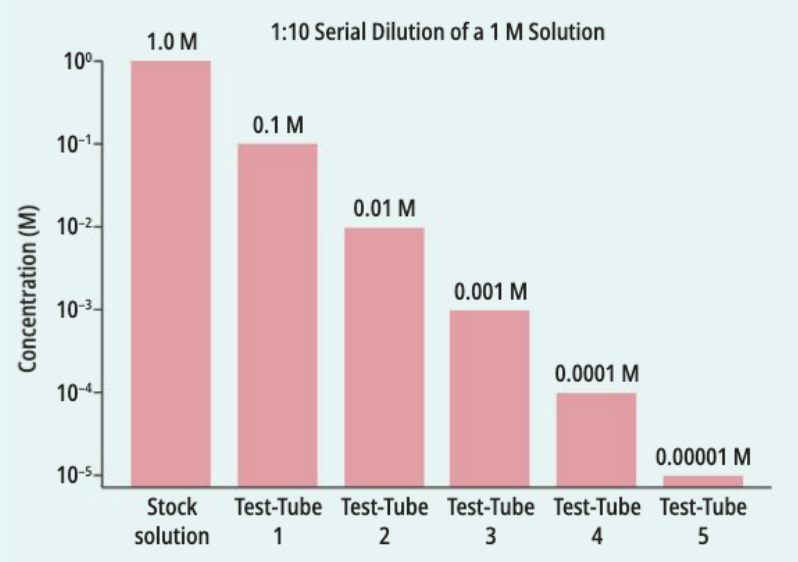
This bar chart shows how a 1 M stock solution becomes progressively more dilute through five consecutive 1:10 dilutions:
- Stock solution: 1.0 M
- Test tube 1: 0.1 M
- Test tube 2: 0.01 M
- Test tube 3: 0.001 M
- Test tube 4: 0.0001 M
- Test tube 5: 0.00001 M
Note
Serial dilutions are particularly useful when you need very dilute solutions or when testing the effectiveness of substances at different concentrations. This technique is commonly used in microbiology, pharmacology, and analytical chemistry.
Dilution factor
The dilution factor tells you how many times more dilute your final solution is compared to the original:
For example, if you take 1 cm³ of stock solution and make it up to 10 cm³ total volume, the dilution factor is .
Note
For multiple serial dilutions, you multiply the individual dilution factors together. Three consecutive 1:10 dilutions give an overall dilution factor of .
Worked examples
Example
Worked Example 1: Simple dilution calculation
Question: What volume of 12 M HCl solution is required to make 500 cm³ of 3 M HCl solution?
Solution: Using
Answer: 125 cm³ of concentrated acid would need to be diluted to 500 cm³.
Example
Worked Example 2: Serial dilution factor
Question: If you perform three consecutive 1:10 dilutions, what is the dilution factor?
Solution: Dilution factor =
Answer: The final solution is 1000 times more dilute than the original.
Key principles to remember
Understanding dilution requires grasping several fundamental concepts:
Important
Critical Principles:
- Adding solvent never changes the amount of solute - it only changes the concentration
- Serial dilutions are systematic - each step uses the same dilution ratio
- Dilution factor indicates the extent of dilution - a higher number means more dilute
- The dilution equation is your most important tool for calculations
Exam tips
When tackling dilution problems in exams, keep these strategies in mind:
- Always check your units are consistent (cm³ with cm³, dm³ with dm³)
- Remember that when diluting, the final concentration is always lower than the initial concentration
- For serial dilutions, multiply individual dilution factors to get the overall factor
- Show all working clearly in calculations
Summary
Key Points to Remember:
- Dilution reduces concentration but keeps the amount of solute constant - you're just spreading it through more solvent
- The dilution equation is fundamental for all dilution calculations
- Serial dilution creates a systematic series of decreasing concentrations by repeating the same dilution ratio
- Dilution factor = and tells you how much weaker your solution has become
- Common laboratory acids and bases are supplied at high concentrations and must be diluted for most experiments