Iron Deficiency (Leaving Cert Chemistry): Revision Notes
📚Revision Notes
Iron Deficiency
What is iron deficiency?
Iron deficiency, also known as anaemia, occurs when our bodies don't have enough iron to function properly. This condition is particularly common in young people who are growing rapidly, as their bodies need extra iron to support development.
When someone has iron deficiency, they usually need treatment with iron tablets and should make changes to their diet to include more iron-rich foods. This helps restore the body's iron levels back to normal.
Note
Growing teenagers and young adults have higher iron requirements because their bodies are rapidly developing new tissues and increasing blood volume, which requires additional iron for haemoglobin production.
Why is iron important in our bodies?
Iron plays a vital role in keeping us healthy because it's an essential part of the haemoglobin molecule in our blood. Haemoglobin is the special protein that carries oxygen from our lungs to all the cells throughout our body.
When we breathe in, oxygen molecules actually attach themselves to the iron atoms within the haemoglobin structure. Without enough iron, our blood cannot carry sufficient oxygen, which makes us feel tired and weak.
Note
Oxygen Transport Process
The iron-oxygen binding process is reversible - oxygen binds to iron in the lungs where oxygen concentration is high, and releases from iron in body tissues where oxygen concentration is lower. This efficient system ensures continuous oxygen delivery throughout the body.
Iron in haemoglobin
The haemoglobin molecule has a complex structure that contains iron atoms at its centre. This iron is what gives blood its red colour and enables it to transport oxygen effectively.
The chemical process works like this: when blood reaches our lungs, oxygen binds to the iron in haemoglobin. As blood circulates through our body, this oxygen is released to cells that need it for energy production.
Important
Critical Concept: Each haemoglobin molecule contains four iron atoms, and each iron atom can bind to one oxygen molecule. This means a single haemoglobin molecule can carry up to four oxygen molecules - this is why iron deficiency so dramatically affects oxygen transport capacity.
Iron-rich foods and supplements
Many foods naturally contain iron stored in various iron compounds. Some excellent sources include:
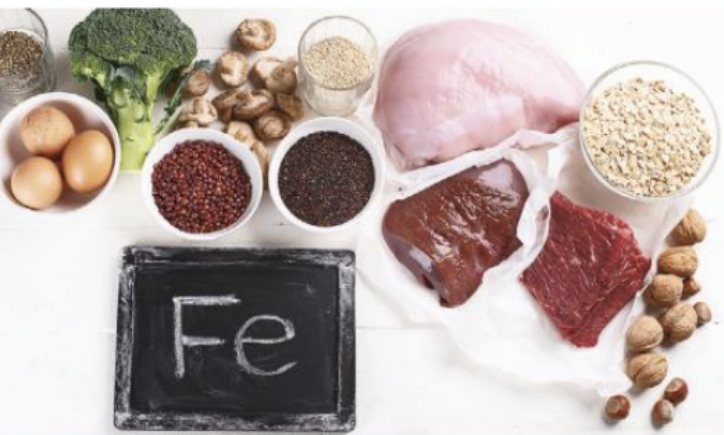
- Red meat and liver
- Egg yolks
- Green leafy vegetables like broccoli
- Nuts and legumes
- Fortified cereals and grains
These foods contain iron in different chemical forms, but processed and fortified foods often have iron added as iron salts to boost their nutritional value.
When dietary changes aren't enough, doctors prescribe iron tablets as supplements:
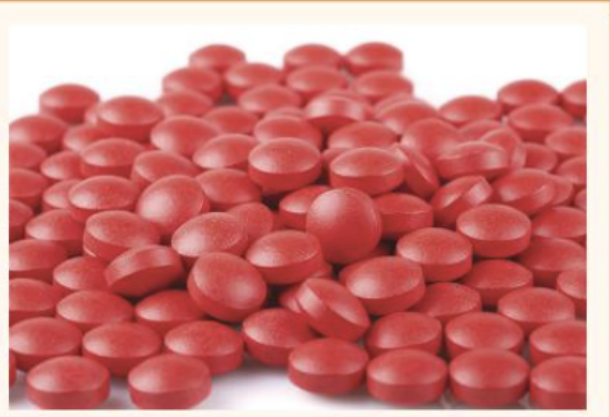
Iron tablets typically contain anhydrous iron(II) sulphate (FeSO₄), which is an effective form for the body to absorb and use.
Analysing iron tablets
To ensure iron tablets contain the correct amount of iron stated on the packaging, chemists can perform quantitative analysis using volumetric analysis. This involves oxidation-reduction reactions where the iron is chemically analysed.
The key reaction uses potassium permanganate (KMnO₄) as the oxidising agent:
This equation shows that one mole of permanganate reacts with five moles of iron(II) ions. The purple permanganate solution changes colour when all the iron has reacted, indicating the end point of the titration.
Important
Key Stoichiometric Ratio: The 1:5 ratio between permanganate and iron ions is crucial for all calculations. Always remember: 1 MnO₄⁻ oxidises 5 Fe²⁺ ions. This ratio is the foundation of every iron content calculation.
Practical procedure for iron analysis
Here's how chemists analyse iron tablets in the laboratory:
Preparation steps:
- Weigh the iron tablets accurately using a laboratory balance
- Grind the tablets using a mortar and pestle to create a fine powder
- Add dilute sulphuric acid to dissolve the iron compounds
- Transfer the solution to a graduated cylinder, then add to a beaker
Titration procedure: 5. Transfer the prepared solution to a volumetric flask 6. Rinse equipment with deionised water and add rinsings to the flask 7. Stir the solution thoroughly to ensure complete dissolution 8. Use a funnel to transfer the solution to a clean volumetric flask 9. Add deionised water and rinsings to the volumetric flask 10. Clean all glassware with deionised water
Analysis steps: 11. Remove the funnel from the flask 12. Use a dropper to carefully bring the solution up to the graduation mark 13. Stopper the flask securely 14. Invert the stoppered flask about 20 times to ensure thorough mixing
Note
Laboratory Safety and Accuracy
Accurate measurements are critical in pharmaceutical analysis - patients depend on receiving the exact iron dosage prescribed by their doctors. Always use appropriate safety equipment and follow proper laboratory procedures when handling acids and chemical solutions.
Worked example calculations
Example
Worked Example: Determining Iron Content in Tablets
Given information:
- 5 iron tablets dissolved in 250 cm³ solution
- 25 cm³ portions titrated against 0.015 M potassium permanganate
- Average titration volume = 5.75 cm³
Step 1: Calculate molarity of FeSO₄ solution
From the balanced equation: 1 mole MnO₄⁻ reacts with 5 moles Fe²⁺
Molarity calculation:
Step 2: Convert to mass
Step 3: Calculate mass per 250 cm³
Step 4: Calculate mass per tablet
Step 5: Calculate percentage of iron
Step 6: Mass of iron per tablet
Exam techniques
When answering questions about iron analysis, remember these key points:
- Always show your working clearly in steps
- Remember the 1:5 ratio between permanganate and iron ions
- Include units in all calculations
- State the colour change from purple to colourless at the end point
- Explain why accurate measurements are important for patient safety
Important
Common Exam Mistakes to Avoid:
- Forgetting to use the 5:1 stoichiometric ratio in calculations
- Not showing units in final answers
- Confusing the direction of the colour change (purple permanganate becomes colourless)
- Failing to explain the health significance of accurate iron content analysis
Summary
Key Points to Remember:
- Iron deficiency (anaemia) affects oxygen transport in blood because iron is essential for haemoglobin function
- Iron tablets containing FeSO₄ are used to treat iron deficiency alongside dietary improvements
- Volumetric analysis using KMnO₄ can determine the exact iron content in tablets
- The redox reaction follows a 1:5 ratio - one permanganate ion oxidises five iron(II) ions
- Accurate analysis ensures patients receive the correct iron dosage for effective treatment