Redox Titration 2: Iodine and Sodium Thiosulfate (Leaving Cert Chemistry): Revision Notes
📚Revision Notes
Redox Titration 2: Iodine and Sodium Thiosulfate
Introduction
The iodine-sodium thiosulfate titration represents the second major type of redox titration you'll encounter in your chemistry studies. This analytical technique involves the reaction between iodine molecules and thiosulfate ions, where sodium thiosulfate acts as a powerful reducing agent. Understanding this titration is essential for quantitative chemical analysis and forms an important part of your practical chemistry skills.
Note
This titration has many practical applications beyond the laboratory. Sodium thiosulfate is commonly used to neutralise excess chlorine in swimming pools, extract gold in mining operations, and even serves as an antidote to cyanide poisoning. These real-world applications demonstrate why mastering this technique is so valuable.
Properties and structure of sodium thiosulfate
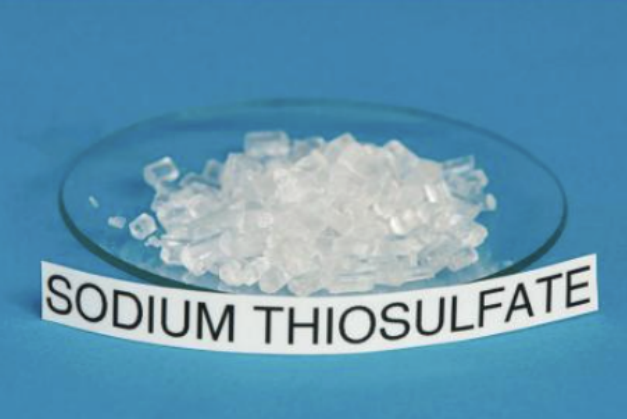
Sodium thiosulfate exists as a crystalline pentahydrate with the formula . The "pent" part of the name refers to the five water molecules trapped within the crystal structure. When heated, these water molecules are lost, leaving behind a white anhydrous powder.
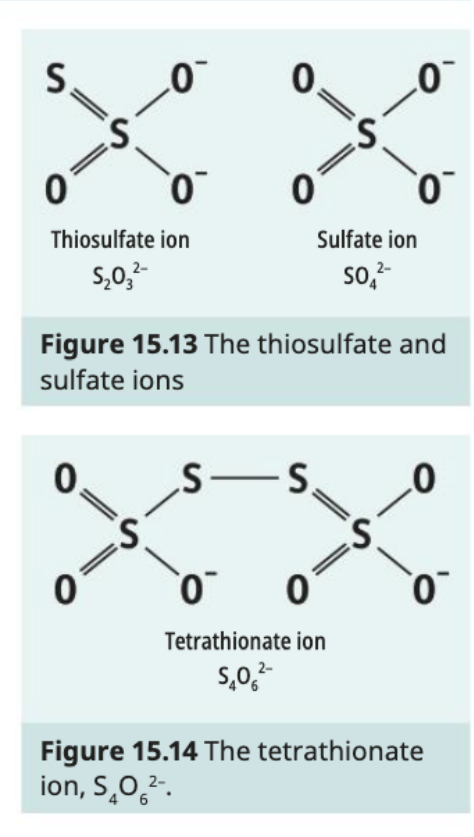
The thiosulfate ion () has a fascinating structure that's similar to the sulphate ion (), except one oxygen atom is replaced by a sulphur atom. This structural change gives the thiosulfate ion its unique reducing properties. The tetrathionate ion () forms when thiosulfate undergoes oxidation, creating a more complex sulfur-oxygen structure.
Important
Key structural points:
- Thiosulfate contains sulphur in two different oxidation states
- The prefix "thio" means sulphur has replaced oxygen
- Water molecules can be removed by heating, making the crystals efflorescent
The redox reaction mechanism
The fundamental reaction between iodine and sodium thiosulfate follows this equation:
In this reaction, iodine acts as the oxidising agent while thiosulfate serves as the reducing agent. Each iodine molecule accepts two electrons from two thiosulfate ions. The thiosulfate ions lose electrons and combine to form the tetrathionate ion.
Example
Understanding the electron transfer:
Step 1: Reduction half-reaction (Iodine gains electrons)
Step 2: Oxidation half-reaction (Thiosulfate loses electrons)
Step 3: Overall reaction The reaction has a 1:2 molar ratio (1 mol : 2 mol )
This stoichiometric relationship is crucial for all calculations involving this titration type.
Standardisation procedures
Unlike primary standards such as sodium carbonate, sodium thiosulfate cannot be used to prepare standard solutions by direct weighing. The crystals are efflorescent, meaning they lose water molecules when exposed to air, making accurate weighing impossible.
Instead, we must standardise sodium thiosulfate solutions against a known standard. The most common method uses potassium permanganate to generate a known amount of iodine:
Important
The standardisation process works as follows:
- A known volume and concentration of potassium permanganate reacts with excess potassium iodide
- This produces a precise amount of iodine according to the equation above
- The iodine is then titrated against the sodium thiosulfate solution
- From the volume of thiosulfate used, we can calculate its exact concentration
This indirect standardisation method ensures accuracy despite the limitations of the sodium thiosulfate crystals themselves.
Endpoint detection and starch indicator
Detecting the endpoint in an iodine-thiosulfate titration requires careful observation of colour changes. Initially, solutions containing iodine appear brown or yellow, depending on concentration.
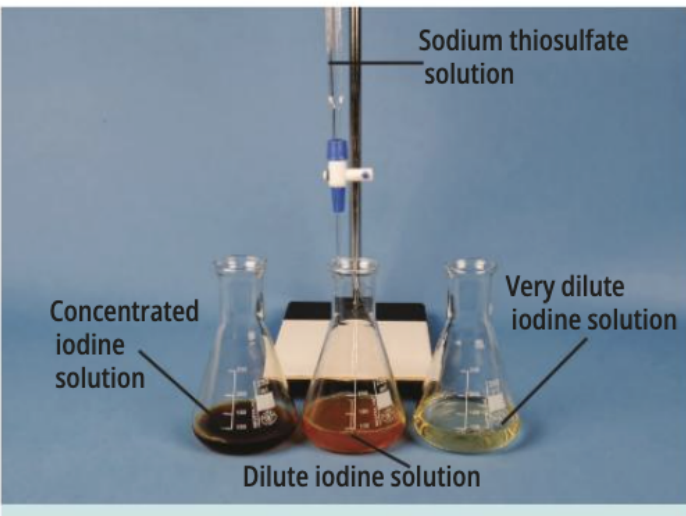
Colour changes during titration:
- Concentrated iodine solutions: dark brown/amber
- Dilute iodine solutions: pale yellow
- Solution at endpoint: colourless
However, relying solely on the disappearance of the yellow colour can lead to inaccurate results. Therefore, we use starch as an indicator to provide a sharp, easily detected endpoint.
Important
Using starch indicator effectively:
- Add starch when the solution becomes pale yellow (not at the beginning)
- Starch forms a blue-black complex with iodine
- The endpoint occurs when this blue-black colour suddenly disappears
- Adding starch too early can make the solution too dark to observe properly
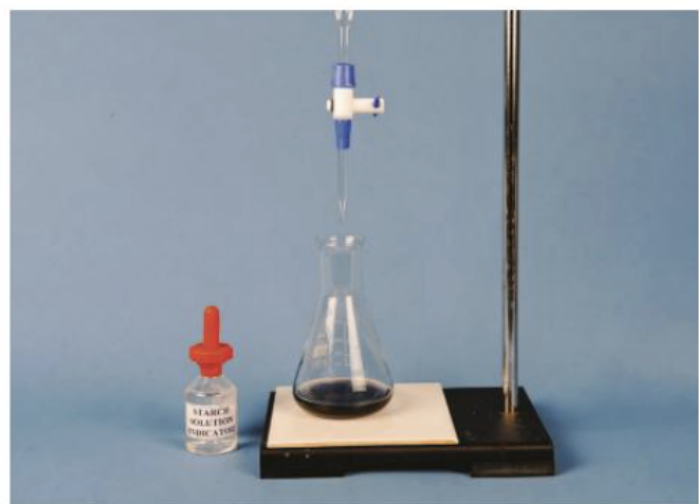
The reason for waiting until the solution is pale yellow before adding starch is practical: if added too early to concentrated iodine solutions, the resulting blue-black colour becomes so intense that detecting the endpoint becomes difficult.
Practical laboratory setup
The standard laboratory setup for iodine-thiosulfate titrations follows the same principles as other titrations, but with some specific considerations.
Essential equipment:
- Burette containing standardised sodium thiosulfate solution
- Conical flask with iodine solution
- Starch indicator solution
- Pipette for accurate volume measurement
Note
Important practical points:
- Iodine solutions should be kept in dark bottles to prevent decomposition
- The titration should be performed relatively quickly to minimise iodine loss
- Excess potassium iodide helps keep iodine in solution as the triiodide ion ()
- Room temperature conditions are suitable for this titration
The triiodide ion formation () is particularly important because it makes iodine more soluble in water and chemically behaves identically to free iodine molecules.
Calculations and worked examples
Calculations for iodine-thiosulfate titrations follow the same principles as other redox titrations, using the electron transfer ratios to establish molar relationships.
Example
Worked Example: Calculating Iodine Concentration
For a titration where 25.0 cm³ of iodine solution requires 22.5 cm³ of 0.125 M sodium thiosulfate:
Step 1: Calculate moles of thiosulfate used Moles of = mol
Step 2: Apply the 1:2 ratio from balanced equation From Moles of = mol
Step 3: Calculate concentration of iodine solution Concentration = M
Key calculation steps:
- Identify the stoicheiometry: Use the balanced equation to find molar ratios
- Apply the redox equivalence principle: moles of electrons gained = moles of electrons lost
- Use the relationship: where n = moles and z = electron change
- Convert between concentration units: as required for the specific problem
Remember that in the equation , two moles of thiosulfate react with one mole of iodine, so the moles of iodine equals half the moles of thiosulfate used.
Exam tips and common mistakes
Important exam points:
- Always write balanced equations showing electron transfer
- Remember the 1:2 molar ratio between iodine and thiosulfate
- Explain why starch is added near the endpoint, not at the beginning
- Distinguish between primary and secondary standards
Important
Common mistakes to avoid:
- Forgetting to account for the 2:1 stoichiometric ratio in calculations
- Adding starch indicator too early in the titration
- Assuming sodium thiosulfate can be used as a primary standard
- Mixing up oxidising and reducing agents in the reaction
Remember!
Summary
Key Points to Remember:
-
The fundamental equation: shows iodine being reduced while thiosulfate is oxidised to tetrathionate
-
Sodium thiosulfate is not a primary standard due to its efflorescent nature, requiring standardisation against known iodine solutions generated from permanganate
-
Starch indicator is added near the endpoint (when solution is pale yellow) to form a blue-black complex that disappears sharply at the endpoint
-
The 1:2 molar ratio between iodine and thiosulfate is crucial for all quantitative calculations in these titrations
-
Practical considerations include keeping iodine solutions in dark conditions and performing titrations promptly to prevent decomposition