Pyrometers (Leaving Cert Engineering): Revision Notes
📚Revision Notes
Optical Pyrometer
What is an optical pyrometer?
An optical pyrometer is a temperature measuring device specifically designed to measure the temperature inside a furnace. This instrument works without direct contact with the hot material, making it ideal for measuring extremely high temperatures that would destroy other types of thermometers.
The device operates on the principle of light intensity, which states that as an object becomes hotter, it emits brighter light. This fundamental relationship between temperature and light emission forms the basis of how optical pyrometers function.
Note
The non-contact nature of optical pyrometers makes them invaluable in industrial applications where direct temperature measurement would be impossible or dangerous, such as in steel production, glass manufacturing, or ceramic kilns.
How does an optical pyrometer work?
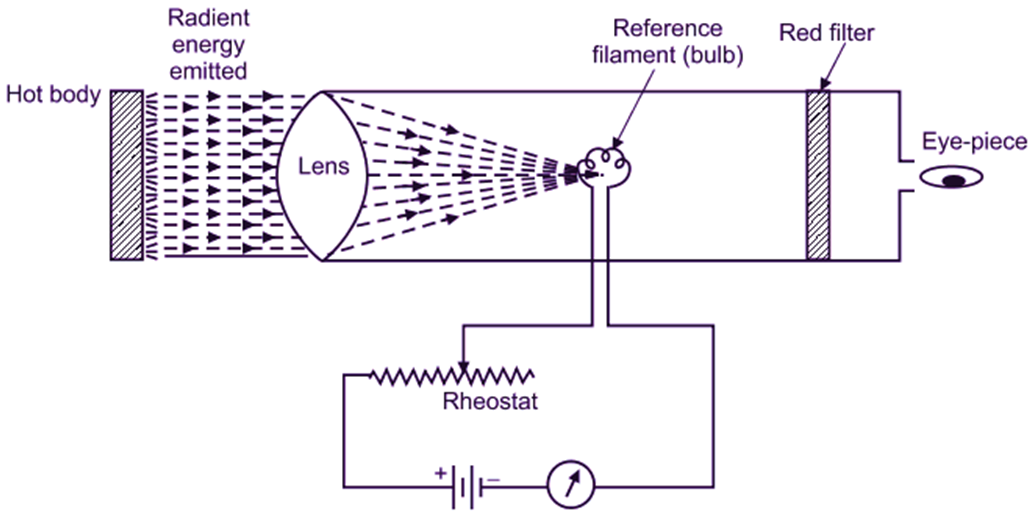
The optical pyrometer consists of several key components working together:
- Furnace window - allows light from inside the furnace to be observed
- Handheld device - contains the measuring apparatus and controls
- Small bulb - produces light that can be adjusted in brightness
- Potentiometer - acts like a variable resistor to control electric current
These components work in harmony to create a precise temperature measurement system based on light intensity comparison.
Operating procedure
Example
Worked Example: Taking a Temperature Reading
The operator follows this specific process to measure furnace temperature:
Step 1: Position the device - aim the pyrometer at the furnace window to observe the internal light
Step 2: Adjust the current - use the potentiometer to increase or decrease the electric current flowing through the small bulb
Step 3: Match the brightness - continue adjusting until the bulb's brightness exactly matches the furnace light
Step 4: Read the measurement - when brightness levels match, the filament appears to vanish, indicating the correct temperature reading
Understanding the brightness positions
The diagram shows three different positions during measurement:
- Position A - bulb is set too bright compared to furnace light
- Position B - correct match where bulb brightness equals furnace brightness
- Position C - bulb is set too dim compared to furnace light
When the brightness levels match perfectly (Position B), the operator can only see one level of brightness, and the bulb filament appears to disappear or "vanish" against the furnace background.
Important
The key to accurate measurement is achieving the exact point where the filament appears to vanish. This "vanishing filament" effect indicates that the bulb and furnace are emitting light at the same intensity, providing a precise temperature reading.
Reading the results
The relationship between current and temperature is straightforward: more current means a hotter furnace. The electric current used to achieve the brightness match directly relates to the furnace temperature, which can be read from the device's calibrated scale.
This measurement method is highly accurate because it relies on the precise matching of light intensities rather than subjective brightness estimation.
Note
The accuracy of optical pyrometers comes from their objective measurement approach - there's no guesswork involved. Either the filament vanishes (correct reading) or it doesn't (adjustment needed).
Summary
Summary
Key Points to Remember:
- Optical pyrometers measure temperature using the light intensity principle - hotter objects emit brighter light
- The device works by matching brightness between a small bulb and the furnace light through a window
- Position B shows the correct measurement when the filament appears to vanish
- More electric current through the bulb indicates a higher furnace temperature
- This method allows non-contact temperature measurement of extremely hot materials