Thermocouple Pyrometer (Leaving Cert Engineering): Revision Notes
📚Revision Notes
Thermocouple Pyrometer
What is a pyrometer?
A pyrometer is a specialised instrument designed to measure extremely high temperatures, particularly in industrial furnaces where standard thermometers cannot operate safely. These devices are essential for monitoring and controlling temperature in metalworking, heat treatment processes, and other high-temperature industrial applications.
Note
Pyrometers are critical in industries where precise temperature control can mean the difference between product quality and costly failures. Standard thermometers simply cannot withstand the extreme conditions found in industrial furnaces.
Understanding thermocouple pyrometers
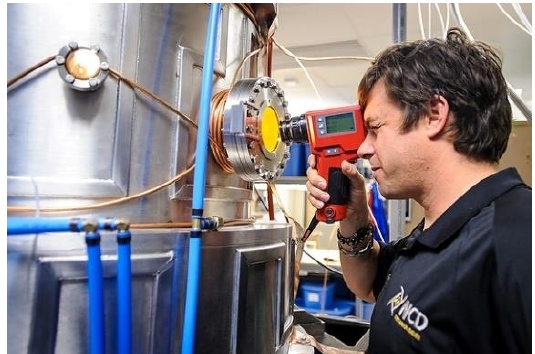
A thermocouple pyrometer is a temperature measuring device that operates on the principle of electrical conductivity. This type of pyrometer is specifically designed to measure furnace temperatures accurately and safely from outside the high-temperature environment.
Working principle
The thermocouple pyrometer functions based on the conductivity of electrons. When metals are heated, electrons become more active and can flow more easily through the material, creating electrical current. The device exploits this property by using two different types of wire that conduct electricity at different rates when heated.
Important
The fundamental principle relies on the fact that different metals have different electrical conductivity properties when heated. This difference is what makes accurate temperature measurement possible.
Construction and components
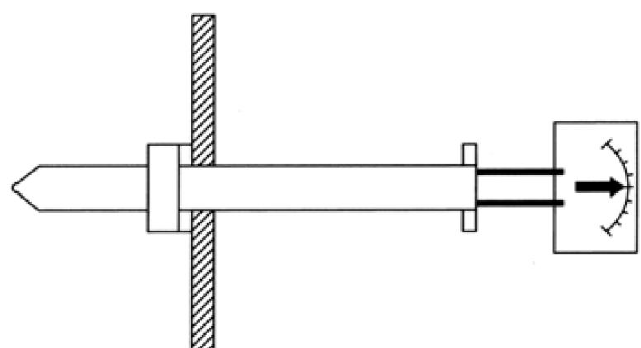
The thermocouple pyrometer consists of several key components:
- Heat-resistant probe: This is inserted into the furnace to sense the temperature
- Two dissimilar wires: Made from different metals, these wires have different electrical conductivity properties
- Measuring instrument: Usually a voltmeter or digital display that shows the temperature reading
How it operates
The operation of a thermocouple pyrometer follows a straightforward process:
Example
Step-by-Step Operation Process:
Step 1: Heat detection - The heat-resistant probe is placed inside the furnace where temperature needs to be measured
Step 2: Heat conduction - As the probe heats up, thermal energy is conducted through the two dissimilar wires
Step 3: Electron flow - The heat causes electrons to move more freely through both wires, creating electrical current
Step 4: Voltage generation - Because the two wires are made of different materials, electric current flows through one wire more easily than the other, creating a voltage difference
Step 5: Temperature reading - This voltage is proportional to the temperature, allowing the measuring instrument to display an accurate temperature reading
Key advantages
Thermocouple pyrometers offer several benefits for industrial temperature measurement:
- High accuracy: Provides precise temperature readings even at extreme temperatures
- Safety: Allows temperature measurement without direct exposure to dangerous heat
- Durability: Heat-resistant construction ensures long-lasting operation
- Quick response: Responds rapidly to temperature changes
- Wide range: Can measure a broad spectrum of high temperatures
Note
The combination of safety and accuracy makes thermocouple pyrometers indispensable in modern industrial processes where both worker safety and product quality depend on precise temperature control.
Industrial applications
Thermocouple pyrometers are commonly used in:
- Steel manufacturing and heat treatment
- Furnace operation and control
- Metalworking processes
- Glass manufacturing
- Ceramic production
Summary
Key Points to Remember:
- Thermocouple pyrometers measure high temperatures using the principle of electron conductivity
- They use two dissimilar wires that conduct electricity at different rates when heated
- The voltage difference created between the wires is proportional to the temperature
- A heat-resistant probe allows safe measurement of furnace temperatures
- These devices are essential for accurate temperature control in industrial processes