States of Matter (Leaving Cert Engineering): Revision Notes
📚Revision Notes
States of Matter
Introduction to the three states
Matter exists in three primary states: solid, liquid, and gas. Each state has distinct properties that result from differences in how particles are arranged and how they move. Understanding these states is fundamental to explaining many physical and chemical processes.
Note
The behaviour of particles in different states can be observed in everyday life - ice cubes melting in a drink, steam rising from hot water, or air filling a balloon. These observations help us understand the underlying particle theory.
Properties of each state
The behaviour of particles determines the properties we observe in each state of matter. By examining particle arrangement and movement, we can explain why solids, liquids, and gases behave differently.
Solids
Solids contain particles arranged in a rigid lattice structure. The particles vibrate around fixed positions but cannot move freely. This arrangement explains several key properties:
- Incompressible - particles are already tightly packed together
- Fixed shape and volume - particles maintain their positions
- High density - particles are closely arranged
Liquids
Liquids contain particles that can roll around each other and settle at the bottom of containers. The particles are generally closer together than in gases but further apart than in solids. This explains liquid properties:
- Take the shape of their container - particles can flow past each other
- Fixed volume - particles remain close together
- Slightly compressible - small spaces exist between particles
Gases
Gases contain particles that move rapidly in straight lines until they collide with other particles or container walls. The particles are widely spaced and only slightly attracted to each other. This explains gas properties:
- Fill all available space - particles spread out completely
- Highly compressible - large spaces exist between particles
- No fixed shape or volume - particles move freely
Kinetic theory and particle motion
The kinetic theory states that all particles are in constant motion. This motion explains how energy affects matter and state changes. When energy is added to particles (through heating), they move faster. When energy is removed (through cooling), particles move more slowly.
Important
The kinetic theory is essential for understanding state changes. Remember: heating increases particle movement, cooling decreases it. This relationship explains why materials expand when heated and contract when cooled.
This theory helps us understand why heating causes expansion and cooling causes contraction in most materials.
Absolute zero
Absolute zero represents the theoretical temperature at which particles have minimal energy and slowest movement. This occurs at or Kelvin on the scientific temperature scale.
Scientists have achieved temperatures very close to absolute zero but have not reached it exactly. Early theories suggested particles would stop moving completely at absolute zero, but experiments have shown this is not the case - particles retain some motion even at extremely low temperatures.
Note
The Kelvin scale starts at absolute zero, making it particularly useful for scientific calculations involving temperature and energy. Each Kelvin degree is the same size as a Celsius degree, but the scale has no negative values.
Phase transitions
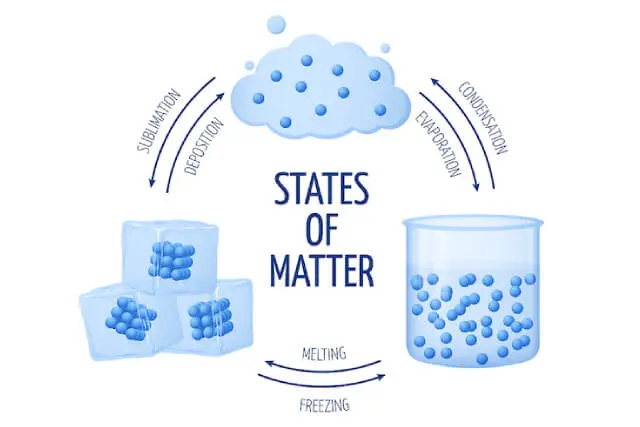
Adding or removing energy from particles causes them to change state. Heating increases particle movement, while cooling decreases it. These energy changes result in phase transitions between the three states.
The six main phase transitions are:
- Melting - solid changes to liquid (energy added)
- Evaporation - liquid changes to gas (energy added)
- Condensation - gas changes to liquid (energy removed)
- Freezing - liquid changes to solid (energy removed)
- Sublimation - solid changes directly to gas (energy added)
- Deposition - gas changes directly to solid (energy removed)
Example
Worked Example: Identifying Phase Transitions
Consider water at different temperatures:
- At 0°C: Ice melts to become liquid water (melting)
- At 100°C: Liquid water becomes steam (evaporation)
- When steam cools: Water vapour becomes liquid droplets (condensation)
- When liquid water cools to 0°C: Forms ice (freezing)
- Dry ice: Solid carbon dioxide becomes gas directly (sublimation)
Solutions
A solution forms when a solid (the solute) dissolves in a liquid (the solvent). However, solutions can form between any combination of states, with the solvent being the component present in the largest quantity.
Common solution types include:
- Solid in liquid - seawater (salt dissolved in water)
- Liquid in liquid - alcohol in cleaning products
- Gas in liquid - oxygen dissolved in water
- Gas in gas - air (mixture of gases)
- Solid in solid - metal alloys like steel (carbon in iron)
Solubility
Solubility is defined as the mass of solute that can dissolve in a given amount of solvent at a specific temperature and pressure. When particles dissolve, they become surrounded by solvent particles, forming a solvation shell (or hydration shell when water is the solvent).
Solutions have a saturation point - the maximum amount of solute that can dissolve. Some solutes (like sugar) show significant increases in solubility with temperature, while others (like salt) show only small increases.
Note
Temperature plays a crucial role in solubility. Hot water can dissolve much more sugar than cold water, which is why sugar dissolves quickly in hot tea but may settle at the bottom of iced drinks.
Suspensions
Suspensions are mixtures where larger particles are held up or suspended by collisions with smaller liquid or gas particles. Unlike solutions, suspended particles will eventually settle out.
Common examples include:
- Smoke - ash particles suspended in air
- Muddy water - clay particles suspended in water
- Fog - water droplets suspended in air
In colloids (such as milk), the distributed particles are extremely small and do not settle out easily.
Important
The key difference between solutions and suspensions: in solutions, particles dissolve completely and won't settle out, while in suspensions, particles remain distinct and will eventually settle if left undisturbed.
Separation techniques
Mixtures and solutions can be separated using various physical methods. Each technique exploits different properties of the components.
Key separation methods include:
- Chromatography - separates substances with different attractions to solvents
- Crystallisation - separates dissolved solids from liquids by controlled cooling
- Distillation - separates liquid mixtures based on different boiling points
- Evaporation - separates liquids from high-melting-point solids
- Filtration - separates suspended solids from liquids using physical barriers
Note
Choosing the right separation technique depends on the physical properties of the substances you want to separate. For example, use distillation for liquids with different boiling points, but use filtration for mixtures containing undissolved solids.
Particles in matter
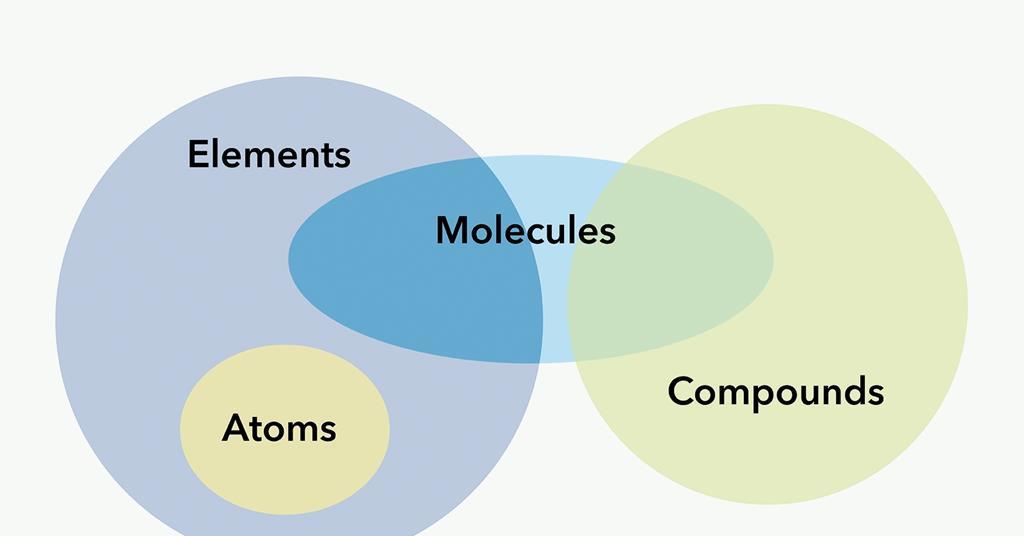
Particles in different states of matter exist as either molecules or ions.
Molecules are particles made of atoms bonded together. They can contain one or more elements. Examples include helium and argon (single atoms), water molecules (two hydrogen atoms and one oxygen atom), and glucose (containing carbon, hydrogen, and oxygen atoms).
Ions are charged particles that have gained or lost electrons. Positively-charged ions have lost electrons, while negatively-charged ions have gained electrons. Common salt (sodium chloride) forms when sodium atoms lose electrons to become sodium ions, and chlorine atoms gain electrons to become chloride ions.
Example
Worked Example: Identifying Particles
Water (H2O): Molecule containing 2 hydrogen atoms and 1 oxygen atom Table salt (NaCl): Ionic compound made of Na+ ions and Cl- ions Oxygen gas (O2): Molecule containing 2 oxygen atoms Carbon dioxide (CO2): Molecule containing 1 carbon atom and 2 oxygen atoms
Summary
Key Points to Remember:
- Particle arrangement determines the properties of solids, liquids, and gases - from tightly packed lattices to widely spaced, rapidly moving particles
- Kinetic theory explains that all particles are in constant motion, with energy changes affecting their speed and state transitions
- Six phase transitions occur between states: melting, evaporation, condensation, freezing, sublimation, and deposition
- Solutions form when solutes dissolve in solvents, and can occur between any combination of states
- Separation techniques exploit different physical properties to separate mixture components effectively