The Atom (Leaving Cert Engineering): Revision Notes
📚Revision Notes
The Atom
What is an atom?
An atom is the basic building block of all matter and chemistry. Every substance around us - from the air we breathe to the metals used in engineering - is made up of atoms. These tiny particles can combine with other atoms to form molecules, but they cannot be divided into smaller parts by ordinary chemical processes.
Note
Understanding atoms is crucial for metallurgy because the properties of metals depend entirely on their atomic structure and how their atoms interact with each other.
Basic atomic structure
The three fundamental particles
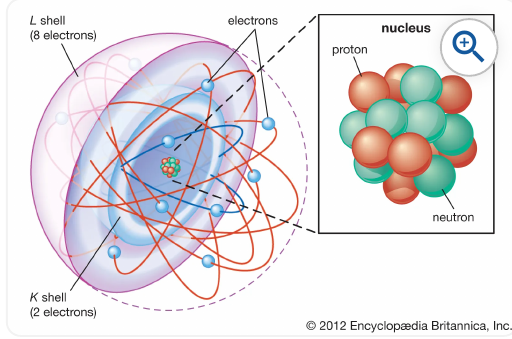
An atom consists of three main types of subatomic particles:
- Protons - positively charged particles
- Neutrons - electrically neutral particles (no charge)
- Electrons - negatively charged particles
The nucleus and electron arrangement
Most of an atom is actually empty space. At the centre sits a tiny, dense nucleus containing the protons and neutrons. Surrounding this nucleus is a cloud of electrons that orbit in specific regions called shells.
Important
To understand the scale: if an atom were the size of a football field, the nucleus would be about the size of a marble in the centre. Despite being so small, the nucleus contains virtually all the atom's mass.
Electric charges and attraction
The protons give the nucleus a positive charge, while the electrons are negatively charged. Like opposite ends of a magnet, these opposite charges attract each other, which keeps the electrons bound to the nucleus. This electrical force is what holds the atom together.
Atomic number
Definition and importance
The atomic number (symbol ) is the most important characteristic of any atom. It is defined as the number of protons in the nucleus.
Example
Examples of Atomic Numbers:
- Carbon has an atomic number of 6 (6 protons)
- Iron has an atomic number of 26 (26 protons)
- Uranium has an atomic number of 92 (92 protons)
Why atomic number matters
Important
The atomic number determines:
- What element the atom is
- The atom's chemical properties
- The atom's position in the periodic table
In a neutral atom, the number of electrons equals the number of protons, so the positive and negative charges balance out exactly.
Atomic mass and isotopes
Understanding atomic mass
While the atomic number tells us about protons, the mass number tells us about the total number of particles in the nucleus. It equals the number of protons plus the number of neutrons.
The mass of atoms is measured using the atomic mass unit, which is defined as of the mass of a carbon-12 atom.
What are isotopes?
Isotopes are atoms that have the same number of protons but different numbers of neutrons. This means:
- They are the same element (same atomic number)
- They have different masses
- They have identical chemical properties
Example
Carbon Isotopes:
Carbon-12 has 6 protons and 6 neutrons, while carbon-14 has 6 protons and 8 neutrons. Both are carbon atoms, but carbon-14 is heavier.
Electron properties
Electric charge of electrons
Scientists have known since the late 19th century that electrons carry a negative electric charge. This charge was first accurately measured by American physicist Robert Millikan in his famous oil-drop experiment.
Note
Millikan suspended tiny oil droplets in an electric field and observed how they moved. By measuring their motion, he determined that all electric charges are multiples of a single basic unit - the charge on one electron.
Mass and other properties
Electrons are incredibly light compared to protons and neutrons. A proton or neutron is about 1,836 times more massive than an electron. This explains why nearly all of an atom's mass comes from the nucleus.
Electrons also have a property called spin, which makes them behave like tiny magnets. This magnetic behaviour is important for understanding how electrons arrange themselves in atoms.
Electron energy levels and orbitals
Quantised energy states
Important
Unlike planets orbiting the Sun, electrons cannot exist at any distance from the nucleus. They can only occupy specific locations called allowed orbits or energy levels.
This concept, first explained by Danish physicist Niels Bohr, is a result of quantum mechanics.
Energy transitions
When an electron moves from one energy level to another, it must absorb or emit a specific amount of energy. If an electron jumps to a higher energy level, the atom absorbs energy. If it drops to a lower level, the atom emits energy as electromagnetic radiation (light).
Note
This process explains how atoms emit light and is the basis for techniques used to identify different elements in metallurgy.
Electron shells and configuration
Shell structure
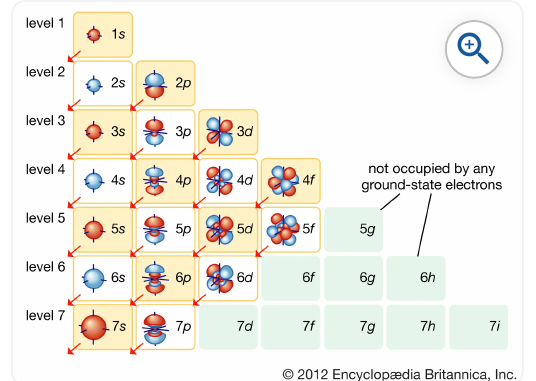
In the quantum mechanical model of the atom, electrons are arranged in shells around the nucleus. Each shell can hold only a certain maximum number of electrons:
- First shell (closest to nucleus): maximum 2 electrons
- Second shell: maximum 8 electrons
- Third shell: maximum 18 electrons
- And so on...
The importance of valence electrons
The valence shell is the outermost electron shell of an atom. The number of electrons in this shell determines how the atom will bond with other atoms.
Important
Atoms with incomplete outer shells tend to:
- Gain electrons
- Lose electrons
- Share electrons with other atoms
This drive to complete the outer shell is the basis of all chemical bonding.
Atomic bonding basics
How atoms form bonds
Understanding how atoms bond together is essential for metallurgy, as it explains the properties of metals and alloys. There are three main ways that atoms can form bonds:
- Electron transfer - one atom gives electrons to another (ionic bonding)
- Electron sharing - atoms share electrons between them (covalent bonding)
- Electron pooling - electrons are shared among many atoms (metallic bonding)
Ions formation
When an atom gains or loses electrons, it becomes an ion:
- If it loses electrons, it becomes a positive ion (more protons than electrons)
- If it gains electrons, it becomes a negative ion (more electrons than protons)
Note
This process is crucial in metallurgy, particularly in processes like electroplating and metal extraction from ores.
Summary
Key Points to Remember:
- Atoms consist of a tiny, dense nucleus (protons + neutrons) surrounded by electrons in shells
- The atomic number (number of protons) determines what element an atom is and its chemical properties
- Electrons can only exist in specific energy levels, not anywhere around the nucleus
- The arrangement of electrons, especially in the outermost shell, determines how atoms bond together
- Understanding atomic structure is fundamental to understanding metal properties and behaviour in metallurgical processes