Solution Mining (Leaving Cert Engineering): Revision Notes
📚Revision Notes
Solution Mining
What is solution mining?
Solution mining is a specialised extraction method used for ores that dissolve easily in water. This technique is particularly useful when valuable minerals are located deep underground, making traditional mining methods difficult or expensive.
Unlike surface mining or underground tunnelling, solution mining allows engineers to extract minerals without physically removing large amounts of rock or soil. The process works by dissolving the target mineral where it naturally occurs and then bringing the mineral-rich solution to the surface for processing.
Note
The key advantage of solution mining is that it extracts minerals in-situ (in place), eliminating the need for extensive excavation or tunnel construction that characterises other mining methods.
How solution mining works
The solution mining process follows a systematic approach that creates a closed-loop system underground:
Example
Worked Example: Solution Mining Process
Step 1: Site preparation A mining plant is established on the surface above the ore deposit. Engineers identify the exact location of the mineral pocket using geological surveys.
Step 2: Drilling bore holes Two separate bore holes are drilled from the surface down to the ore deposit pocket. These holes serve different purposes in the extraction process.
Step 3: Injection of mining solution Water (or sometimes other solvents) is pumped down through the first bore hole, called the injection well. This water reaches the ore deposit and begins dissolving the valuable minerals.
Step 4: Dissolution process The water mixes with the soluble ore, creating a mineral-rich solution. The dissolved minerals become suspended in the water, forming a concentrated solution.
Step 5: Recovery The mineral-laden solution is forced upward through the second bore hole, known as the recovery well. This solution is then pumped to the surface processing plant.
Step 6: Processing and refinement At the surface, the solution undergoes further refinement to separate and purify the valuable minerals from the water.
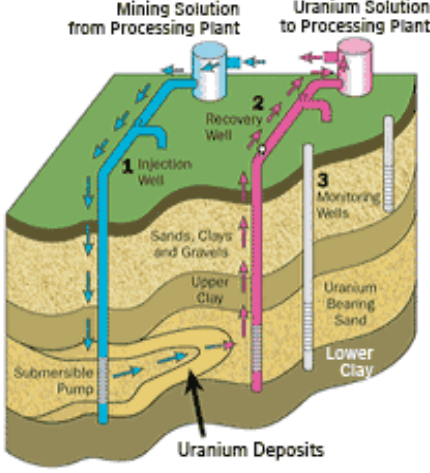
The diagram above shows this process in action for uranium extraction, demonstrating how the injection and recovery wells work together to create an efficient extraction system.
Important
Critical Concept: Solution mining requires exactly two bore holes - one for injecting the solvent (usually water) and one for recovering the mineral-rich solution. This creates a controlled circulation system that prevents contamination of surrounding groundwater.
Applications of solution mining
Solution mining is particularly effective for certain types of minerals:
Uranium extraction This is one of the most common applications of solution mining. Uranium deposits that are naturally soluble can be extracted using this method, making it safer and more environmentally friendly than traditional uranium mining.
Rock salt mining Simple rock salt deposits can be dissolved using water, creating brine that is pumped to the surface. This method is highly efficient for salt extraction.
Other soluble minerals Any mineral that readily dissolves in water or other solvents can potentially be extracted using solution mining techniques.
Note
Suitability Requirements: For solution mining to be viable, the target ore must be naturally water-soluble and located in a geological formation that allows controlled circulation of fluids without excessive loss to surrounding rock.
Advantages of solution mining
Solution mining offers several benefits compared to traditional extraction methods:
- Reduced surface disruption: No need for large open pits or extensive underground tunnelling
- Lower environmental impact: Minimal disturbance to the landscape and surrounding ecosystems
- Enhanced safety: Workers don't need to enter dangerous underground spaces
- Cost-effective: Often more economical than conventional mining for suitable ore types
- Selective extraction: Can target specific mineral deposits without removing unwanted material
Note
Environmental Benefits: Solution mining typically has a much smaller surface footprint compared to open-pit mining and doesn't require the extensive infrastructure of underground mining operations, making it particularly attractive for environmentally sensitive areas.
Key terminology
- Bore hole: A narrow shaft drilled into the ground to access underground deposits
- Injection well: The bore hole used to pump water or solvents down to the ore deposit
- Recovery well: The bore hole used to bring the mineral-rich solution back to the surface
- Ore deposit pocket: The underground location where valuable minerals are concentrated
- In-situ leaching: Another term for solution mining, meaning extraction "in place"
- Mining solution: The liquid used to dissolve the target minerals (usually water)
Remember!
Summary
Key Points to Remember:
- Solution mining works only with water-soluble ores located deep underground
- The process uses two bore holes - one for injection, one for recovery
- Water is pumped down the injection well to dissolve minerals
- The mineral-rich solution is pumped up through the recovery well
- Common applications include uranium and rock salt extraction
- This method offers reduced environmental impact compared to traditional mining