Elastomers (Leaving Cert Engineering): Revision Notes
📚Revision Notes
Elastomers
What are elastomers?
Elastomers represent a specialised category of polymers that possess remarkable flexibility and elastic properties. The name itself provides a helpful clue - these materials are characterised by their ability to stretch significantly and then return to their original shape when the applied force is removed.
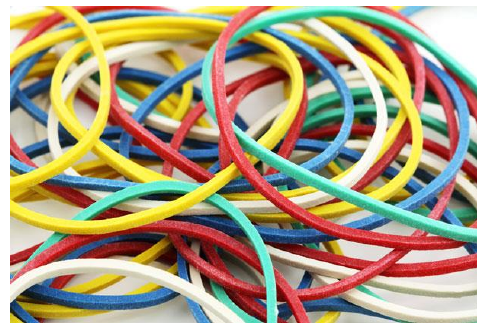
The defining feature of elastomers is their capacity to undergo extreme deformation whilst maintaining their structural integrity. When stretched, compressed, or twisted, these polymers will consistently bounce back to their initial form, making them invaluable in applications requiring flexibility and resilience.
Note
The term "elastomer" combines "elastic" and "polymer", directly reflecting these materials' most important characteristic - their ability to behave like elastic materials while maintaining their polymer structure.
Structure and properties
Elastomers possess a unique molecular architecture that sits between two other major polymer categories. Their internal structure represents a hybrid between thermoplastics and thermosets, combining characteristics of both types.
The molecular arrangement is amorphous, meaning the polymer chains are randomly oriented rather than organised in regular patterns. However, what makes elastomers special is the presence of limited crosslinking between the polymer chains. This crosslinking is much less extensive than in thermosets but more significant than in thermoplastics.
Important
This specific structural arrangement allows the polymer chains to move and stretch when force is applied, but the crosslinks act like molecular springs, pulling the chains back into their original positions when the force is removed.
Natural and synthetic examples
Natural rubber serves as the most familiar example of an elastomer. Although rubber occurs naturally, it demonstrates all the characteristic properties that define this polymer category. The rubber tree produces latex containing long polymer chains that exhibit the typical elastic behaviour.
Synthetic elastomers have been developed to meet specific industrial requirements, often providing enhanced properties such as resistance to heat, chemicals, or weathering compared to natural alternatives.
Note
Modern synthetic elastomers include materials like silicone rubber, neoprene, and polyurethane, each designed for specific applications where natural rubber might not perform adequately.
Key applications
Elastomers find widespread use in applications where flexibility and recovery are essential. Common examples include:
- Tyres - requiring durability and flexibility for road contact
- Seals and gaskets - needing to maintain shape under pressure
- Sports equipment - benefiting from bounce and flexibility
- Medical devices - requiring biocompatibility and elasticity
Note
The choice of elastomer for each application depends on specific requirements such as temperature resistance, chemical compatibility, and the degree of flexibility needed.
Summary
Key Points to Remember:
- Elastomers are highly flexible polymers that return to their original shape after deformation
- Their structure combines features of both thermoplastics and thermosets with limited crosslinking
- The amorphous structure with crosslinks allows stretching whilst ensuring recovery
- Natural rubber is the most common example of an elastomer
- Applications focus on situations requiring flexibility, resilience, and shape recovery