Line Defect (Leaving Cert Engineering): Revision Notes
📚Revision Notes
Line Defects
Line defects are structural imperfections that occur along a line within a crystal lattice. Unlike point defects which affect individual atoms, line defects extend through the material in one dimension and can significantly impact the mechanical properties of metals.
Note
Line defects represent one-dimensional imperfections that can extend through entire grains or even across multiple grains in a crystalline material, making them particularly significant for understanding material behaviour under stress.
What is a dislocation?
A dislocation is the most common type of line defect found in crystalline materials. Think of it like a dislocated shoulder - just as your arm bone can slip out of its proper position in the shoulder socket, atoms in a crystal can slip out of their regular arrangement.
Note
Understanding Dislocations Through Analogy
The shoulder dislocation analogy is particularly helpful because it captures the essence of what happens at the atomic level - a disruption in the normal, orderly arrangement that should exist in a healthy crystal structure.
In materials science terms, a dislocation occurs where there is an incomplete row of atoms within the crystal structure. This creates a linear flaw that disrupts the otherwise orderly arrangement of atoms in the lattice.
How dislocations move and cause damage
When a material experiences shear stress (forces that try to slide one part of the material past another), dislocations become mobile and start to move through the crystal structure.
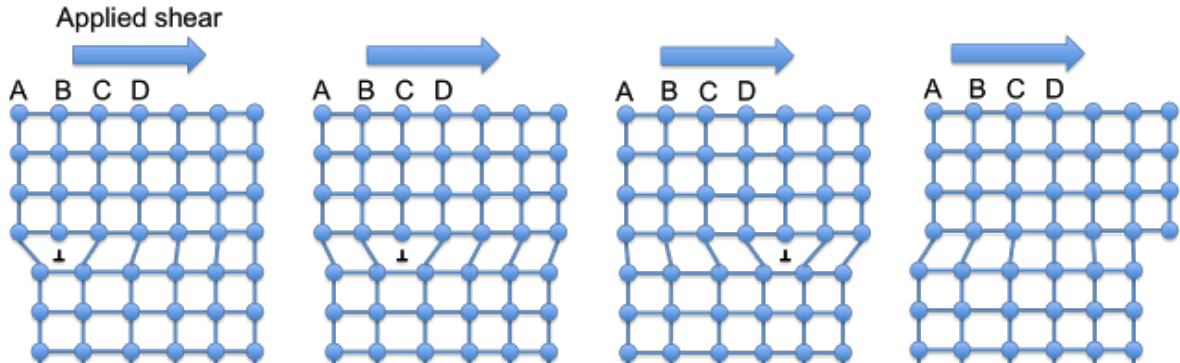
The diagram above shows how this movement happens step by step. As the applied shear force continues, the dislocation travels through the material from the interior towards the surface.
Effects on material properties
Dislocations have several important effects on the behaviour of metals:
Important
Critical Effects of Dislocations on Material Properties
- Stress concentration - The incomplete row of atoms creates areas of high stress within the material
- Crack initiation - When a dislocation reaches the surface, it often forms the starting point for a crack
- Material failure - These surface cracks can grow and eventually lead to complete failure of the component
- Changed mechanical properties - The presence of dislocations can make materials either harder or more brittle than intended
Movement under applied forces
The key characteristic of dislocations is their ability to move through the crystal when forces are applied. This movement happens because:
- The dislocation represents the easiest path for atoms to rearrange themselves
- Less energy is required to move a dislocation than to deform the perfect crystal structure
- The movement allows the material to accommodate the applied stress
However, this accommodation comes at a cost - as dislocations move and multiply, they weaken the material and create potential failure points.
Important
The Double-Edged Nature of Dislocation Movement
While dislocation movement allows materials to accommodate stress (which can be beneficial for ductility), it simultaneously creates weaknesses that can lead to catastrophic failure. This is why understanding and controlling dislocation behaviour is crucial in materials engineering.
Remember!
Summary
Key Points to Remember:
- Dislocations are line defects - they consist of incomplete rows of atoms that extend through the crystal structure
- Movement under stress - dislocations become mobile when shear forces are applied to the material
- Surface crack formation - when dislocations reach the surface, they typically create cracks that can grow
- Material failure pathway - the progression from internal dislocation to surface crack to complete failure is a common failure mechanism in metals
- Property changes - dislocations alter the mechanical properties of materials, often making them more prone to failure