Point Defects (Leaving Cert Engineering): Revision Notes
📚Revision Notes
Point Defects
Understanding metal defects
Metals naturally form organised arrangements of atoms called crystal lattice structures. However, achieving perfect crystal structures is impossible in real materials. All metals contain structural imperfections known as defects that can occur at single points, along lines, or across entire surfaces within the material.
Note
Perfect crystal structures are theoretically ideal but practically impossible to achieve. Even the most carefully manufactured metals will contain some level of structural imperfections due to the limitations of atomic arrangement during formation and cooling processes.
These defects significantly influence a metal's mechanical properties and behaviour. While minor defects can often be accommodated without major issues, severe defects may lead to crack formation and eventual component failure.
Important
The relationship between defects and material properties is crucial for engineering applications. Understanding how defects affect performance allows engineers to predict material behaviour and select appropriate materials for specific applications.
What are point defects?
Point defects are structural imperfections that occur at individual atomic positions within a crystal lattice. These localised disturbances affect only a few atoms and represent the smallest scale of defects possible in crystalline materials.
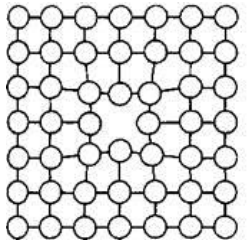
Point defects alter the regular geometric arrangement of atoms, which can modify the material's mechanical properties such as strength, hardness, and ductility. Understanding these defects is crucial for predicting how metals will behave under different conditions.
Note
Point defects are considered zero-dimensional defects because they occur at specific atomic positions rather than extending in any particular direction through the material, unlike line defects (dislocations) or surface defects (grain boundaries).
Types of point defects
Vacancy defects
A vacancy defect forms when one or more atoms are absent from their expected positions in the crystal lattice structure.
When atoms are missing, empty spaces or voids are created within the otherwise regular atomic arrangement. These vacant positions cause the surrounding material to distort inward as nearby atoms shift to fill the gap. This internal distortion can make the material more susceptible to deformation under applied forces.
Example
Formation During Cooling:
During metal forming operations, the cooling process can create vacancy defects through the following sequence:
- Hot metal has atoms with high kinetic energy
- As temperature drops, atoms lose energy and settle into positions
- Rapid cooling may prevent atoms from reaching ideal positions
- Some lattice sites remain empty, creating vacancy defects
Vacancy defects commonly occur during the cooling process after metal forming operations, as atoms may not settle into their ideal positions before the structure solidifies.
Substitution defects
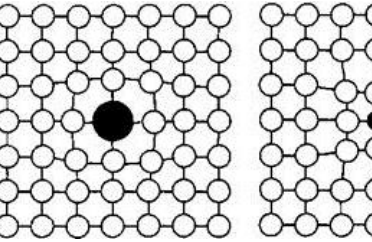
Substitution defects occur when foreign atoms replace the parent material's atoms within normal lattice positions.
The replacement atoms are typically different elements that have somehow entered the crystal structure during processing or service. This atomic substitution creates two distinct effects depending on the size relationship between the foreign and parent atoms:
- Larger foreign atoms: Create compressive stress in the surrounding lattice, potentially increasing material hardness but reducing ductility
- Smaller foreign atoms: Generate tensile stress that can lead to material softening and increased deformation susceptibility
Note
The degree of property change depends on the size difference between atoms. Small differences may have minimal effects, while large differences can dramatically alter material behaviour. This size relationship is often expressed as the atomic radius ratio between foreign and parent atoms.
These size mismatches disrupt the regular spacing of the crystal lattice, compromising the material's original properties.
Interstitial defects
An interstitial defect involves foreign atoms occupying the spaces between normal atomic positions rather than replacing existing atoms.
The term "interstitial" derives from the Latin word for "free space," accurately describing how these defects form. Foreign atoms squeeze into the gaps that naturally exist within crystal structures, creating additional stress concentrations.
Important
Critical Effects of Interstitial Defects:
Interstitial defects are generally undesirable because they:
- Place significant stress on the surrounding material
- Increase material hardness beyond design intentions
- Reduce ductility, making the material more brittle
- Create internal pressure that can initiate crack formation
These effects make interstitial defects particularly problematic in applications requiring material flexibility or impact resistance.
Effects on material properties
Point defects influence material behaviour by disrupting the regular atomic bonding patterns within the crystal structure. The specific effects depend on the type, size, and concentration of defects present.
Materials with high defect concentrations may exhibit unpredictable mechanical properties, making them unsuitable for critical applications where reliability is essential. Engineers must consider these defect-related property changes when selecting materials for specific applications.
Important
Engineering Considerations:
When defect concentrations exceed acceptable limits, materials may fail unexpectedly under normal operating conditions. This unpredictability poses significant risks in critical applications such as aerospace components, pressure vessels, or structural elements where failure could have catastrophic consequences.
Remember!
Summary
Key Points to Remember:
- Point defects are atomic-scale imperfections that occur at individual positions within crystal structures
- Vacancy defects create empty spaces where atoms are missing, causing inward distortion of surrounding material
- Substitution defects involve foreign atoms replacing parent atoms, with effects depending on relative atomic sizes
- Interstitial defects place foreign atoms in spaces between normal positions, typically increasing stress and brittleness
- All point defects can alter material properties like strength, hardness, and ductility in ways that affect engineering performance