The Hydrological Cycle (Leaving Cert Geography): Revision Notes
📚Revision Notes
The hydrological cycle
What is the hydrological cycle?
The hydrological cycle, also called the water cycle, is a fundamental geographical concept that explains how water moves and changes forms within our environment. This natural process is essential for sustaining life on Earth and plays a crucial role in shaping our planet's landscapes.
The cycle is vital for maintaining Earth's climate, regulating temperatures, and ensuring a continuous supply of freshwater for drinking, agriculture and industry. It demonstrates nature's sustainable water recycling system, showing how interconnected our planet's systems are.
Note
The hydrological cycle is a perfect example of Earth's interconnected systems working together. Changes in one part of the cycle can have far-reaching effects on weather patterns, climate, and water availability across the globe.
The hydrological cycle consists of four main stages: evaporation, condensation, precipitation, and runoff, along with the important process of infiltration.
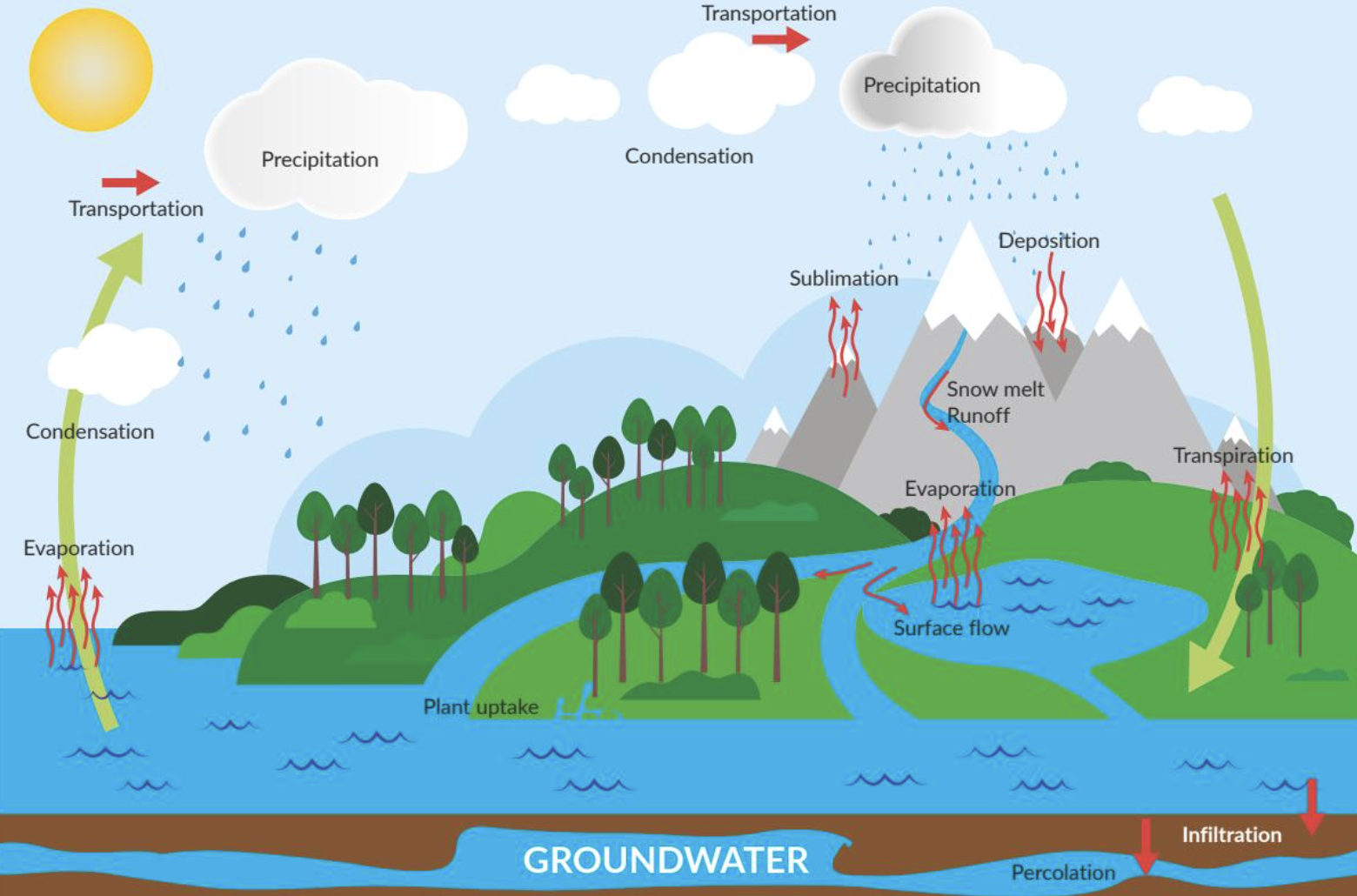
Evaporation
Evaporation is the initial step where water transforms from liquid to vapour. This process begins with the warmth of the sun, which provides the necessary energy to drive the transformation. When sunlight reaches the Earth's surface, it converts to energy in water bodies such as oceans, seas, lakes and rivers. This energy causes water molecules to become more energetic and break free from the liquid's surface, turning into water vapour.
Important
The sun is the primary energy source driving the entire hydrological cycle. Without solar energy, evaporation would not occur, and the water cycle would cease to function.
Several factors influence the rate of evaporation:
- Temperature: Higher temperatures increase evaporation rates as warmer water molecules possess more energy and are more likely to escape into the air
- Surface area: Larger water bodies provide more surface area for evaporation to occur, which is why oceans contribute significantly to the Earth's water vapour content
- Humidity: The amount of water vapour already present in the air affects evaporation. Dry air can absorb more moisture, encouraging faster evaporation
- Wind: Wind helps carry away water vapour rising from the surface, creating a continuous supply of drier air that encourages more evaporation
Evaporation has far-reaching implications. The water vapour released forms clouds, which eventually lead to precipitation, affecting weather patterns and influencing rainfall and snowfall. It is vital for replenishing freshwater resources and helps regulate Earth's climate by transporting heat from warm regions to cooler areas.
Condensation
Condensation is the crucial second step following evaporation. It is the process where water vapour in the atmosphere transforms back into liquid form, leading to cloud formation and, eventually, precipitation.
Condensation begins when warm, moisture-laden air rises and encounters cooler temperatures at higher altitudes. As air cools, it loses its capacity to hold moisture. The point at which air becomes saturated with moisture is called the dew point. When this occurs, the air cannot hold any more water vapour, causing excess water vapour to condense into tiny water droplets or ice crystals, depending on the temperature.
Note
The dew point is a critical concept in understanding condensation. It's the temperature at which air becomes saturated with water vapour. When air temperature drops to the dew point, condensation begins to occur.
Several factors affect condensation:
- Temperature: The cooling of air is the primary driver of condensation. Colder air is more efficient at causing water vapour to revert to its liquid form
- Humidity: Higher humidity levels mean there is more water vapour in the air. When air is close to its saturation point, even slight cooling can trigger condensation and cloud formation
- Nucleation: Water droplets often need tiny particles, known as condensation nuclei, to attach to before they can form clouds. These particles can be dust, salt or other airborne particles
Condensation creates clouds, which are visible collections of water droplets or ice crystals suspended in the atmosphere. The formation of clouds through condensation influences weather patterns and plays a key role in the distribution of precipitation. It is also essential for freshwater production, contributing to the formation of precipitation which recharges groundwater, fills lakes and rivers, and sustains life on Earth.
Precipitation
Precipitation is the culmination of several preceding processes, including evaporation, condensation and cloud formation. It is the critical step that brings water back to the Earth's surface, ensuring the continuous movement of water through our environment.
Within clouds, tiny water droplets or ice crystals continue to grow as they collide and merge. As these water droplets or ice crystals become larger and heavier, they eventually overcome air resistance and begin to fall towards the Earth's surface due to gravity.
Depending on temperature at different altitudes and the size of the water droplets or ice crystals, precipitation can take various forms:
- Rain (liquid water)
- Snow (ice crystals)
- Sleet (frozen raindrops)
- Hail (large, layered ice balls)
Important
Temperature is the key factor determining the type of precipitation. The temperature profile from cloud level to ground level determines whether precipitation falls as rain, snow, sleet, or hail.
Several factors impact the type, amount and distribution of precipitation:
- Temperature: This determines whether precipitation falls as rain, snow or other forms. Colder temperatures favour the freezing of water droplets, resulting in snow or other frozen precipitation
- Air masses: The characteristics of air masses, including their moisture content and temperature, influence the amount of moisture available for precipitation
- Topography: Mountainous areas can force moist air to rise, cool, and release moisture, leading to increased precipitation on windward sides and a rain-shadow effect on leeward sides
Precipitation is vital for several reasons. It provides the primary source of freshwater for human activities, including drinking, agriculture and industrial processes. It sustains natural ecosystems by nourishing plants and maintaining habitats for various species. Precipitation patterns influence climate and weather conditions, impacting regional climates and seasonal variations. However, excessive or insufficient precipitation can lead to natural hazards such as floods and droughts.
Runoff
Runoff, also known as surface runoff, is a critical component of the hydrological cycle that occurs when excess water, primarily from precipitation, flows over the Earth's surface. This process plays a crucial role in shaping landscapes, replenishing water bodies, and influencing weather patterns.
Runoff begins with precipitation, including rain, snow, sleet and hail. When the intensity of precipitation exceeds the rate at which the ground can absorb it (infiltration), runoff is initiated. Excess water starts to flow downhill due to gravity, following various pathways including roads, streets, rivers and streams. This flow is essential for gathering water and transporting it to larger water bodies.
As runoff progresses, it collects in natural or human-made channels, such as creeks or stormwater drains. Multiple smaller flows often converge into larger watercourses. Eventually, runoff reaches rivers, lakes, reservoirs or the ocean. In some cases, it may infiltrate into the ground and contribute to groundwater recharge.
Note
Runoff is nature's way of collecting and transporting water from various sources to larger water bodies. This process is essential for maintaining the flow of rivers and streams, especially during dry periods when groundwater discharge helps sustain water levels.
Several factors affect the amount and speed of runoff:
- Topography: The slope and shape of land determine how quickly runoff moves. Steep slopes typically lead to faster runoff, while flat areas may result in slower movement
- Soil type: Soil characteristics, such as permeability and porosity, influence infiltration rates. Sandy soils generally allow for more infiltration compared to clayey soils
- Land use: Urban areas with impermeable surfaces such as concrete and asphalt can increase runoff due to reduced infiltration. Conversely, natural landscapes with vegetation promote slower runoff
- Precipitation intensity: The intensity of rainfall or snowmelt events can greatly impact runoff. Heavy downpours are more likely to generate rapid runoff compared to lighter, sustained rain
Important
Urbanisation significantly increases runoff rates by creating impermeable surfaces that prevent water from infiltrating into the ground. This can lead to increased flood risks and reduced groundwater recharge in urban areas.
Understanding runoff is crucial for water resource management, erosion and sediment transport, flood management, and ecosystem health. Runoff contributes to filling rivers, lakes, and reservoirs, ensuring a constant supply of freshwater. It can erode soil and transport sediments downstream, shaping landscapes and influencing landform formation. Effective management of runoff is essential to mitigate flood risks, whilst proper runoff patterns sustain aquatic ecosystems.
Infiltration
Infiltration is a crucial process within the hydrological cycle where water from precipitation or other sources soaks into the ground and moves through soil and rock layers. This process plays a vital role in replenishing groundwater and maintaining the balance of water in the environment.
When precipitation reaches the Earth's surface, it interacts with the top layer of soil, known as the zone of aeration. This zone contains both air and water-filled spaces. Water moves downward through the soil and rock layers under the influence of gravity. This process is called percolation, and it continues until water reaches the zone of saturation, where all available spaces are filled with water.
Infiltrated water eventually contributes to groundwater, which is water stored beneath the Earth's surface. Groundwater serves as a vital source of freshwater for wells, springs and rivers.
Note
The journey from surface water to groundwater involves two key zones: the zone of aeration (where soil contains both air and water) and the zone of saturation (where all spaces are filled with water). Understanding these zones helps explain how groundwater is recharged and stored.
Several factors affect the rate and extent of infiltration:
- Soil type: Different soil types have varying levels of porosity and permeability. Sandy soils generally allow water to infiltrate quickly, while clay soils may slow down the process because they are more compact
- Vegetation: Vegetation can enhance infiltration by reducing surface runoff and encouraging water to seep into the ground. Plants also help maintain soil structure, which benefits infiltration
- Precipitation intensity: The intensity and duration of precipitation events can impact infiltration. Light, steady rain may infiltrate more effectively than heavy, intense rainfall that can lead to surface runoff
Infiltration plays a crucial role in maintaining ecosystem health and supporting human activities. Infiltrated water replenishes underground aquifers, which are essential sources of freshwater for drinking, agriculture and industry. By filtering water as it percolates through soil, infiltration helps improve the quality of surface waters in rivers, lakes and streams. Adequate infiltration can reduce surface runoff, lowering the risk of floods during heavy rainfall events. Infiltration supports vegetation growth and sustains natural habitats by providing water to plants and aquatic ecosystems.
Important
Human activities such as urbanisation and deforestation can significantly reduce infiltration rates. This can lead to increased flooding, reduced groundwater recharge, and degraded water quality. Sustainable land management practices are essential for maintaining healthy infiltration rates.
In some regions, human activities such as urbanisation and deforestation can reduce infiltration rates by altering soil structures and increasing surface runoff. Sustainable land use practices, such as preserving green spaces, promoting afforestation, and minimising soil disturbance, can help maintain healthy infiltration rates and protect groundwater resources.
Summary
Key Points to Remember:
- The hydrological cycle is a continuous process that moves water through evaporation, condensation, precipitation, runoff and infiltration
- Evaporation transforms liquid water to vapour using the sun's energy and is influenced by temperature, surface area, humidity and wind
- Condensation occurs when water vapour cools and reaches its dew point, forming clouds that will eventually produce precipitation
- Precipitation brings water back to Earth's surface in various forms (rain, snow, sleet, hail) depending on temperature and atmospheric conditions
- Runoff and infiltration determine whether water flows over the surface or soaks into the ground, affecting water resource management and ecosystem health