Ocean Currents (Leaving Cert Geography): Revision Notes
📚Revision Notes
Ocean currents
What are ocean currents?
Ocean currents are continuous flows of seawater that move through the world's oceans. These powerful water movements are driven by several key forces working together: wind patterns, the Coriolis effect from Earth's rotation, breaking waves, and differences in water temperature and salinity. Ocean currents are absolutely essential for Earth's climate system and play a vital role in supporting marine life across the globe.
Note
Ocean currents act like a global transportation system, moving not just water but also heat, nutrients, marine organisms, and even human-made materials across vast distances. This makes them crucial for understanding both natural climate patterns and human impacts on marine environments.
Types of ocean currents
Ocean currents can be divided into two main categories based on where they flow and what drives them.
Surface currents
Surface currents make up approximately 10% of all ocean water. These currents flow in the upper layers of the ocean, typically extending down to depths of around 400 metres. Wind is the primary driving force behind surface currents, with Earth's rotation also playing a significant role by deflecting their path through the Coriolis effect.
Deep-water currents
Deep-water currents account for the remaining 90% of ocean water. Unlike surface currents, these are driven by differences in water density, which depend on two main factors: temperature (thermal) and salinity (haline). This density-driven movement is called thermohaline circulation, and it forms a critical component of the global climate system by transporting heat and nutrients around the world.
Important
The 90-10 split between deep and surface currents shows that the vast majority of ocean water movement occurs in the deep ocean, largely invisible from the surface. This hidden circulation system has enormous influence on global climate despite being out of sight.
The global ocean conveyor belt
The global ocean conveyor belt, also known as thermohaline circulation, is a massive, continuous system of deep-ocean currents that spans the entire globe. This system plays a crucial role in regulating Earth's climate and supporting marine ecosystems worldwide.
How thermohaline circulation works
Thermohaline circulation operates based on water density differences created by temperature and salinity variations. Cold, salty water is denser than warm, less salty water, so it sinks towards the ocean floor. Meanwhile, warmer, less salty water remains near the surface due to its lower density. This creates a global pattern of circulation with both deep and surface currents.
The process begins in specific regions such as the North Atlantic and areas near Antarctica, where surface water becomes cold and salty enough to sink and form deep-water currents. These deep currents then slowly flow across ocean basins, travelling vast distances over centuries. Eventually, this deep water rises back to the surface through a process called upwelling, which occurs mainly in the Pacific and Indian Oceans.
Note
Think of thermohaline circulation like a slow-motion conveyor belt that takes hundreds to thousands of years to complete one full cycle. Water that sinks in the North Atlantic today might not return to the surface until it reaches the Pacific Ocean centuries later!
Importance of the conveyor belt
This circulation system is essential for distributing heat and nutrients around the globe. It influences climate patterns by moving warm water towards the poles and cold water towards the equator. The system also brings nutrients from the deep sea to the surface, which supports marine ecosystems and maintains ocean biodiversity.
Important
If the global ocean conveyor belt were to slow down or stop, it could dramatically alter global climate patterns. Some scientists worry that climate change could disrupt this system, potentially leading to rapid climate shifts in certain regions.
Deep-water currents
Deep ocean currents operate differently from surface currents as they are primarily driven by water density differences rather than wind. This process, known as thermohaline circulation, involves cold, saline water sinking to ocean depths whilst warmer, less saline water rises towards the surface.
Formation of deep currents
Deep currents begin their journey in polar regions where water becomes extremely cold and gains high salinity, making it very dense. This dense water sinks and creates a flow that moves along the ocean floor towards the equator. The movement is slow and steady, with water taking centuries to complete its journey across ocean basins.
Atlantic Meridional Overturning Circulation (AMOC)
Example
Key Example: Atlantic Meridional Overturning Circulation (AMOC)
The AMOC demonstrates how deep ocean currents work in practice:
Step 1: Warm water flows north
- Warm, salty surface water travels from the tropical Atlantic towards the Arctic
Step 2: Cooling and sinking
- In the North Atlantic, this water cools and becomes dense enough to sink
Step 3: Deep return journey
- The now-cold, dense water flows southward along the ocean floor
Step 4: Global connection
- This deep water eventually connects with the global conveyor belt system
Climate impact: The AMOC significantly influences weather patterns in Europe and North America, helping to keep Western Europe warmer than it would be otherwise.
Role in climate and ecosystems
Deep ocean currents serve as a global conveyor belt system, connecting the world's oceans and acting as a crucial mechanism for global heat distribution. They transfer warm water from the equator to the poles and vice versa, which is essential for regulating global climate and affects weather patterns and marine biodiversity.
Deep currents also play a vital role in nutrient cycling. As these currents travel, they transport oxygen and nutrients, supporting life in deep-sea ecosystems. This nutrient transport is essential for maintaining ocean biodiversity and supporting marine food chains.
Surface ocean currents
Surface ocean currents represent a major component of Earth's ocean system and significantly influence global climate patterns. These water movements occur at the ocean surface and are driven by several interconnected factors.
Driving forces of surface currents
Surface ocean currents are created by three primary factors: global wind patterns, Earth's rotation, and the configuration of ocean basins. Wind systems such as trade winds and westerlies are crucial in initiating surface water movement. These winds blow consistently over large ocean areas, pushing water to create currents.
Earth's rotation causes the Coriolis effect, which deflects the path of winds and currents. In the northern hemisphere, this deflexion is to the right, whilst in the southern hemisphere, it deflects to the left. The shape of ocean basins and continental coastlines also influence current direction and flow, as they can redirect, split, or concentrate water movement.
Note
The Coriolis effect is often misunderstood. It doesn't affect small-scale phenomena like water draining from a bathtub, but it has a significant impact on large-scale systems like ocean currents and weather patterns that operate over long distances and time periods.
Warm and cold currents
Surface ocean currents can be classified as either warm or cold, depending on their origin. Warm currents originate near the equator and flow towards the poles, whilst cold currents flow from polar or high-latitude regions towards the equator.
Example
Examples of Major Surface Currents
Warm Current - Gulf Stream:
- Origin: Gulf of Mexico
- Path: Along the east coast of the United States towards Europe
- Impact: Significantly warms the climate of Western Europe, including Ireland
- Speed: Can reach speeds of up to 2.5 metres per second
Cold Current - California Current:
- Origin: High-latitude regions of the North Pacific
- Path: Flows southward along the west coast of North America
- Impact: Brings cooler temperatures and supports marine ecosystems
- Effect: Creates the characteristic cool, foggy climate of the California coast
Gyres
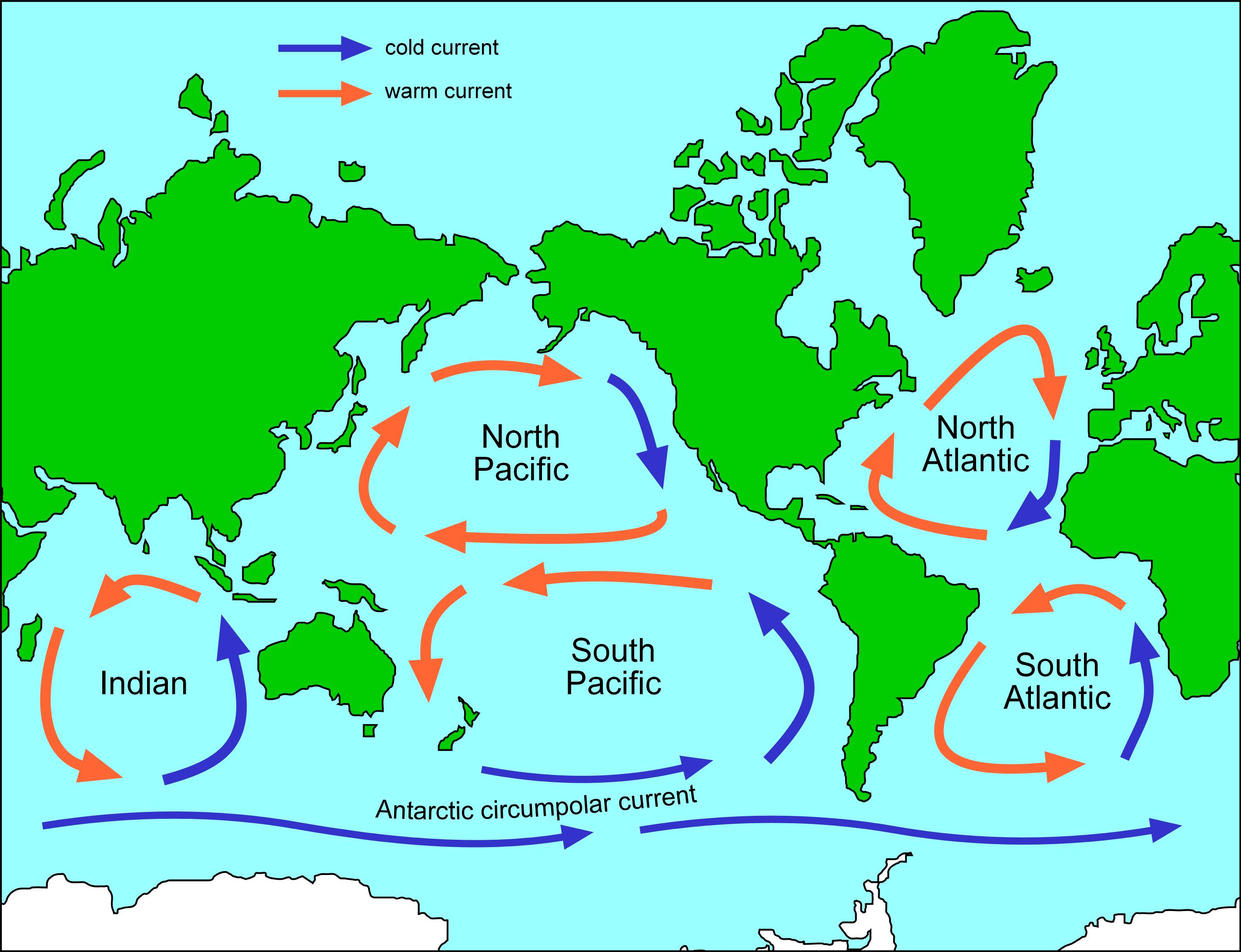
Gyres are large systems of circular surface ocean currents that form due to Earth's wind patterns and the forces created by planetary rotation. These immense, rotating ocean currents are fundamental in determining continental climates and are essential for marine navigation and biology.
Formation of gyres
Gyres are primarily formed by major wind patterns such as trade winds, westerlies, and polar easterlies. Earth's rotation contributes through the Coriolis effect, which causes currents to shift direction - clockwise in the northern hemisphere and anticlockwise in the southern hemisphere.
Important
The direction of gyre rotation is always the same within each hemisphere due to the Coriolis effect. This consistent pattern helps scientists predict current flows and is crucial for understanding global ocean circulation.
The five major gyres
There are five major ocean gyres:
- the North Atlantic
- South Atlantic
- North Pacific
- South Pacific
- Indian Ocean gyres. Each occupies a vast area within their respective ocean basins. For example, the North Atlantic Gyre, which includes the Gulf Stream, significantly influences the climate of western Europe, including Ireland, by transporting warm water from equatorial regions towards the north.
These gyre systems demonstrate the interconnected nature of ocean currents and their profound impact on global climate patterns, making them essential components of Earth's climate system.
Note
Ocean gyres also concentrate floating debris, including plastic waste, in their centres. The most famous example is the Great Pacific Garbage Patch, which has formed in the centre of the North Pacific Gyre due to the circular current patterns.
Summary
Key Points to Remember:
- Ocean currents are continuous seawater movements driven by wind, Earth's rotation, and temperature/salinity differences
- Surface currents (10% of ocean water) are wind-driven, whilst deep-water currents (90%) are driven by density differences
- The global ocean conveyor belt (thermohaline circulation) redistributes heat and nutrients worldwide, regulating Earth's climate
- The Atlantic Meridional Overturning Circulation (AMOC) is a key example of how deep currents influence regional weather patterns
- Five major gyres create large circular current systems that significantly impact continental climates through heat transport
- The Coriolis effect causes currents to deflect right in the northern hemisphere and left in the southern hemisphere
- Cold, salty water sinks while warm, fresh water rises, driving the global circulation system