Coordinating the Plane (Leaving Cert Mathematics): Revision Notes
📚Revision Notes
Coordinating the Plane
What is the coordinate plane?
The coordinate plane is a flat surface divided by two perpendicular lines that help us locate any point precisely. Think of it like a map grid that mathematicians use to pinpoint exact locations.
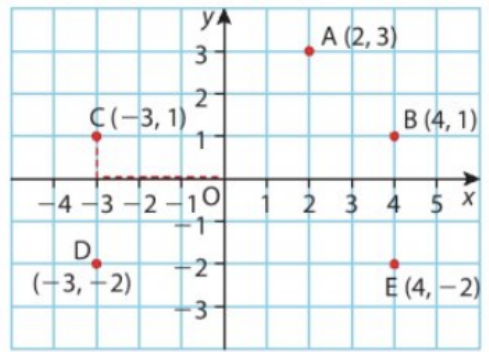
This system consists of several key components that work together to create our coordinate system.
The axes
The coordinate plane has two main reference lines called axes.
The x-axis is the horizontal line that runs left to right across the plane. You can remember this because it goes "across" the page.
The y-axis is the vertical line that runs up and down through the plane. This line helps us measure how high or low a point sits.
These two axes intersect (cross each other) at a special point called the origin.
Note
Remember the simple memory trick: the x-axis goes "across" horizontally, while the y-axis goes "up and down" vertically. This will help you never confuse the two!
The origin
The origin is the point where the x-axis and y-axis meet. It has coordinates and is usually labelled with the letter O. This serves as the starting point for all measurements on the coordinate plane.
The Cartesian plane
This entire coordinate system is called the Cartesian plane, named after the French mathematician René Descartes (1596-1650) who developed this method of representing points using numbers.
Note
Historical Context
The Cartesian plane is named in honour of René Descartes, a French mathematician who lived from 1596 to 1650. His innovation of using coordinates to represent points revolutionised mathematics by connecting algebra and geometry.
How to read coordinates
Every point on the coordinate plane can be described using a pair of numbers called coordinates. These are written in the form , where:
- The first number tells us how far to move horizontally from the origin
- The second number tells us how far to move vertically from the origin
Important
Critical Rule: Coordinate Order
Coordinates are ALWAYS written as - never .
To remember the order, think "along the corridor, then up the stairs" - move horizontally first, then vertically.
The four quadrants
The coordinate plane is divided into four regions called quadrants. These are numbered using Roman numerals and help us describe the general location of points.
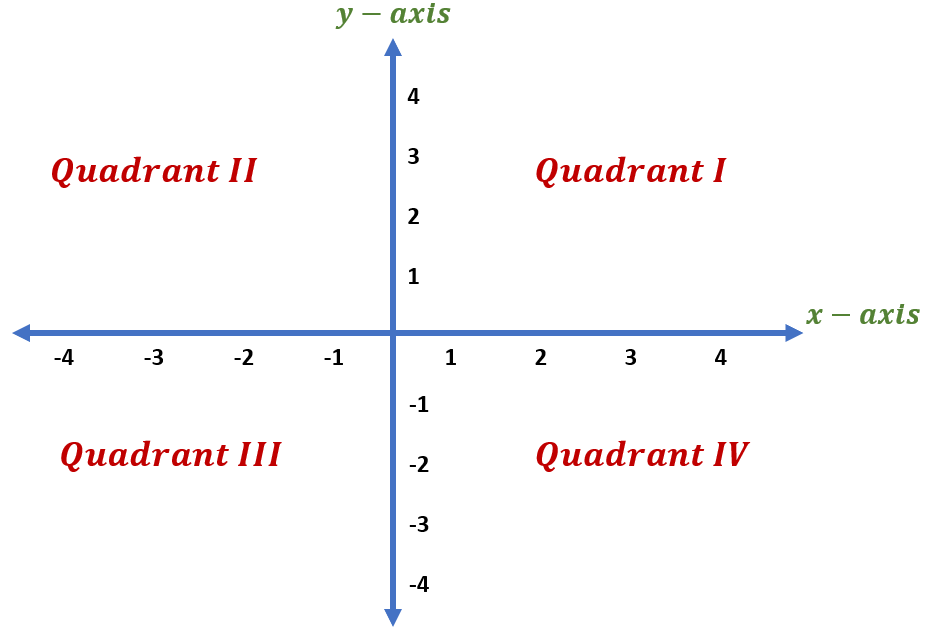
- First Quadrant (I): Top-right region where both and are positive
- Second Quadrant (II): Top-left region where is negative and is positive
- Third Quadrant (III): Bottom-left region where both and are negative
- Fourth Quadrant (IV): Bottom-right region where is positive and is negative
Note
The quadrants are numbered using Roman numerals (I, II, III, IV) and go anticlockwise starting from the top-right quadrant. This numbering system is standard in mathematics worldwide.
Special positions on the plane
Some points have special positions worth noting:
Points on the x-axis have a y-coordinate of , such as or .
Points on the y-axis have an x-coordinate of , such as or .
The origin lies on both axes simultaneously.
Note
When a point lies exactly on one of the axes, it doesn't belong to any quadrant - it's considered to be "on the axis" rather than "in a quadrant."
Worked example 1: Plotting basic points
Example
Worked Example: Plotting Points A(2, 3), B(4, 1), C(-3, 1), D(-3, -2), and E(4, -2)
Step 1: Start at the origin for each point.
Step 2: For point A, move units right along the x-axis, then units up.
Step 3: For point B, move units right, then unit up.
Step 4: For point C, move units left (negative direction), then unit up.
Step 5: For point D, move units left, then units down (negative direction).
Step 6: For point E, move units right, then units down.
Worked example 2: Creating geometric shapes
Example
Worked Example: Creating a Rectangle
When we plot the points A, B, C, and D and connect them, we create a rectangle.
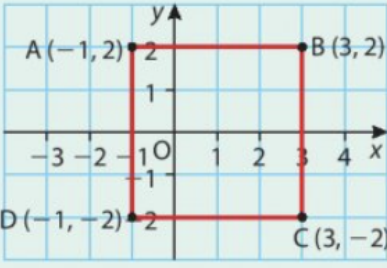
Step 1: Plot each point using the method above.
Step 2: Connect the points in order: A to B, B to C, C to D, and D back to A.
Step 3: Notice that opposite sides are parallel and equal, confirming we have a rectangle.
Finding midpoints: The midpoint of line segment BC can be found by looking at the grid. Since B is at and C is at , the midpoint lies exactly halfway between them at .
Worked example 3: Identifying quadrants
Example
Worked Example: Determining Quadrant Locations
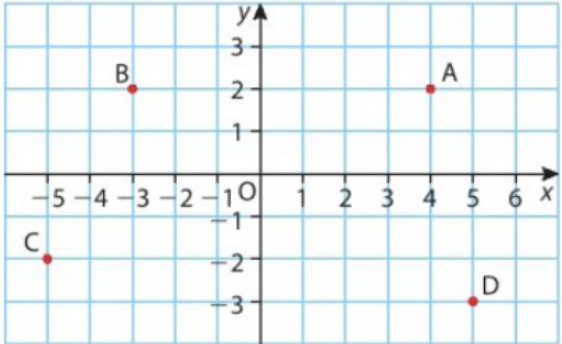
For the point : Both coordinates are positive, so this point lies in the First Quadrant.
For the point : Both coordinates are negative, so this point lies in the Third Quadrant.
For the point : is positive, is negative, so this point lies in the Fourth Quadrant.
For the point : is negative, is positive, so this point lies in the Second Quadrant.
Important
Exam Tips and Common Mistakes
- Always check your coordinate order - it's , not
- When plotting negative coordinates, remember to move in the opposite direction
- Quadrant identification is a common exam question - practise until it becomes automatic
- Use the grid lines to count accurately when plotting points
- Label your points clearly with their coordinates when required
- Remember: points on the axes don't belong to any quadrant
Summary
Key Points to Remember:
- The coordinate plane consists of two perpendicular axes that intersect at the origin
- The x-axis is horizontal and the y-axis is vertical
- Coordinates are written as - move horizontally first, then vertically
- The plane is divided into four quadrants numbered I, II, III, IV anticlockwise from the top-right
- Points on axes have one coordinate equal to zero, while the origin has both coordinates equal to zero
- The system is called the Cartesian plane after René Descartes