Slope of a Line (Leaving Cert Mathematics): Revision Notes
📚Revision Notes
Slope of a Line
What is slope?
The slope of a line measures how steep the line is. It tells us how much the line rises or falls as we move from left to right along it.
The slope is calculated as the vertical change divided by the horizontal change, which is also called rise over run.
Note
Think of slope like climbing stairs - the steeper the stairs, the greater the slope! The slope tells you exactly how much you go up (or down) for every step you take horizontally.
The slope formula
When we have two points on a line, we can calculate the slope using this formula:
Where:
- represents the slope
- is the first point
- is the second point
This formula works by finding the vertical change and dividing it by the horizontal change .
Calculating slope step by step
To find the slope between two points, follow this systematic approach:
Example
Step-by-Step Process: Calculating Slope
- Identify your points: Label them as and
- Find the vertical change: Subtract from
- Find the horizontal change: Subtract from
- Divide: Put the vertical change over the horizontal change
Understanding positive and negative slopes
The sign of the slope tells us the direction of the line:
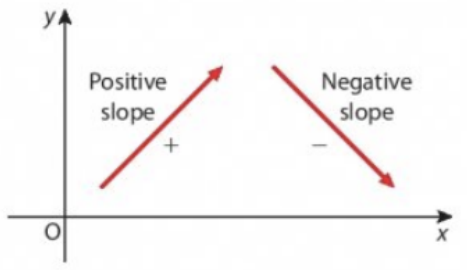
- Positive slope: The line rises as we move from left to right. The line goes upward.
- Negative slope: The line falls as we move from left to right. The line goes downward.
Note
Memory Tip: When you look at a line from left to right:
- If it's going up, the slope is positive
- If it's going down, the slope is negative
Parallel lines and slope
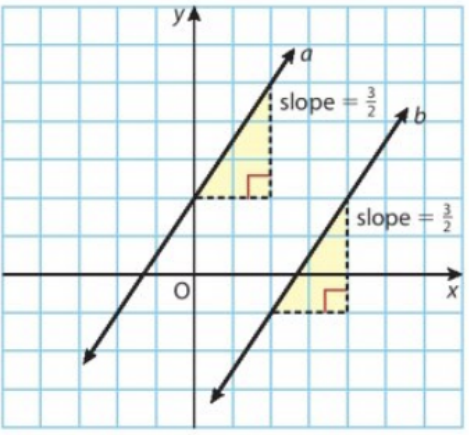
Parallel lines are lines that never meet and always stay the same distance apart.
Important
Key Property of Parallel Lines: Parallel lines have equal slopes.
If two lines are parallel, their slopes will be exactly the same. For example, if one line has a slope of , then any line parallel to it will also have a slope of .
Perpendicular lines and slope
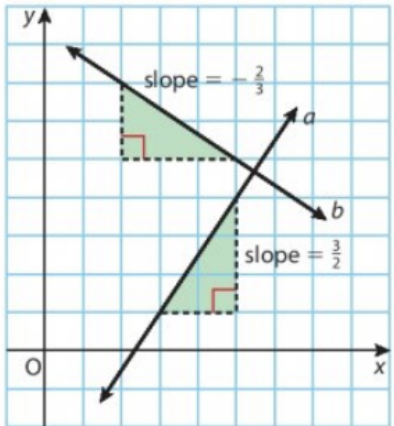
Perpendicular lines meet at right angles (90°).
Important
Key Property of Perpendicular Lines: If two lines are perpendicular, the product of their slopes equals -1.
This can be written as:
For example, if one line has a slope of , then a perpendicular line will have a slope of because:
Worked examples
Example
Example 1: Basic Slope Calculation
Problem: Find the slope of line AB where A = (3, -1) and B = (5, 2).
Solution: Using the slope formula:
- Point A:
- Point B:
Therefore, the slope of line AB is .
Example
Example 2: Proving Perpendicular Lines
Problem: Show that line AB is perpendicular to line CD where A(-1, 0), B(3, 2), C(-1, 4), and D(2, -2).
Solution: First, find the slope of AB:
Next, find the slope of CD:
Check if the product equals -1:
Since the product of the slopes is -1, line AB is perpendicular to line CD.
Example
Example 3: Identifying Slope from a Graph
When looking at a graph, you can estimate slope by:
- Picking two clear points on the line
- Counting the vertical change (up or down)
- Counting the horizontal change (left or right)
- Dividing vertical by horizontal
Remember that going up or right gives positive values, while going down or left gives negative values.
Summary
Key Points to Remember:
- Slope formula: - this is your most important tool
- Positive slopes go upward from left to right, negative slopes go downward
- Parallel lines always have the same slope value
- Perpendicular lines have slopes that multiply to give -1
- Rise over run - count vertical change over horizontal change when reading from graphs