Probability and Chance (Leaving Cert Mathematics): Revision Notes
📚Revision Notes
Probability and Chance
What is probability?
Probability is a way of using numbers to measure how likely something is to happen. We use probability every day without realising it - when you hear weather forecasts, they often use probability language.
For example, you might hear phrases like:
- "There is a strong likelihood of rain tomorrow"
- "In the afternoon there is a possibility of thunder"
- "The rain will probably clear towards evening"
These are all ways of describing how likely different weather events are to occur.
Note
Notice how we use probability language in everyday conversation without even thinking about it mathematically. Weather forecasters are actually giving us informal probability estimates!
The probability scale
The probability scale runs from 0 to 1, where:
- 0 means an event is impossible (it cannot happen)
- 1 means an event is certain (it will definitely happen)
- All other probabilities fall somewhere between 0 and 1

The probability scale can also be shown with more detailed descriptions:

Important
Key rule: The more likely an event is to happen, the closer its probability value is to 1. The less likely an event is, the closer its probability value is to 0.
Describing probability with words
We can describe the likelihood of events using everyday language:
- Impossible - probability = 0 (cannot happen)
- Very unlikely - probability close to 0
- Unlikely - probability less than 0.5
- Even chance - probability = 0.5 or (equally likely to happen or not happen)
- Likely - probability greater than 0.5
- Very likely - probability close to 1
- Certain - probability = 1 (will definitely happen)
Note
The term "even chance" is particularly important - it means the event is equally likely to happen or not happen, like flipping a fair coin.
Worked examples
Example
Worked Example 1: Identifying probability types
Let's classify some everyday events:
Certain events (probability = 1):
- The sun will rise tomorrow
- You will get older next year
Impossible events (probability = 0):
- Rolling a 7 on a normal six-sided dice
- Drawing a black card from a pack containing only red cards
Even chance events (probability = 0.5):
- A coin landing on heads when flipped
- The next baby born being a boy or girl
Example
Worked Example 2: Using spinners to understand probability
When we have a spinner that is divided equally, we can work out probabilities by counting sections.
For a spinner divided into equal red and green sections:
- Probability of landing on red = number of red sections ÷ total number of sections
- If there are equal amounts of red and green, each has probability = 0.5
Example
Worked Example 3: Comparing different spinners
Different spinners give us different probabilities depending on how they're divided.
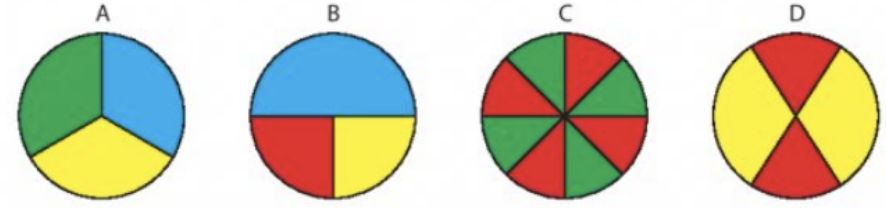
- Spinner A: Three equal sections means each colour has probability =
- Spinner B: Four equal sections means each colour has probability =
- Spinner C: Eight equal sections - count the sections of each colour to find probabilities
- Spinner D: Four sections - but they may not all be equal in size
Common exam tips
Important
Essential Exam Tips:
- Always check your probabilities: All probability values must be between 0 and 1 (inclusive)
- Even chance always equals 0.5 or : This is when outcomes are equally likely
- Use the probability scale: Draw or visualise the scale to help place events correctly
- Read carefully: Words like "impossible", "certain", "likely" have specific mathematical meanings
- Count systematically: When working with spinners or other equipment, count sections carefully
Summary
Key Points to Remember:
- Probability measures likelihood using numbers from 0 to 1
- Impossible events have probability 0, certain events have probability 1
- Even chance means probability = 0.5 - the event is equally likely to happen or not happen
- The probability scale helps us visualise how likely different events are
- Probability language connects everyday words with mathematical values