Religion and Values (Leaving Cert Religious Education): Model Answers
📚Model Answers
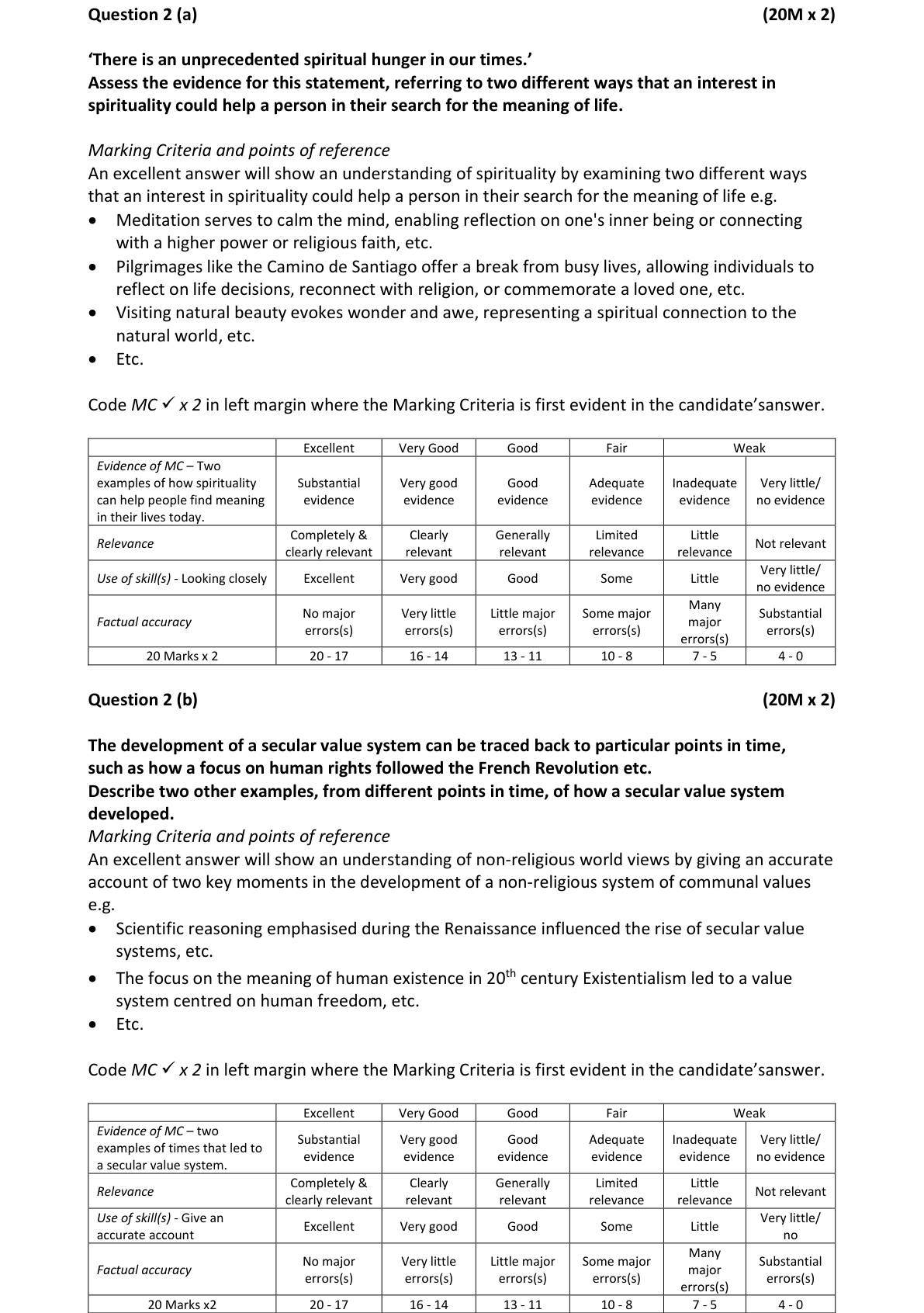
Spiritual Hunger and Secular Value System Development
Sample Answer
Question 2(a)
There is substantial evidence to support the statement that there is an unprecedented spiritual hunger in our times. In an increasingly secular and materialistic world, many people are searching for deeper meaning and purpose beyond consumerism and career success. This spiritual hunger manifests itself in various ways, and I will examine two different approaches to spirituality that help individuals in their search for the meaning of life: meditation practices and pilgrimage journeys.
Firstly, meditation has become increasingly popular in contemporary society as a way of addressing spiritual hunger. Meditation serves to calm the mind, enabling reflection on one's inner being and connecting with something greater than oneself. In our fast-paced, technology-driven world, many people feel disconnected from their authentic selves and struggle with stress, anxiety and a sense of meaninglessness. Meditation offers a way to step back from the constant noise and distractions of modern life and engage in deep introspection. Evidence for this can be seen in the growing popularity of mindfulness meditation, which has its roots in Buddhist spiritual practice but has been adapted for secular contexts. Many people report that regular meditation helps them gain clarity about their values, discover a sense of inner peace, and feel more connected to the transcendent dimension of existence. Whether one interprets this transcendence in religious terms (as connection with God or a higher power) or in secular terms (as connection with one's deepest self), meditation provides a practical tool for exploring spiritual questions and finding meaning. The fact that meditation apps, retreats and courses have seen exponential growth in recent years demonstrates the widespread spiritual hunger that exists.
Secondly, pilgrimage journeys represent another significant way that people today are exploring spirituality in their search for meaning. Pilgrimages like the Camino de Santiago in Spain have experienced a remarkable resurgence, with hundreds of thousands of people walking the route each year. These pilgrimages offer a break from busy lives, allowing individuals to reflect on life decisions, reconnect with religious faith, or commemorate a loved one. The physical challenge of a pilgrimage, combined with the time for contemplation and the sense of being part of an ancient spiritual tradition, creates conditions for deep personal transformation. Many pilgrims report experiencing profound insights about the meaning and direction of their lives. The popularity of pilgrimage in our secular age is striking evidence of spiritual hunger – people are willing to take weeks away from work and family, endure physical hardship, and invest considerable resources in these journeys, suggesting a deep need for spiritual experience that is not being met by conventional modern life. The pilgrimage also offers community, as walkers share their stories and support one another, addressing the isolation and fragmentation that characterises much of contemporary society.
In assessing the evidence, it is clear that the spiritual hunger described in the statement is real and widespread. The growth of meditation and pilgrimage cannot be explained purely in terms of health benefits or tourism; rather, these practices meet a deep human need for transcendence, meaning and connection. Both approaches help individuals in their search for meaning by providing structured ways to step outside ordinary life, engage in self-reflection, and explore existential questions. They offer alternatives to the dominant secular materialist worldview that many find spiritually unsatisfying. The unprecedented nature of this spiritual hunger can be seen in how people are drawing on ancient spiritual traditions (Buddhist meditation, Christian pilgrimage) while often adapting them to contemporary contexts, suggesting that traditional religious institutions are not fully meeting people's spiritual needs. This represents a significant cultural shift and confirms that spirituality remains a vital dimension of human experience, even in our secular age.
Question 2(b)
The development of secular value systems can indeed be traced to particular historical moments when non-religious frameworks for understanding ethics and meaning emerged. I will describe two examples from different periods: the influence of scientific reasoning during the Renaissance, and the development of Existentialism in the 20th century.
The first significant development occurred during the Renaissance period (14th-17th centuries), when scientific reasoning began to be emphasised, influencing the rise of secular value systems. Prior to this period, the Catholic Church dominated European intellectual life and provided the primary framework for understanding ethics, meaning and human existence. However, during the Renaissance, there was a renewed interest in classical Greek and Roman thought, along with groundbreaking scientific discoveries. Figures like Galileo Galilei used empirical observation and mathematical reasoning to understand the natural world, sometimes contradicting Church teachings – for example, his support for the heliocentric model of the solar system challenged biblical interpretations. This scientific approach represented a shift towards valuing evidence, reason and human inquiry over religious authority and revelation. The Renaissance humanists, such as Erasmus, emphasised human dignity, individual potential and the value of education, placing humanity rather than God at the centre of their worldview. This laid the groundwork for secular ethics based on human flourishing rather than divine commandment. The emphasis on scientific reasoning meant that moral questions could be approached through rational analysis of human welfare and social good, rather than exclusively through reference to scripture or church doctrine. This represented a fundamental shift in how values were justified and developed, moving from a theological foundation to a humanistic one. The Renaissance thus marks a crucial point in the development of secular value systems, establishing reason and human experience as legitimate sources of moral authority alongside religious tradition.
The second example comes from 20th century Existentialism, which emerged particularly in the aftermath of the World Wars. Philosophers like Jean-Paul Sartre, Simone de Beauvoir and Albert Camus developed a value system centred on human freedom, authenticity and personal responsibility in a universe without inherent meaning. Sartre famously declared that "existence precedes essence," meaning that humans are not created with a predetermined purpose or nature (as religious worldviews claim), but must instead create their own meaning through their choices and actions. This represented a distinctly secular approach to the question of life's meaning. The focus on human existence and the individual's subjective experience led to an ethical framework based on authenticity (being true to oneself), freedom (recognising one's radical liberty to choose), and responsibility (accepting the consequences of one's choices). Existentialists argued that individuals must create their own values in an absurd, meaningless universe – a directly secular position that rejects the notion of God-given moral laws. This philosophy gained widespread cultural influence in the mid-20th century, shaping literature, film and popular attitudes. The Existentialist emphasis on individual freedom and subjective meaning contributed to movements for personal liberation, including feminism (as developed by de Beauvoir) and challenges to traditional social conventions. It provided a framework for living meaningfully in a secular age, without recourse to religious belief. The impact of Existentialism on contemporary secular culture is evident in ongoing emphases on personal authenticity, individual choice and the idea that each person must find or create their own meaning and values.
Both examples demonstrate how secular value systems developed at specific historical moments in response to particular circumstances. The Renaissance represented a shift towards reason and human-centredness that challenged religious authority, while 20th century Existentialism provided a coherent philosophical framework for living meaningfully in a world without God. These developments show that secular values did not simply emerge naturally, but were actively constructed by thinkers responding to the intellectual and social conditions of their times. Together, they illustrate the historical trajectory from a religiously-dominated worldview towards the secular, pluralistic value systems that characterise much of contemporary Western society.
Note
Examiner's Commentary
This is an excellent response that demonstrates comprehensive understanding of both spiritual and secular approaches to meaning. The answer provides substantial evidence for spiritual hunger through detailed exploration of meditation and pilgrimage, showing clear understanding of how these practices help individuals find meaning in contemporary society. For part (b), the response traces secular value development accurately through two well-chosen historical examples - Renaissance humanism and 20th century Existentialism - with precise reference to key thinkers and their contributions. The writing is coherent and well-structured throughout, with relevant examples integrated effectively. The answer shows sophisticated understanding of the relationship between historical context and the development of value systems, fully addressing both parts of the question with appropriate depth and factual accuracy.
Estimated Mark Breakdown
| Criteria | Commentary | Likely Mark Range |
|---|---|---|
| Evidence of MC × two examples of how spirituality can help people in the search for meaning of life in their lives today | Substantial evidence provided through detailed exploration of meditation and pilgrimage with clear explanation of how each helps people find meaning | 20-17 |
| Relevance | Completely and clearly relevant to the question, directly addressing spiritual hunger and meaning-seeking throughout | 20-17 |
| Use of ability - Looking closely | Excellent analysis showing deep understanding of both practices and their significance in contemporary spirituality | 20-17 |
| Factual accuracy | No major errors; accurate references to meditation practices, Camino de Santiago, and contemporary spiritual trends | 20-17 |
| Evidence of MC - two examples of times that led to a secular value system | Substantial evidence with accurate account of Renaissance humanism and 20th century Existentialism as distinct historical developments | 20-17 |
| Relevance | Completely and clearly relevant, directly addressing secular value development with appropriate historical examples | 20-17 |
| Use of ability - Give an accurate account | Excellent accurate account of both historical periods with specific references to key figures and ideas | 20-17 |
| Factual accuracy | No major errors; accurate references to Renaissance thinkers, Galileo, Sartre, and Existentialist philosophy | 20-17 |
Marking Scheme