Key Terminology (Grade 12 NSC Matric Life Sciences): Revision Notes
📚Revision Notes
Key Terminology
Understanding reproductive terminology
When studying human reproduction, it's essential to master the key scientific terms that describe the processes and structures involved. These terms form the foundation for understanding how humans reproduce and ensure species survival. Let's explore the most important vocabulary you need to know.
Basic concepts: Diploid and haploid cells
Before diving into specific reproductive terms, you need to understand the difference between diploid and haploid cells, as this concept underlies all reproductive processes.
Important
Understanding the difference between diploid and haploid cells is fundamental to grasping all reproductive processes. This concept appears in virtually every exam question about reproduction, so make sure you master it completely.
Diploid cells (2n) are body cells that contain two complete sets of chromosomes. In humans, this means chromosomes arranged in pairs. All your body cells - from skin cells to muscle cells - are diploid. When these cells need to divide for growth or repair, they use a process called mitosis, which produces identical diploid cells.
Haploid cells (n) contain only one set of chromosomes - exactly half the normal number. In humans, haploid cells have chromosomes (one from each pair). These special cells are the reproductive cells, and they're produced through a different type of cell division called meiosis.
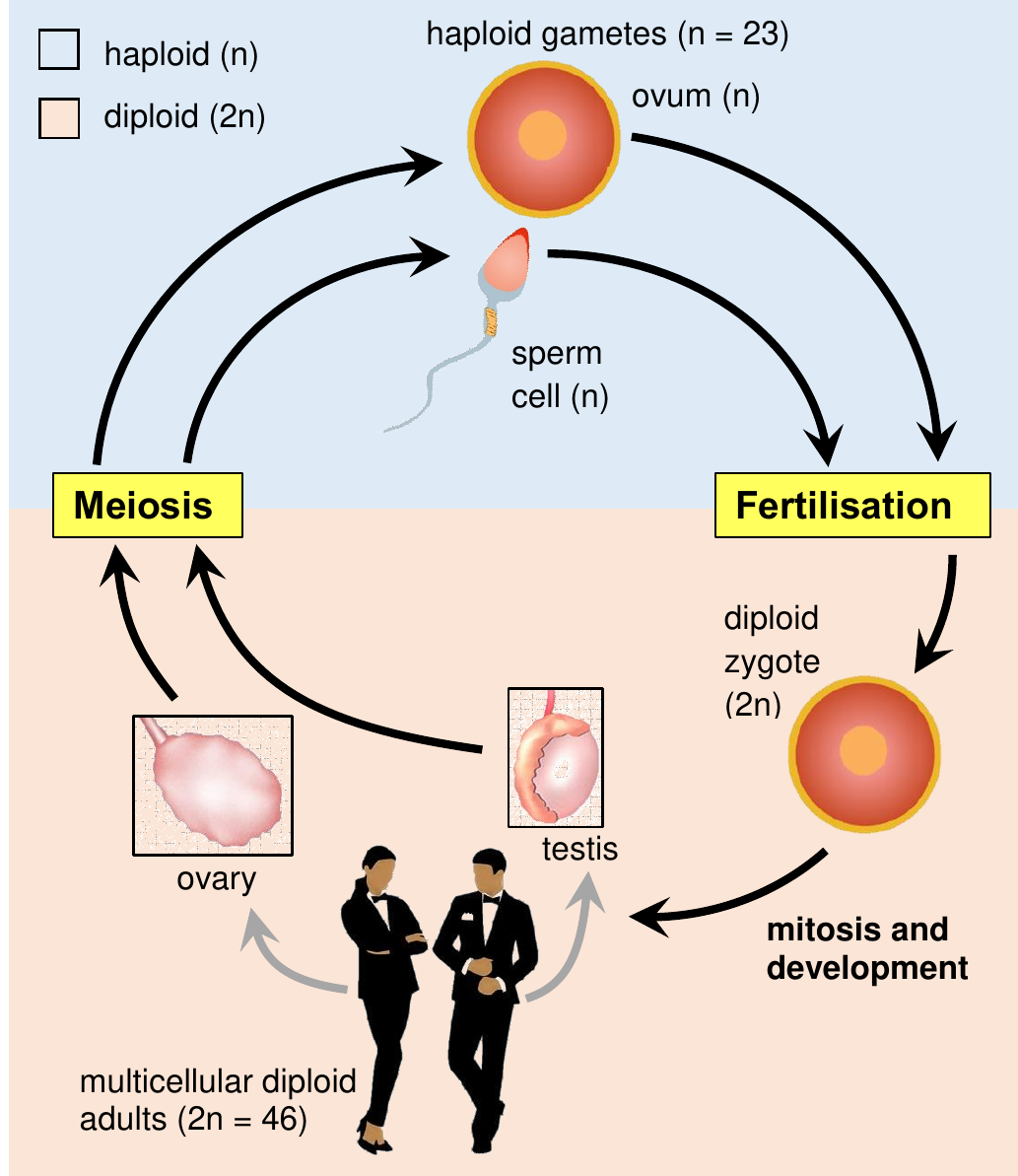
Note
The diagram above shows how these different types of cells interact in the human life cycle, demonstrating the alternation between haploid and diploid phases that characterises sexual reproduction. Pay close attention to how the chromosome number changes at each stage.
Essential reproductive terminology
Now let's examine the key terms you'll encounter when studying human reproduction:
Gametes: The reproductive cells
A gamete is a specialised reproductive cell that contains half the normal number of chromosomes (haploid). In humans, there are two types of gametes: sperm cells (male gametes) and egg cells or ova (female gametes). Each gamete carries chromosomes, and when two gametes fuse during fertilisation, they create a diploid zygote with the full complement of chromosomes.
Note
Think of gametes as puzzle pieces - each one carries half the genetic information needed to create a new organism. Only when two pieces come together can the complete picture emerge.
Gametogenesis: Making reproductive cells
Gametogenesis refers to the overall process by which gametes are produced in the reproductive organs. This process occurs through meiosis in both the testes (male reproductive organs) and ovaries (female reproductive organs). Gametogenesis is crucial because it reduces the chromosome number from diploid to haploid, ensuring that when fertilisation occurs, the offspring will have the correct number of chromosomes.
Oogenesis: Egg cell production
Oogenesis is the specific term for the production of egg cells (ova) in the ovaries. This process involves meiosis, where diploid cells in the ovaries divide to produce haploid egg cells. Oogenesis is a complex process that begins before birth and continues throughout a woman's reproductive years, with typically one mature egg being released each month during ovulation.
Spermatogenesis: Sperm cell production
Spermatogenesis describes the production of sperm cells in the testes. Like oogenesis, this process uses meiosis to create haploid gametes from diploid cells. However, unlike oogenesis, spermatogenesis is a continuous process that produces millions of sperm cells throughout a man's adult life. The process takes approximately 74 days from start to finish.
Germinal epithelium: Where it all begins
The germinal epithelium is the specialised tissue found on the surface of both testes and ovaries. This cuboidal epithelium is where gametogenesis begins - it contains the primitive cells that will eventually develop into mature sperm and egg cells. Think of the germinal epithelium as the "nursery" where reproductive cells begin their journey to maturity.
Common misconceptions to avoid
Important
Avoid These Common Mistakes:
Many students confuse mitosis and meiosis. Remember:
- Mitosis = Growth and repair of body cells (diploid to diploid)
- Meiosis = Production of gametes (diploid to haploid)
Another common error is thinking that all cells in the body are diploid. Remember that mature gametes are haploid - this is essential for sexual reproduction to work properly.
Exam tips
Example
Exam Success Strategy: Answering Reproduction Questions
- When answering questions about reproductive terminology, always specify whether cells are haploid or diploid
- Remember the chromosome numbers: diploid = chromosomes , haploid = chromosomes
- Link processes to their locations: oogenesis in ovaries, spermatogenesis in testes
- Understand that gametogenesis is the umbrella term that includes both oogenesis and spermatogenesis
Remember!
Summary
Key Points to Remember:
- Gametes are haploid reproductive cells - sperm and egg cells each contain chromosomes
- Gametogenesis produces gametes through meiosis - this happens in both ovaries and testes
- Oogenesis creates egg cells in ovaries, while spermatogenesis produces sperm in testes
- Germinal epithelium is the starting tissue where reproductive cells begin their development
- Understanding haploid vs diploid is crucial - body cells are diploid ( chromosomes), gametes are haploid ( chromosomes)