The Menstrual Cycle (Grade 12 NSC Matric Life Sciences): Revision Notes
📚Revision Notes
The Menstrual Cycle
Introduction to the menstrual cycle
The menstrual cycle is a monthly process that occurs in the female reproductive system. It involves coordinated changes in both the ovaries and uterus over approximately 28 days. This cycle begins when a girl reaches puberty and continues until menopause, typically between ages 45-55. Understanding this cycle is crucial for comprehending human reproduction and how the female body prepares for potential pregnancy each month.
Note
The menstrual cycle represents one of the most sophisticated biological timing systems in the human body, involving precise coordination between the brain, ovaries, and uterus to maintain reproductive health.
Essential terminology
Before diving into the cycle details, let's understand the key terms that will help you master this topic:
Graafian follicle - This is a mature structure in the ovary that contains a developing egg surrounded by fluid. Think of it as the egg's protective home where it grows and prepares for release.
Ovulation - This is the exciting moment when a mature egg bursts out of its follicle and is released from the ovary, ready for potential fertilisation.
Endometrium - This refers to the special lining inside the uterus that thickens each month to create a welcoming environment for a fertilised egg.
Menstruation - This is the monthly shedding of blood and tissue from the uterus when pregnancy doesn't occur. It's the body's way of refreshing the system for the next cycle.
Corpus luteum - After ovulation, the empty follicle transforms into this yellow structure that produces important hormones to support early pregnancy.
Fertilisation - This occurs when a sperm successfully fuses with an egg, combining their genetic material to potentially create new life.
Implantation - If fertilisation occurs, this is when the developing embryo attaches itself to the endometrium to begin pregnancy.
Important
Master these key terms first! Understanding these seven essential concepts will make the entire menstrual cycle much easier to comprehend. Each term represents a crucial event or structure in the reproductive process.
The two cycles within the menstrual cycle
The menstrual cycle actually consists of two interconnected cycles happening simultaneously: the ovarian cycle (what happens in the ovaries) and the uterine cycle (what happens in the uterus). These cycles work together like a perfectly coordinated dance.
Ovarian cycle
The ovarian cycle focuses on what happens to the egg and its surrounding structures in the ovaries. This cycle is primarily controlled by two hormones from the brain: FSH (Follicle Stimulating Hormone) and LH (Luteinising Hormone).
Here's how the ovarian cycle unfolds:
Stage 1: Follicle development - FSH from the pituitary gland travels to the ovaries and stimulates several small follicles to begin growing. Usually, only one follicle will become dominant and continue developing into a mature Graafian follicle.
Stage 2: Hormone production - As the Graafian follicle grows larger, it starts producing oestrogen. This hormone enters the bloodstream and has important effects throughout the body, particularly on the uterus.
Stage 3: Ovulation - Around day 14 of the cycle, rising oestrogen levels trigger a surge of LH from the pituitary gland. This LH surge causes the mature Graafian follicle to rupture and release its egg - this is ovulation!
Stage 4: Corpus luteum formation - The empty follicle doesn't just disappear. Instead, LH transforms it into a corpus luteum, which becomes a temporary hormone factory producing progesterone.
Stage 5: Two possible outcomes - If the egg isn't fertilised, the corpus luteum breaks down after about 10 days, progesterone levels drop, and the cycle begins again. If fertilisation occurs, the corpus luteum continues producing progesterone to support the early pregnancy.
Example
Worked Example: Tracking Ovarian Changes
Day 1-13: FSH stimulates follicle development → Rising oestrogen production
Day 14: LH surge triggers ovulation → Egg released from follicle
Day 15-25: Corpus luteum produces progesterone → Maintains cycle
Day 26-28: If no pregnancy, corpus luteum degenerates → Cycle restarts
Uterine cycle
While the ovarian cycle focuses on egg development, the uterine cycle concentrates on preparing the uterus for potential pregnancy. The endometrium undergoes dramatic changes in thickness and structure throughout the month.
The uterine cycle consists of several phases:
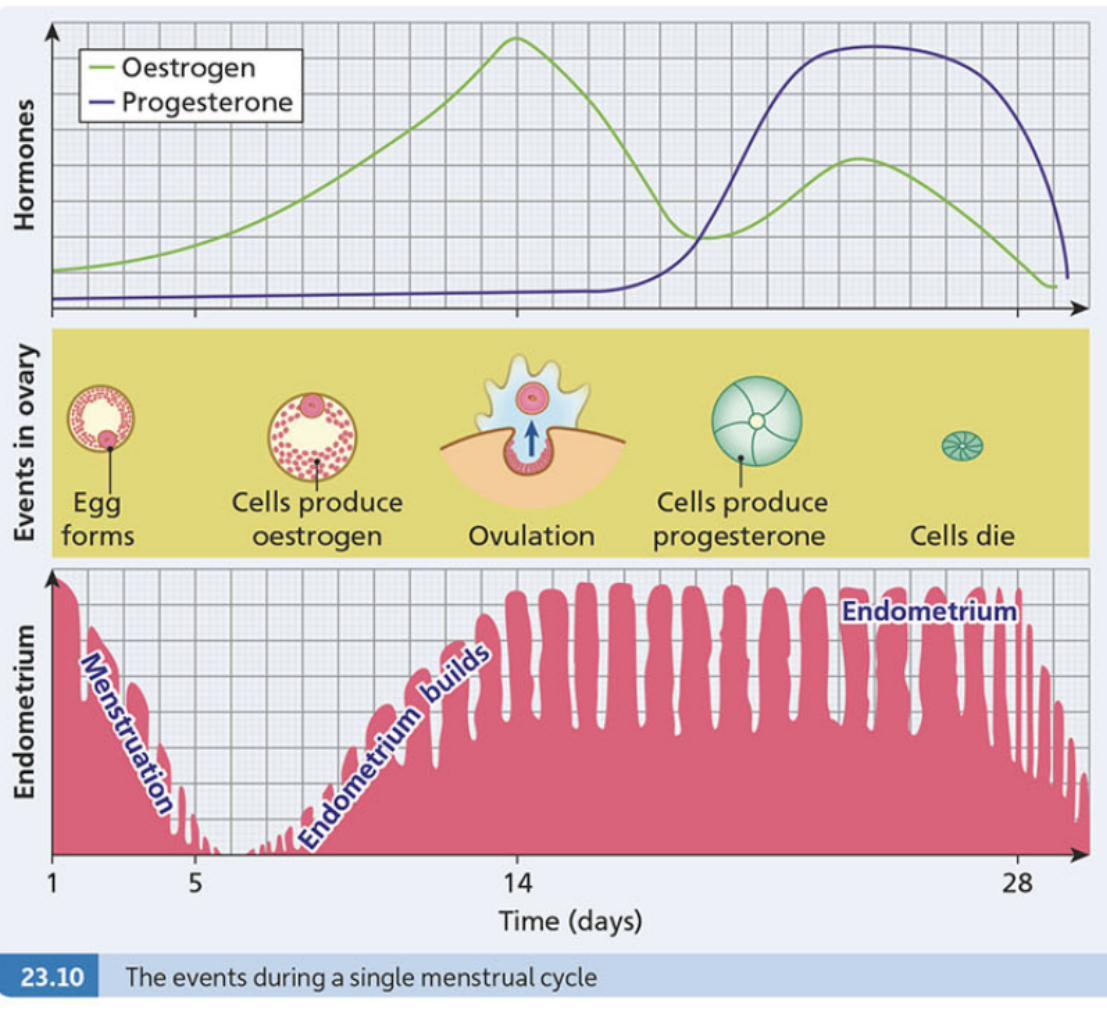
Menstrual phase (Days 1-7) - This is when the previous month's endometrial lining breaks down and is shed through the vagina as menstrual flow. The endometrium becomes very thin during this time.
Proliferative phase (Days 8-13) - Rising oestrogen levels from the developing follicle stimulate the endometrium to rebuild itself. It becomes thicker and develops more blood vessels and glands, creating a nutrient-rich environment.
Secretory phase (Days 14-28) - After ovulation, progesterone from the corpus luteum causes the endometrium to thicken even further and become more vascular. The glands become enlarged and begin secreting nutrients that could nourish an implanting embryo.
Resolution - If pregnancy doesn't occur, falling progesterone levels cause the endometrium to break down, leading to menstruation and the start of a new cycle.
Note
The uterine cycle is essentially the endometrium responding to hormonal signals from the ovaries. When oestrogen rises, the lining builds up. When progesterone rises, it becomes even more prepared for pregnancy. When both hormones fall, menstruation occurs.
Phases and timing of the menstrual cycle
The menstrual cycle can be visualised as a 28-day journey with distinct phases, each serving a specific purpose in preparing the body for potential reproduction.
Days 1-7 (Menstrual phase) - The cycle begins with menstruation. New follicles start developing in the ovaries while the uterine lining is shed. Hormone levels are at their lowest during this time.
Days 8-13 (Pre-ovulation phase) - The dominant Graafian follicle matures and produces increasing amounts of oestrogen. This hormone stimulates the endometrium to thicken and become more glandular and vascular.
Day 14 (Ovulation) - This is the pivotal moment when the mature egg is released. Some women can actually feel ovulation occurring as mild pain on one side of their abdomen.
Days 15-22 (Post-ovulation/Luteal phase) - The corpus luteum produces progesterone, which further prepares the endometrium for possible implantation by making it even thicker and more nutrient-rich.
Days 23-28 (Late luteal phase) - This is the decision point. If fertilisation hasn't occurred, the corpus luteum begins to break down, progesterone levels fall, and the stage is set for menstruation to begin the cycle anew.
Important
Remember the key day: Day 14 is ovulation day! This is when the egg is released and represents the most fertile time of the cycle. Everything before day 14 prepares for ovulation, and everything after responds to whether pregnancy has occurred.
Hormonal control of the menstrual cycle
The menstrual cycle is orchestrated by a complex interplay of hormones that communicate between the brain and reproductive organs. Understanding this hormonal control helps explain why the cycle is so precisely timed and coordinated.
The main hormonal players are:
- FSH and LH - These are produced by the pituitary gland in the brain and control ovarian function. FSH stimulates follicle development, while LH triggers ovulation and corpus luteum formation.
- Oestrogen - Produced by developing follicles, this hormone prepares the uterus for potential pregnancy and influences the release of other hormones.
- Progesterone - Secreted by the corpus luteum after ovulation, this hormone maintains the endometrium and prevents further ovulation during the cycle.
The hormonal control sequence works like this:
- FSH stimulates follicle development and oestrogen production
- Rising oestrogen levels stimulate LH release
- The LH surge triggers ovulation
- The corpus luteum produces progesterone
- High progesterone levels prevent further FSH and LH release
- If pregnancy doesn't occur, progesterone levels fall and the cycle restarts
Note
Exam tip: Hormone level graphs frequently appear in NSC examinations. Practice interpreting these graphs and understanding how hormone levels change throughout the cycle and influence each other.
Negative feedback mechanisms
One of the most important concepts in understanding menstrual cycle control is negative feedback. This is nature's way of maintaining balance and preventing the system from getting out of control.
A negative feedback mechanism works like a thermostat - when something gets too high, it triggers responses that bring it back down. In the menstrual cycle, progesterone acts as the main negative feedback hormone.
Here's how it works: When progesterone levels are high (after ovulation), they send signals back to the pituitary gland to stop producing FSH and LH. This prevents new follicles from developing and ensures that only one egg is released per cycle. If the egg isn't fertilised, progesterone levels drop, removing this inhibition, and the cycle can begin again.
Important
Critical Concept: Negative Feedback
This negative feedback system is crucial because it:
- Prevents multiple ovulations in one cycle
- Ensures proper timing of hormone release
- Maintains cycle regularity
- Prepares the system for the next cycle if pregnancy doesn't occur
Common misconception: Students often think that high hormone levels always stimulate more hormone production. Remember that progesterone actually inhibits FSH and LH production - this is negative feedback, not positive feedback.
Example
Worked Example: Understanding Negative Feedback
Step 1: After ovulation occurs (day 14) Step 2: Corpus luteum produces high levels of progesterone Step 3: High progesterone levels signal the pituitary gland Step 4: Pituitary reduces FSH and LH production (negative feedback) Step 5: This prevents new follicles from developing during the current cycle Step 6: If no pregnancy, progesterone drops and cycle can restart
Summary
Key Points to Remember:
- The menstrual cycle is a 28-day process involving coordinated changes in both ovaries (ovarian cycle) and uterus (uterine cycle)
- Ovulation typically occurs around day 14, triggered by an LH surge from the pituitary gland
- Four key hormones control the cycle: FSH and LH (from the brain) control the ovaries, while oestrogen and progesterone (from the ovaries) control uterine changes
- The endometrium thickens each month in preparation for potential pregnancy and is shed during menstruation if fertilisation doesn't occur
- Negative feedback mechanisms, particularly involving progesterone, maintain cycle balance and prevent multiple ovulations in one cycle