Visual Defects (Grade 12 NSC Matric Life Sciences): Revision Notes
📚Revision Notes
Visual Defects
Visual defects are common problems that affect how clearly we can see objects at different distances. These conditions occur when light entering the eye doesn't focus properly on the retina, which is the light-sensitive layer at the back of the eye. Understanding these defects helps us appreciate how corrective lenses and treatments work to restore clear vision.
Note
The retina acts like the "screen" in a cinema - when light focuses correctly on it, we see a clear image. When light focuses elsewhere, the image becomes blurry, just like when a projector is out of focus.
Short-sightedness (myopia)
Short-sightedness is a condition where people can see nearby objects clearly, but distant objects appear blurry and out of focus. This affects daily activities like reading road signs, watching television from across the room, or recognising faces from a distance.
Why short-sightedness happens
In a short-sighted eye, light rays from distant objects focus in front of the retina instead of directly on it. This incorrect focusing creates a blurred image. Several factors can cause this problem:
- The eyeball is too long from front to back
- The cornea (clear front surface of the eye) is too curved for the eyeball's length
- The lens cannot become less convex when needed
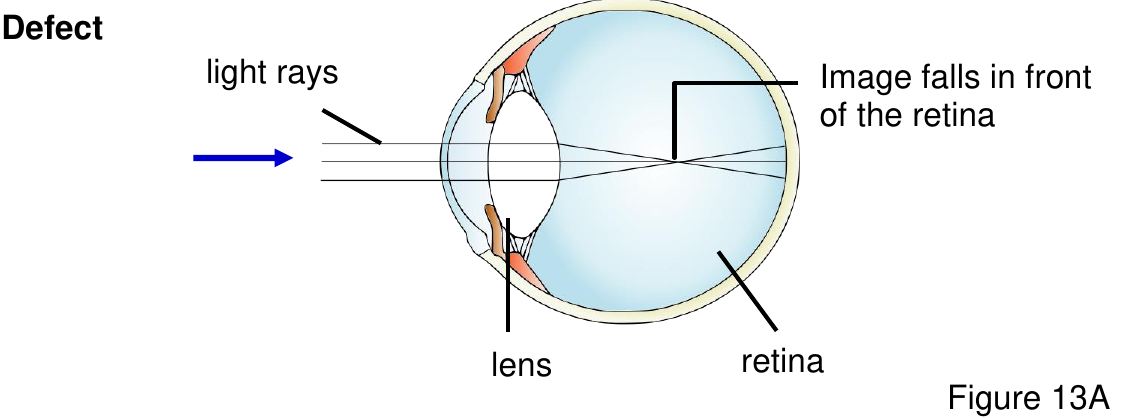
The diagram above shows how light rays converge too early, forming an image before reaching the retina.
Note
Think of it this way: in myopia, the eye is like a camera that focuses too quickly - the image forms before it reaches the "film" (retina), resulting in a blurry picture of distant objects.
How short-sightedness is corrected
Short-sightedness is treated by wearing glasses or contact lenses with concave lenses. These lenses are thinner in the centre and thicker at the edges, which causes them to diverge (spread out) light rays before they enter the eye.
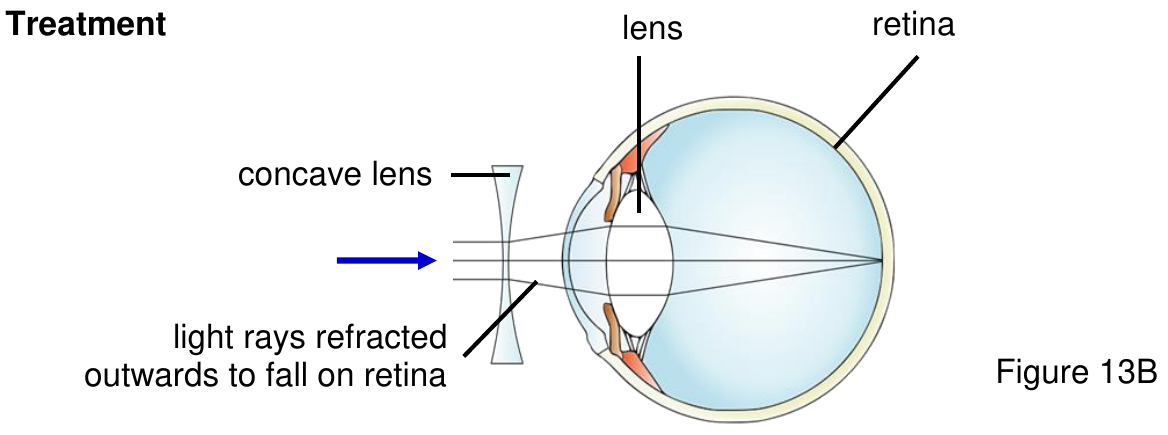
The concave lens refracts light rays outward, allowing them to focus correctly on the retina and produce a clear image.
Long-sightedness (hyperopia)
Long-sightedness is the opposite problem to short-sightedness. People with this condition can see distant objects clearly, but nearby objects appear blurry. This makes close-up activities like reading, writing, or using a smartphone difficult and tiring.
Why long-sightedness happens
In a long-sighted eye, light rays from nearby objects focus behind the retina instead of on it. This happens because:
- The eyeball is too short (rounded) from front to back
- The cornea is not curved enough for the eyeball's length
- The lens cannot become sufficiently convex when focusing on close objects
How long-sightedness is corrected
Long-sightedness is corrected using glasses or contact lenses with convex lenses. These lenses are thicker in the centre and thinner at the edges, which helps converge (bring together) light rays before they enter the eye.
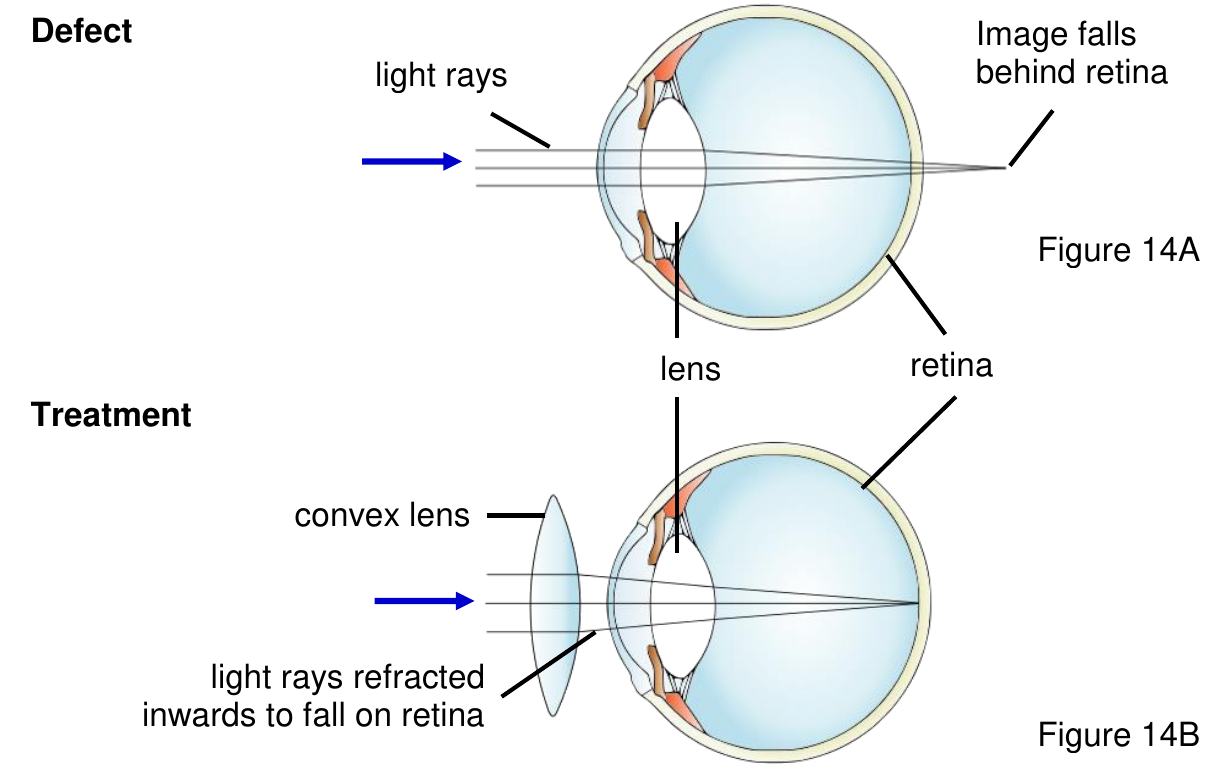
The convex lens refracts light rays inward, ensuring they focus properly on the retina rather than behind it.
Note
Remember the lens shapes: concave lenses "cave inward" and spread light apart (for myopia), while convex lenses curve outward and bring light together (for hyperopia).
Astigmatism
Astigmatism occurs when the cornea or lens has an irregular shape, meaning it's not perfectly rounded in all directions. Instead of being spherical like a football, the cornea might be shaped more like a rugby ball, with different curvatures in different directions.
Effects of astigmatism
When light enters an astigmatic eye, it doesn't focus to a single point on the retina. Instead, it creates multiple focal points, leading to:
- Blurred vision at all distances
- Headaches from eye strain
- Squinting to try to see more clearly
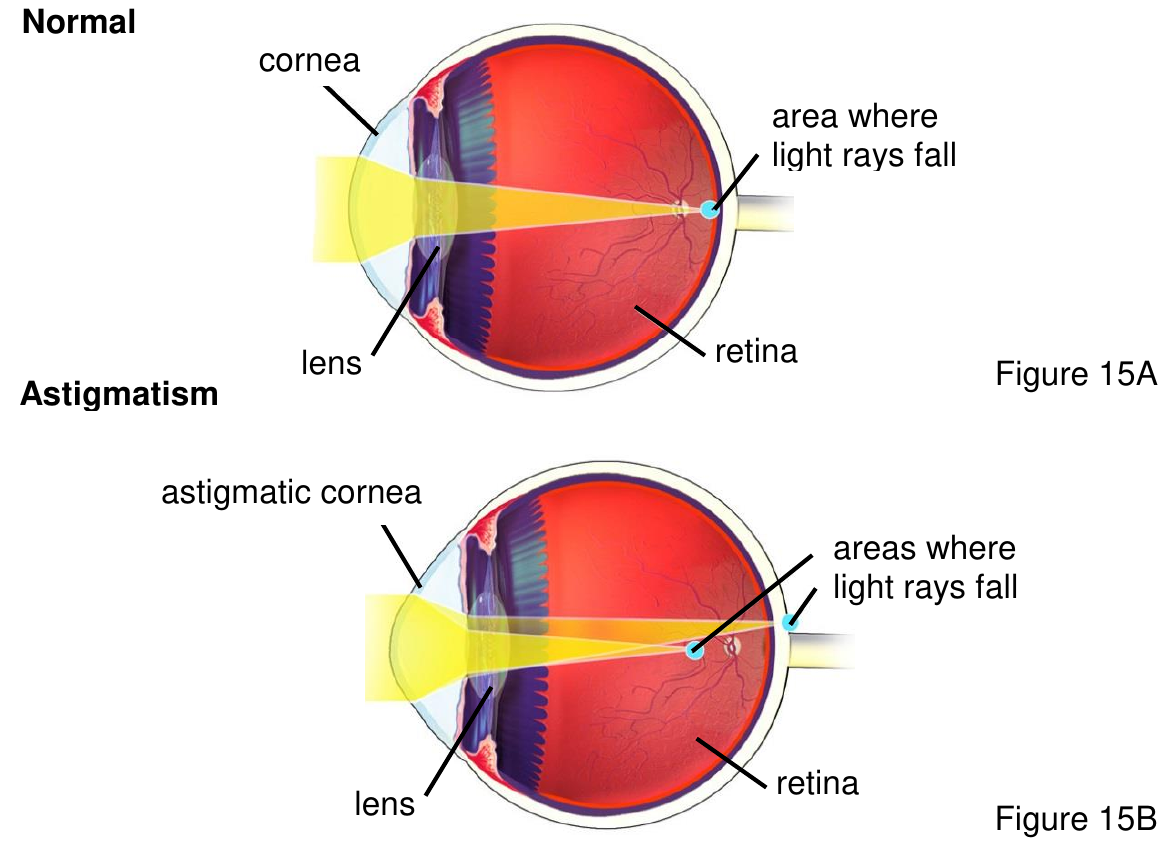
The comparison above shows how a normal eye focuses light to one precise area, while an astigmatic eye scatters light across multiple areas of the retina.
Important
Unlike myopia and hyperopia which affect vision at specific distances, astigmatism causes blurred vision at all distances because light never focuses to a single clear point on the retina.
Treatment of astigmatism
Astigmatism can be corrected through several methods:
- Prescription glasses with specially shaped lenses to compensate for the irregular curvature
- Contact lenses that provide a more uniform surface for light to pass through
- Laser therapy to reshape the cornea and create a more regular surface
Cataracts
Cataracts develop when the normally clear and transparent lens of the eye becomes cloudy or opaque. This cloudiness prevents light from passing through clearly, similar to trying to look through a frosted window.
How cataracts affect vision
The cloudy lens scatters incoming light instead of focusing it properly on the retina. This results in:
- Very blurry vision with no clear focal point
- Difficulty seeing in bright light
- Problems with night vision
- A gradual worsening of symptoms over time
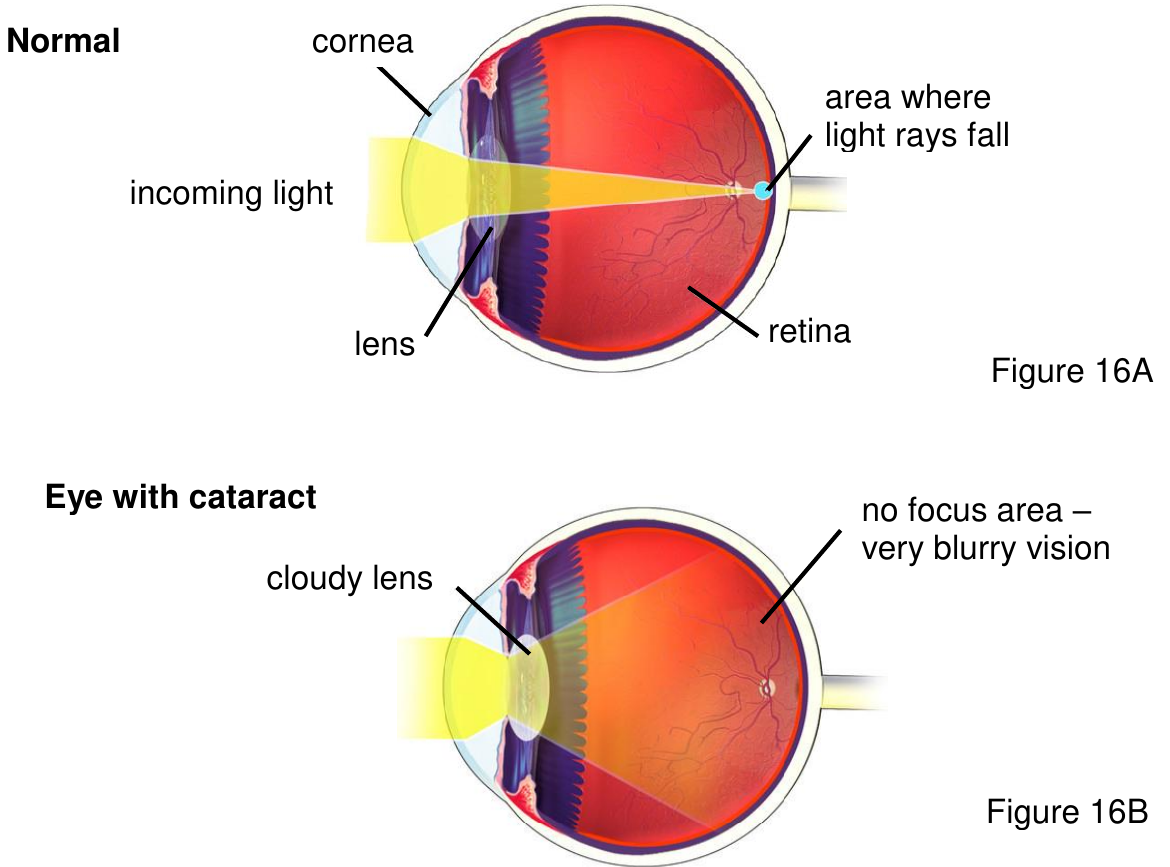
The comparison shows how a clear lens allows light to focus properly, while a cloudy lens from cataracts prevents clear focusing.
Note
Cataracts are different from other visual defects because the problem isn't where light focuses, but rather that the cloudy lens prevents clear light transmission altogether. It's like trying to see through a dirty window - cleaning glasses won't help!
Treatment of cataracts
Cataract treatment progresses through stages:
- Early stages: Stronger prescription spectacles may help improve vision temporarily
- Advanced stages: Surgery becomes necessary when spectacles no longer help. During cataract surgery, the cloudy natural lens is removed and replaced with a clear synthetic lens
Important
Common misconception: Many students think all visual defects can be corrected with the same type of lens. Remember that different defects require different solutions - concave lenses for myopia, convex lenses for hyperopia, and specially shaped lenses for astigmatism.
Exam tip: When describing visual defects, always mention where the light focuses (in front of, behind, or scattered across the retina) and explain how the corrective lens redirects light to focus properly on the retina.
Summary
Key Points to Remember:
- Myopia (short-sightedness): Light focuses in front of the retina; corrected with concave lenses that diverge light rays
- Hyperopia (long-sightedness): Light focuses behind the retina; corrected with convex lenses that converge light rays
- Astigmatism: Light focuses at multiple points due to irregular cornea shape; corrected with prescription lenses, contacts, or laser therapy
- Cataracts: Cloudy lens prevents proper light transmission; treated with stronger glasses initially, then surgical lens replacement
- Key principle: All treatments work by ensuring light focuses correctly on the retina for clear vision