Auxins (Grade 12 NSC Matric Life Sciences): Revision Notes
📚Revision Notes
Auxins
What are auxins?
Auxins are special chemical messengers called plant hormones that play a crucial role in how plants grow and respond to their environment. These important chemicals are mainly produced in the growing tips of plant stems and roots, as well as in the apical buds (the growing points at the tips of stems).
Think of auxins as the plant's internal communication system - they are made in one part of the plant but travel to other parts to control growth and development. Unlike animals, plants cannot move to find better conditions, so they rely on these hormones to help them grow towards favourable conditions like sunlight.
Note
This communication system is what allows plants to coordinate their growth responses across their entire structure, even though they lack a nervous system like animals do.
Main functions of auxins
Auxins serve as master controllers of plant growth and have several important jobs:
Primary functions:
- Apical dominance - controlling which branches grow and which don't
- Growth regulation - managing responses to light (phototropism) and gravity (geotropism)
Other important functions:
- Stimulating cell division (mitosis) for new growth
- Helping cuttings develop adventitious roots for propagation
- Supporting the development of flowers and fruits
- Controlling when leaves and ripe fruits fall off (abscission)
Apical dominance - nature's pruning system
Apical dominance is one of auxins' most important roles and explains why plants have their characteristic tapered shape.
Important
Understanding apical dominance is essential because it explains the natural shape of most plants and is the basis for many agricultural and gardening practices.
How apical dominance works: When a plant stem grows upward, auxins are continuously produced at the tip of the stem. These auxins then travel downward through the stem and have a special effect - they inhibit (prevent) the growth of lateral branches that are close to the tip.
This creates a natural hierarchy where:
- The main stem continues growing straight up
- Branches closer to the tip remain short or don't develop
- Branches further down the stem can grow more freely
- The result is a tapered, Christmas tree-like shape
What happens when you remove the tip? This is where understanding auxins becomes really practical. When gardeners or farmers remove the tip of a stem (called "pinching" or "pruning"), they remove the source of auxins. Without these inhibiting hormones, the lateral branches suddenly begin to grow vigorously.
Example
Practical Application: Fruit Tree Management
When fruit farmers want to increase their harvest:
Step 1: Remove the growing tips of main branches
Step 2: This eliminates the source of growth-inhibiting auxins
Step 3: Lateral branches begin growing vigorously
Step 4: More branches = more locations for fruit production
Step 5: Result is a shorter, bushier tree with increased fruit yield
This technique is widely used in agriculture, particularly in fruit farming. By removing stem tips, farmers can:
- Keep plants shorter and more manageable
- Encourage more branching, leading to more fruit production
- Make harvesting easier since fruit grows closer to the ground
Auxins and phototropism
Phototropism is the way plants bend and grow towards light sources, and auxins are the key players that make this happen.
Understanding phototropism: When plants detect light coming from one direction (called unilateral light), they don't just passively accept whatever light they receive. Instead, they actively grow towards the strongest light source to maximise their photosynthesis.
How auxins create phototropic responses: The process involves a clever redistribution of auxin hormones within the plant stem:
- Light detection: When light hits a plant from one side, special light-sensing mechanisms in the plant detect this unilateral light stimulus
- Auxin redistribution: The plant responds by moving auxins away from the light-exposed side and concentrating them on the shaded side of the stem
- Differential growth: Auxins stimulate cell elongation, so the shaded side with more auxins grows faster than the light-exposed side
- Bending occurs: This unequal growth causes the stem to bend towards the light source
Note
This bending response can happen quite quickly in some plants - you might notice seedlings on a windowsill turning towards the window within just a few hours of being placed there.
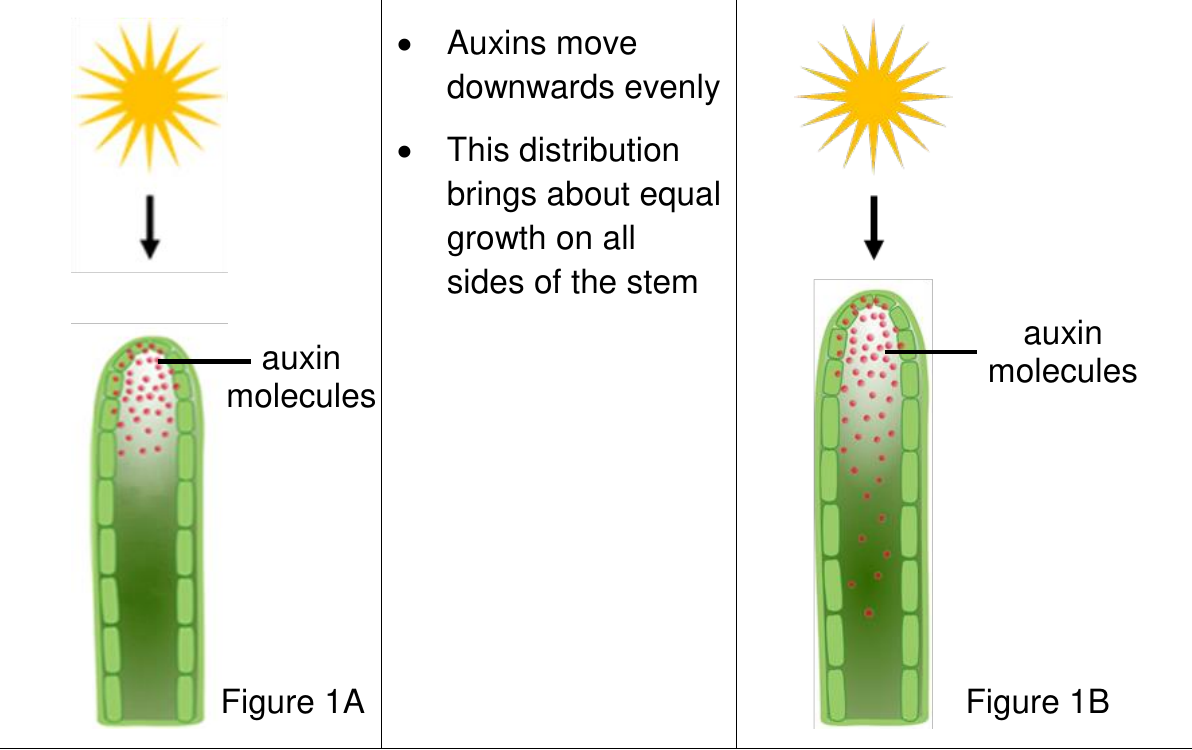
When light comes from directly overhead: If sunlight comes from directly above, auxins are distributed evenly throughout the stem. This balanced distribution results in equal growth on all sides, so the plant grows straight upward towards the light.
Summary
Key Points to Remember:
- Auxins are plant hormones produced at growing tips that act as chemical messengers controlling growth and responses
- Apical dominance occurs when auxins from the stem tip inhibit nearby branch growth, creating the plant's tapered shape
- Removing the tip stops apical dominance and encourages branching - this is used in agriculture to increase fruit production
- In phototropism, auxins redistribute to the shaded side of the stem, causing faster growth there and making the plant bend towards light
- Even light distribution leads to even auxin distribution and straight upward growth