Adrenal Glands (Grade 12 NSC Matric Life Sciences): Revision Notes
📚Revision Notes
Adrenal Glands
Introduction and location
The adrenal glands are a pair of small, triangular-shaped endocrine glands that sit directly on top of each kidney. These vital glands play a crucial role in maintaining homeostasis in your body by producing important hormones that help you respond to stress and regulate essential body functions.
Note
The strategic location of adrenal glands on top of the kidneys allows for close coordination between hormone production and kidney function, which is particularly important for aldosterone's role in regulating salt and water balance.
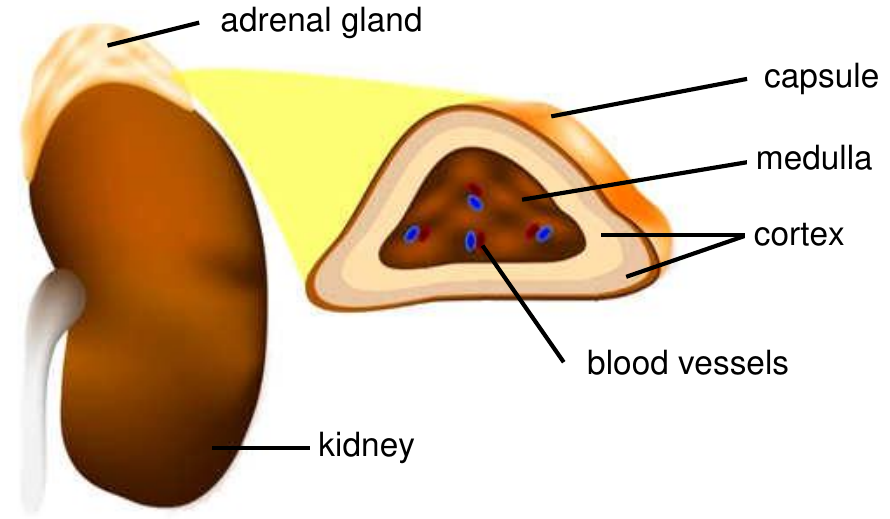
Structure of adrenal glands
Each adrenal gland has a distinctive two-part structure that you need to understand:
- Outer cortex: The outer layer of the adrenal gland that produces certain hormones
- Central medulla: The inner core region that produces other hormones
- Capsule: The protective outer covering that surrounds the entire gland
- Blood vessels: Rich blood supply throughout the medulla ensures efficient hormone distribution
Important
This dual structure is important because different parts of the gland produce different hormones with distinct functions. The cortex and medulla work as separate hormone-producing factories within the same gland.
Hormones produced by adrenal glands
The adrenal glands produce two main hormones that we'll focus on:
- Adrenalin (also known as epinephrine)
- Aldosterone
Each hormone has specific target organs and performs unique functions in maintaining your body's balance.
Note
While the adrenal glands actually produce several hormones, adrenalin and aldosterone are the two most important ones for understanding how your body responds to stress and maintains proper fluid balance.
Adrenalin - the emergency hormone
Adrenalin is often called the "fight or flight" hormone because it prepares your body to either face danger or escape from it. When you're stressed, frightened, or excited, your adrenal glands release adrenalin into your bloodstream.
Target organs and functions of adrenalin
Heart:
- Increases heart rate to pump blood faster
- Enhances blood supply to cardiac muscles for improved performance
Liver:
- Stimulates the conversion of stored glycogen into glucose
- Provides immediate energy for muscles and brain
Skeletal muscles:
- Increases blood supply to voluntary muscles
- Prepares muscles for rapid, powerful movement
Eyes:
- Causes pupil dilation (widening)
- Improves vision and alertness in emergency situations
Skin:
- Reduces blood supply to non-essential areas like skin
- Redirects blood to more vital organs during emergencies
Lungs:
- Increases breathing rate
- Ensures more oxygen reaches the bloodstream quickly
Body cells in general:
- Increases overall metabolic rate
- Speeds up cellular processes throughout the body
Example
Real-life Example: Adrenalin in Action
Imagine you're walking alone at night and suddenly hear footsteps behind you. Within seconds, adrenalin floods your system:
- Your heart pounds faster, pumping blood to your muscles
- Your breathing quickens, delivering more oxygen
- Your pupils dilate, improving your night vision
- Your liver releases glucose for instant energy
- You're now ready to either confront the situation or run to safety
Aldosterone - the salt regulator
Aldosterone works very differently from adrenalin. This hormone focuses on maintaining the proper balance of salts and water in your body, which is essential for healthy blood pressure and cellular function.
Target organs and functions of aldosterone
Kidneys:
- Regulates the concentration of sodium (Na⁺) and potassium (K⁺) ions in your blood
- Works closely with ADH (antidiuretic hormone) to maintain proper fluid balance
- Controls how much salt is retained or eliminated by the kidneys
This regulation is crucial because the right balance of salts affects blood pressure, nerve function, and muscle contractions throughout your body.
Note
Unlike adrenalin which acts quickly during emergencies, aldosterone works continuously in the background to maintain the delicate balance of salts in your blood. This process is essential for proper cellular function and blood pressure regulation.
Why these hormones matter for homeostasis
Both adrenalin and aldosterone are essential for maintaining homeostasis, but they work in different ways:
- Adrenalin helps your body respond to immediate stress or danger by mobilising energy and preparing your systems for action
- Aldosterone maintains long-term balance by regulating salt and water levels in your blood
Important
These two hormones demonstrate how the endocrine system handles both emergency responses and continuous maintenance. Without adrenalin, we couldn't respond effectively to threats. Without aldosterone, our cells would fail due to improper salt concentrations.
Together, these hormones ensure that your body can handle both emergency situations and daily maintenance of essential functions.
Summary
Key Points to Remember:
- Adrenal glands are triangular-shaped glands located on top of each kidney, consisting of an outer cortex and inner medulla
- Adrenalin is the "fight or flight" hormone that prepares your body for emergency responses by affecting the heart, liver, muscles, eyes, skin, and lungs
- Aldosterone regulates salt balance in the blood by working on the kidneys to control sodium and potassium concentrations
- Both hormones are crucial for homeostasis - adrenalin for immediate stress responses and aldosterone for maintaining proper fluid and salt balance
- The rich blood supply in the adrenal glands ensures these important hormones can be quickly distributed throughout the body when needed