Endocrine Glands (Grade 12 NSC Matric Life Sciences): Revision Notes
📚Revision Notes
Endocrine Glands
Introduction to glands
Your body has two main types of glands that produce and release important substances. Understanding the difference between these glands is essential for grasping how the endocrine system works.
Exocrine glands are glands that release their secretions through special tubes called ducts. These secretions reach external surfaces or body cavities. Think of sweat glands that release sweat through ducts to your skin surface, or digestive glands that release enzymes through ducts into your digestive system.
Endocrine glands work very differently. These glands release their secretions (called hormones) directly into your bloodstream. They don't use ducts at all. Instead, they are surrounded by tiny blood vessels called capillaries that carry the hormones throughout your body.
Important
Key Difference to Remember:
- Exocrine = Exo (outside) = uses ducts to reach external surfaces
- Endocrine = Endo (inside) = releases directly into bloodstream (inside the body)
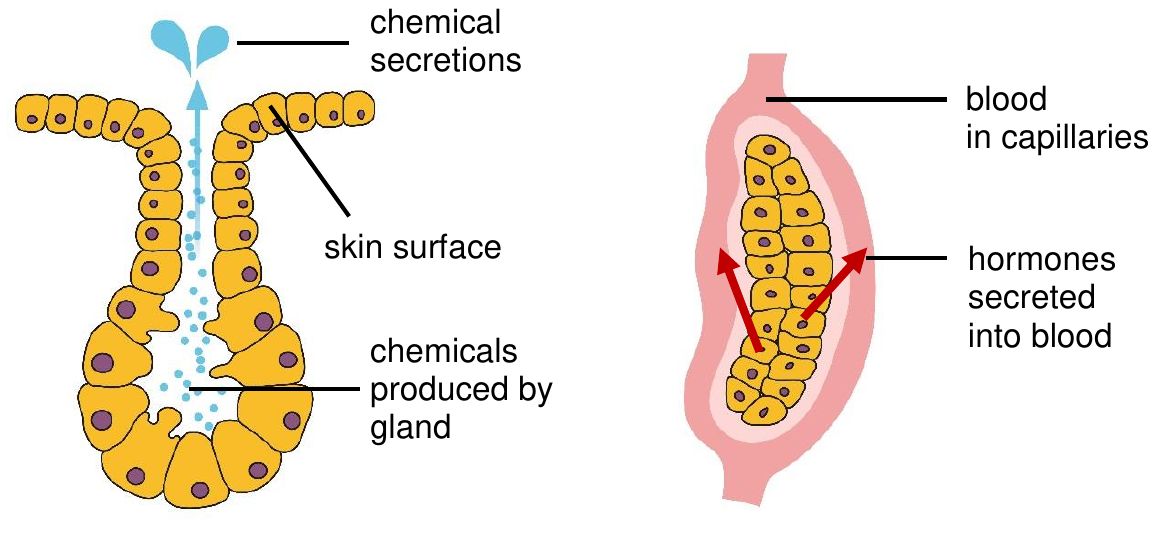
The diagram above clearly shows this important difference. Notice how the exocrine gland on the left has a duct system that carries secretions to the skin surface, while the endocrine gland on the right releases hormones directly into the blood capillaries.
What are hormones?
Hormones are special chemical messengers that travel through your bloodstream to communicate between different parts of your body. They are organic compounds that coordinate many vital functions to keep you healthy and functioning properly.
Most hormones are proteins, though some are made from lipids (fats) and are called steroids. What makes hormones particularly powerful is that they work effectively even in very small amounts. Unlike nerve impulses that give quick, short-term responses, hormones provide longer-lasting effects on your body.
Note
When hormone production goes wrong - either too much (over-secretion) or too little (under-secretion) - it can lead to various health disorders. This is why maintaining proper hormone balance is crucial for good health.
The three main functions of hormones
Hormones serve three essential purposes in your body:
-
Reproduction, growth and development - Hormones control sexual development, reproduction processes, and how you grow from childhood to adulthood
-
Maintenance of internal environment - Hormones help maintain stable conditions inside your body by stimulating or inhibiting the function of cells and organs. This includes regulating things like water balance, temperature, and blood chemistry
-
Regulation of metabolism - Hormones control how your body produces, uses, and stores energy from the food you eat
The human endocrine system
Your endocrine system consists of several glands located throughout your body. Each gland produces specific hormones that have particular jobs to do. These glands work together like an orchestra, with each playing its part to maintain harmony in your body.
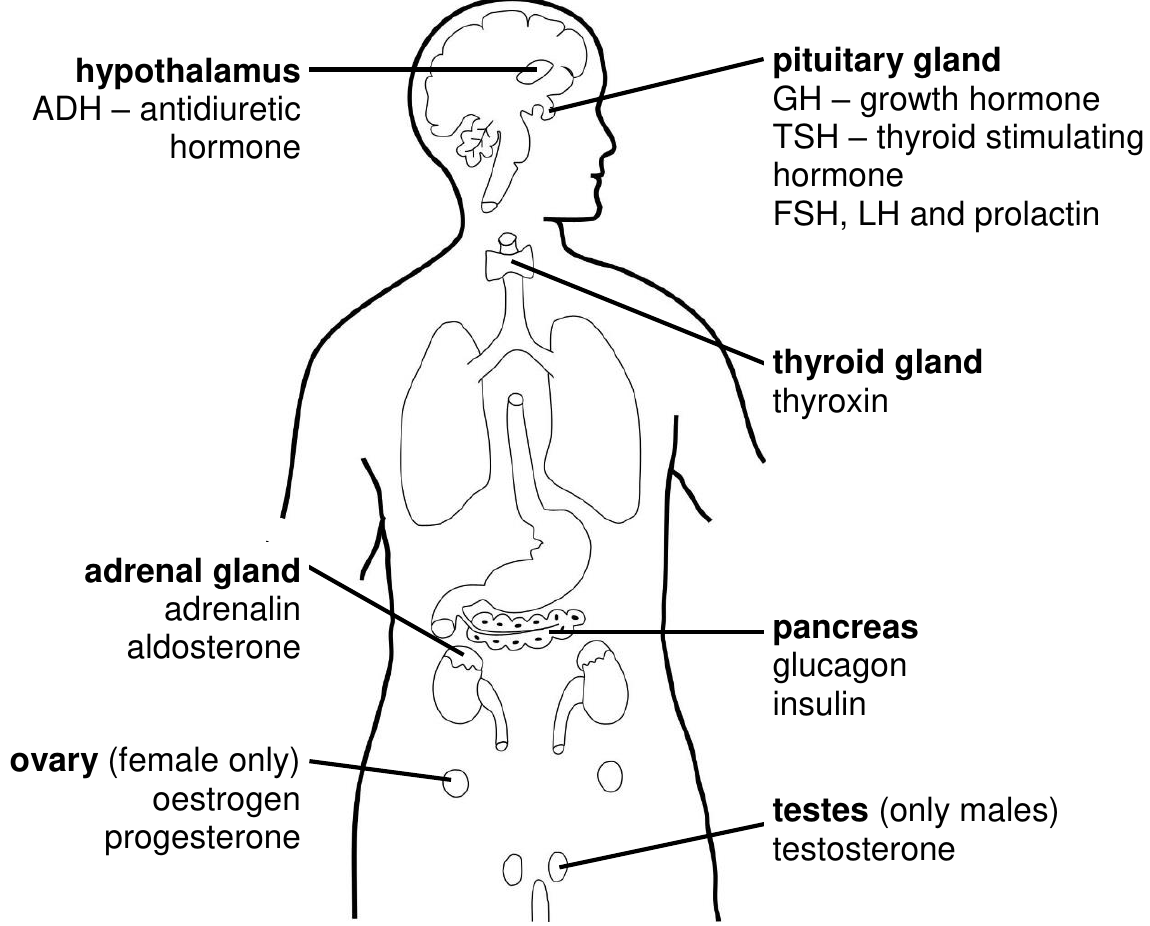
The diagram above shows the major endocrine glands and the hormones they produce. Let's examine the key players:
- Hypothalamus - Located in your brain, produces ADH (antidiuretic hormone)
- Pituitary gland - Also in your brain, produces growth hormone, thyroid stimulating hormone, FSH, LH, and prolactin
- Thyroid gland - In your neck, produces thyroxin
- Adrenal glands - Above your kidneys, produce adrenalin and aldosterone
- Pancreas - In your abdomen, produces glucagon and insulin
- Ovaries (females) - Produce oestrogen and progesterone
- Testes (males) - Produce testosterone
Note
Important Concept: Hormone Interactions
It's important to understand that hormones don't work alone. They often interact with each other in sequences of events. Sometimes they work together to produce a common effect, while other times they work against each other to maintain balance.
The hypothalamus and pituitary gland
The hypothalamus deserves special attention because it serves as a crucial link between your nervous system and your endocrine system. This small area of your brain is located above and connected to the pituitary gland.
The hypothalamus plays a vital role in controlling many essential functions in your body. It produces and releases important hormones, including ADH (antidiuretic hormone), which helps regulate water balance in your body.
Important
Critical Connection: Two Communication Systems
What makes the hypothalamus particularly important is that it connects two major communication systems in your body - the fast-acting nervous system and the slower, longer-lasting endocrine system. This connection allows your body to respond to changes both quickly and with sustained effects.
Summary
Key Points to Remember:
- Exocrine glands use ducts to secrete substances to external surfaces, while endocrine glands secrete hormones directly into the bloodstream
- Hormones are chemical messengers made mostly of proteins that work in small amounts to produce long-lasting effects throughout the body
- The three main functions of hormones are reproduction/growth/development, maintaining internal environment, and regulating metabolism
- The human endocrine system includes multiple glands throughout the body, each producing specific hormones for different purposes
- The hypothalamus serves as the important link between the nervous system and endocrine system, helping coordinate body responses