Homeostatic Control of the Internal Environment (Grade 12 NSC Matric Life Sciences): Revision Notes
📚Revision Notes
Homeostatic Control of the Internal Environment
What is the internal environment?
The internal environment refers to the tissue fluid that surrounds all the cells in your body. Think of it as the 'neighbourhood' where your cells live. The conditions inside your cells depend entirely on what's happening in this internal environment around them.
When your body faces changes from either the external environment (like temperature changes outside) or internal environment (like increased CO₂ from exercise), your body automatically works to control these effects. This control process is called homeostasis.
Note
The internal environment is not the same as the external environment around your body - it's specifically the fluid that directly bathes your cells and provides their immediate living conditions.
Why is homeostasis so important?
Without homeostasis working properly, your organs, organ systems, and ultimately your entire body could be negatively affected. Your cells need stable conditions to function optimally, just like you need a comfortable environment to study effectively.
Important
If homeostatic mechanisms fail, cellular functions become disrupted, leading to organ dysfunction and potentially life-threatening conditions. This is why understanding homeostasis is crucial for understanding human health.
The human body maintains balance in several key areas:
- Water levels
- Salt levels
- Glucose levels
- CO₂ concentrations
- Thyroxin hormone levels
- Body temperature
Understanding why each of these factors needs careful control and how your body achieves this control is essential for grasping homeostasis.
The main mechanisms for maintaining homeostasis
Your body has six major homeostatic control systems that work continuously to keep your internal environment stable.
Let's break down why each of these factors is so crucial:
Water regulation: Every metabolic reaction in your body needs the right balance of water and salt concentrations in your blood and tissue fluid. Your kidneys and skin work together to maintain this balance.
Note
Salt regulation: The amount of dissolved salts in your blood and tissue fluid controls osmotic pressure. This affects whether your cells gain or lose water through osmosis, which can seriously impact how well they function.
CO₂ regulation: When your cells perform cellular respiration, they produce CO₂ as a waste product. This CO₂ affects the pH (acidity) of your blood and tissue fluid. Since enzymes are extremely sensitive to pH changes, your lungs must carefully regulate CO₂ levels.
Glucose regulation: Your body needs to control glucose concentration to ensure consistent energy levels and proper metabolic functioning. Your liver and pancreas work together in this vital process.
Note
Thyroxin regulation: This thyroid hormone controls your overall metabolic rate. Even small changes in thyroxin levels can significantly affect how fast or slow your metabolism runs.
Temperature regulation: Your body temperature affects enzyme activity. If temperature gets too high, enzymes become denatured (permanently damaged). If it gets too low, enzyme activity slows down dramatically. Your skin plays a key role in temperature control.
Negative feedback in water balance control - osmoregulation
One of the most important examples of homeostatic control is how your body maintains water balance through a process called osmoregulation. This system is crucial because proper water balance ensures your metabolism can continue functioning normally.
The control of water and salt levels in your blood and tissue fluid operates through a negative feedback system. Here's how it works:
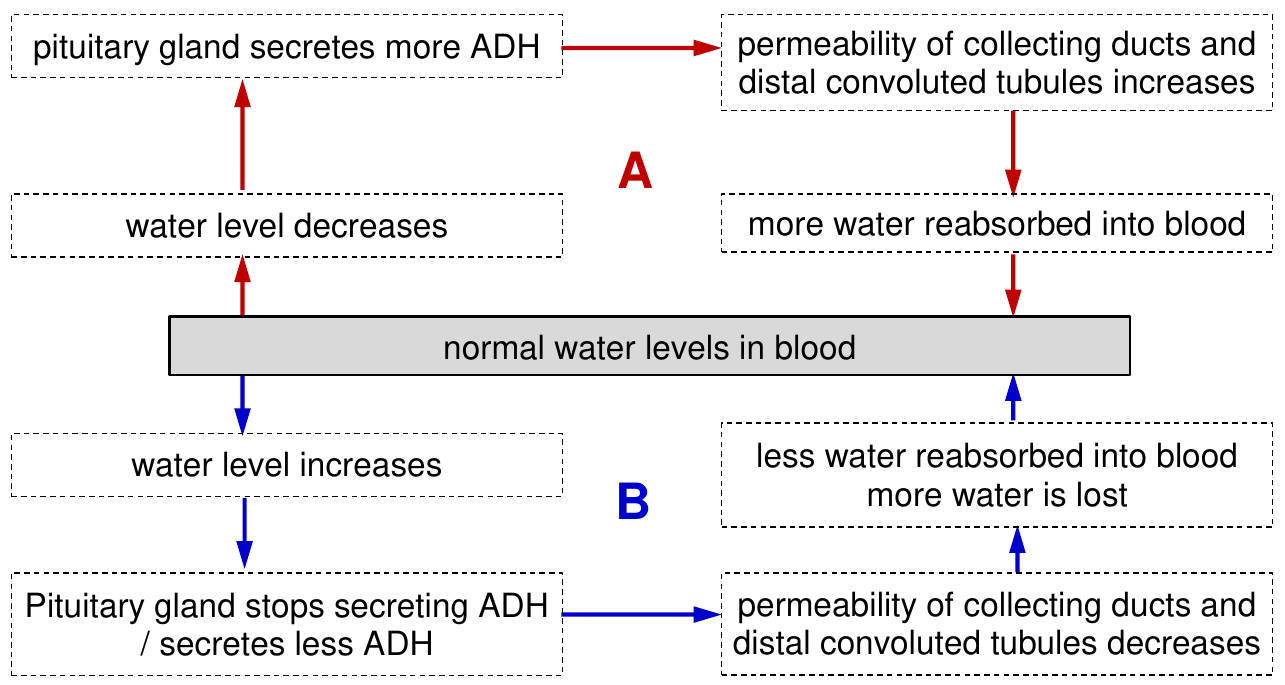
Understanding the feedback loop
Example
Worked Example: Water Level Decrease (Path A)
Step 1: Water levels in blood decrease (stimulus)
Step 2: Pituitary gland detects the change (receptor/control centre)
Step 3: Pituitary secretes more ADH (response)
Step 4: ADH increases kidney permeability (effector action)
Step 5: More water reabsorbed, levels return to normal (negative feedback)
When water levels decrease (Path A):
- Your pituitary gland detects the change and secretes more ADH (antidiuretic hormone)
- ADH travels to your kidneys and increases the permeability of the collecting ducts and distal convoluted tubules
- This means more water gets reabsorbed back into your blood instead of being lost as urine
- Water levels return to normal
Example
Worked Example: Water Level Increase (Path B)
Step 1: Water levels in blood increase (stimulus)
Step 2: Pituitary gland detects the change (receptor/control centre)
Step 3: Pituitary secretes less ADH (response)
Step 4: ADH decreases kidney permeability (effector action)
Step 5: Less water reabsorbed, excess water lost, levels return to normal (negative feedback)
When water levels increase (Path B):
- Your pituitary gland responds by secreting less ADH
- The permeability of kidney collecting ducts and distal convoluted tubules decreases
- Less water gets reabsorbed, so more water is lost through urine
- Water levels return to normal
Key terms to remember
- ADH (Antidiuretic hormone): A hormone that controls water reabsorption in the kidneys
- Pituitary gland: The control centre that releases ADH
- Collecting ducts and distal convoluted tubules: Parts of the kidney where water reabsorption occurs
- Permeability: How easily water can pass through the kidney tubule walls
- Negative feedback: A control system where the response opposes the original change
Important
Common Misconceptions to Avoid
Misconception: "Homeostasis means everything stays exactly the same." Reality: Homeostasis means maintaining balance within normal ranges - there are always small fluctuations.
Misconception: "Only the kidneys are involved in water balance." Reality: While kidneys are the main effectors, the pituitary gland (control centre) and various receptors are equally important.
Misconception: "More ADH always means less urine." Reality: More ADH means more concentrated urine (less water lost), but the volume can still vary.
Exam tips
Note
Essential Exam Strategies:
- Always describe feedback loops in sequence: stimulus → receptor → control centre → effector → response
- Use specific scientific terms like "pituitary gland" instead of just "brain"
- Explain both pathways (A and B) when describing negative feedback
- Remember that negative feedback opposes the original change
- Link the importance of each homeostatic mechanism to enzyme function and metabolism
Summary
Key Points to Remember:
- The internal environment is the tissue fluid surrounding your cells, and its stability is essential for cellular function
- Homeostasis involves controlling six key factors: water, salts, glucose, CO₂, thyroxin, and temperature
- Negative feedback systems work by opposing changes to maintain balance within normal ranges
- ADH from the pituitary gland controls water reabsorption in the kidneys through osmoregulation
- Without homeostatic control, organs and organ systems would be negatively affected, potentially threatening survival